FREE! Click here to Join FunTrivia. Thousands of games, quizzes, and lots more!
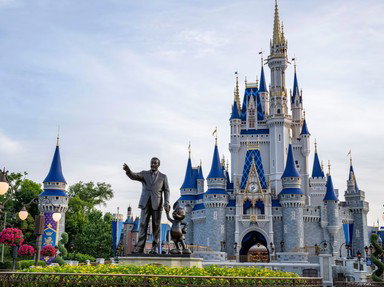
Quiz about The Opening of Disneys Magic Kingdom

The Opening of Disney's Magic Kingdom Quiz


Let's travel back in time to October of 1971. It was an incredible period for Disney as their official grand opening of Magic Kingdom in Florida was that month. Take the quiz and also learn a bit more about this fun era in Entertainment history.
This is a renovated/adopted version of an old quiz by author plangy

A photo quiz by stephgm67. Estimated time: 3 mins.
  1. Home
  2. »
  3. Quizzes
  4. »
  5. Entertainment Trivia
  6. »
  7. Walt Disney World
  8. »
  9. Magic Kingdom

Author
stephgm67
Time
3 mins
Type
Photo Quiz
Quiz #
19,499
Updated
Mar 13 26
# Qns
10
Difficulty
Average
Avg Score
7 / 10
Plays
33
Last 3 plays: papabear5914 (7/10), cbushman (7/10), Rizeeve (10/10).
-
Question 1 of 10
1. The official Grand Opening was held on October 25, 1971. Who dedicated the park before a large crowd in front of the flag pole on Main Street? Hint


Question 2 of 10
2. On opening day at the Magic Kingdom, how much was a one day pass for an adult (in USD)? Hint


Question 3 of 10
3. The people attending Opening Day often did not realize they were walking on what was essentially a second floor over a whole series of utilidors (utility corridors) under the ground. What material was used to cover the utilidors as the "ground" for the Magic Kingdom? Hint


Question 4 of 10
4. Essentially a construction zone with two operating rides, what land in Magic Kingdom was the least finished on Opening Day? Hint


Question 5 of 10
5. What ride, located in Fantasyland, focused on the villain and not the hero and ended up frightening the riders (especially the children)? Hint


Question 6 of 10
6. On the opening day of Magic Kingdom in 1971, there were only two roller coasters in the park.


Question 7 of 10
7. When the Magic Kingdom opened in October 1971, the brown path running through Liberty Square was a key element of the land's immersive historical design. What does it represent? Hint


Question 8 of 10
8. When the Magic Kingdom opened in 1971, what was the restaurant that was found inside of Cinderella's Castle? Hint


Question 9 of 10
9. In 1971, the Jungle Cruise at the Magic Kingdom wasn't just a home for animatronic animals like the elephants in the photo. What real-life Florida animals were a nemesis on the ride? Hint


Question 10 of 10
10. The Orange Bird character and souvenir was everywhere during the October 1971 grand opening of the park. He was the result of a sponsorship deal with what enterprise who paid for the construction of the Sunshine Pavilion? Hint


(Optional) Create a Free FunTrivia ID to save the points you are about to earn:

arrow Select a User ID:
arrow Choose a Password:
arrow Your Email:


View Image Attributions for This Quiz

Most Recent Scores
Today : papabear5914: 7/10
Today : cbushman: 7/10
Today : Rizeeve: 10/10
Today : Guest 66: 5/10
Today : sluggo13: 5/10
Today : Guest 205: 6/10
Today : bergmania: 3/10
Today : PurpleComet: 5/10
Today : polly656: 3/10

Quiz Answer Key and Fun Facts
1. The official Grand Opening was held on October 25, 1971. Who dedicated the park before a large crowd in front of the flag pole on Main Street?

Answer: Roy O. Disney

Walt Disney died on December 15, 1966, at the age of 65 of lung cancer. He had already begun plans for a massive "Florida Project" that was to be even more ambitious than Disneyland in California. His brother, Roy O. Disney, picked up the reigns. Although Roy, at age 75, had been planning to retire, he postponed his plans and took full command of the company to ensure that Walt's final and most ambitious dream became a reality.

Most of October of 1971 was considered a "Preview Month" when guests could "test out" the park. The official grand opening was held on October 25th of that year. Roy, always nervous in public, refused to go out alone, famously stating that Mickey Mouse was the closest thing to Walt that was left. He walked out holding Mickey's hand, and they stood together at the podium in front of the flag pole on Main Street for the entire ceremony.
2. On opening day at the Magic Kingdom, how much was a one day pass for an adult (in USD)?

Answer: $3.50

In October 1971, a guest didn't just walk into the park and ride everything. They first had to pay for general admission, which essentially got them through the front gates and onto the transportation system (monorail, ferry, or bus). Adults paid $3.50, juniors (ages 12-17) paid $2.50 and children (ages 3-11) were charged $1.00.

Once inside, almost every ride required a separate paper coupon. These were categorized by how "thrilling" or popular the attraction was and were ranked "A" through "E". These could be found at kiosks throughout the park. "A" tickets were ten cents and could get people on rides like Cinderella's Golden Carousel. "E" tickets, on the other end of the spectrum, were eighty to ninety cents and accessed rides like It's A Small World. Many people bought a bundled Adventure Book which was a small booklet that included an admission ticket and a specific number of coupons (usually a mix of "A" through "E" tickets). These were either $4.75 or $5.75 depending on the number of coupons inside.
3. The people attending Opening Day often did not realize they were walking on what was essentially a second floor over a whole series of utilidors (utility corridors) under the ground. What material was used to cover the utilidors as the "ground" for the Magic Kingdom?

Answer: Dirt from the Seven Seas Lagoon

A 9 acre series of concrete utilidors (utility corridors) was built on top of the land for the Magic Kingdom project. Then, 8 million cubic yards (6.12 million cubic meters) of earth from the Seven Seas Lagoon construction site was added. Workers piled that dirt all around the sides and over the roof of the tunnels. The second floor, which was what the Magic Kingdom guests walked on, was then built on top of all that packed dirt.

The tunnels served a variety of purposes. First, characters could travel there and the problem of a cowboy from Frontierland walking around Tomorrowland was thwarted. Secondly, trash was unseemly looking and it could now be sucked away in a vacuum system in the tunnels. Also, it was a great holding place for all of the costume pieces, food prep, and control systems.
4. Essentially a construction zone with two operating rides, what land in Magic Kingdom was the least finished on Opening Day?

Answer: Tomorrowland

While the rest of the park was largely functional in October of 1971, Tomorrowland was practically just a construction zone with a sterile and barren appearance. The land was so incomplete that guests could look across the empty plots and view mostly heavy machinery and stacks of building materials. On that day, Tomorrowland offered only two functioning attractions: The Grand Prix Raceway and Skyway to Fantasyland (an aerial bucket ride that also served as transportation).

It wasn't until 1975 that Tomorrowland was finally considered finished and reached its full "opening phase" potential. Even after being completed, Tomorrowland was famously described by Imagineers as an ongoing moving target. This is because the future keeps becoming the past.
5. What ride, located in Fantasyland, focused on the villain and not the hero and ended up frightening the riders (especially the children)?

Answer: Snow White's Adventures

The Imagineers at Disney originally designed the ride so that the guest was Snow White and the rider saw things from her perspective. However, this meant that instead of seeing a friendly princess, riders were harassed by the Evil Queen. The queen, in her witchy form, popped up roughly seven times throughout the short ride in dark corners, offered the poison apple, and cackled loudly. In the original 1971 version, the ride ended abruptly with the witch standing on a cliff, attempting to drop a massive boulder onto the riders.

The reaction on opening day to this ride was a mixture of confusion and terror. The feedback regarding the Snow White ride was immediate and overwhelmingly negative. Parents were furious that they had waited in line for a "Snow White" ride only for their children to never actually see the princess. Instead, the kids were subjected to darkness, scary sounds, and a frightening ending to the ride. The ride name was eventually changed to Snow White's Scary Adventure and in 1994 it was completely overhauled to include Snow White herself, a less scary witch, and the "Happily Ever After" ending that guests had been demanding since 1971.
6. On the opening day of Magic Kingdom in 1971, there were only two roller coasters in the park.

Answer: False

The Magic Kingdom in 1971 was a completely "coaster-less" park. While it had plenty of family attractions, high-speed thrills were not part of the initial lineup. The decision to open without a coaster was largely a matter of budget and priority. Building the park was a massive financial undertaking-far more expensive than the original Disneyland. The Phase 1 goal was to establish the "Vacation Kingdom of the World" with a focus on high-volume rides, storytelling, and proven family rides from the California location.

Thrill rides on that opening day centered more around the Grand Prix Raceway and the Skyway cable cars. The legendary coaster Space Mountain did not open until 1975 followed by Big Thunder Mountain Railroad coaster in 1980.
7. When the Magic Kingdom opened in October 1971, the brown path running through Liberty Square was a key element of the land's immersive historical design. What does it represent?

Answer: Flow of human sewage

The primary reason for this design choice was to simulate the appearance of an open waste trench. In the 18th century, colonial towns lacked modern plumbing, and waste was often discarded directly into the center of dirt streets. Imagineers used a specific brownish-red, porous concrete to mimic the look of liquid waste and mud that would have naturally collected in the low point of a town's road.

To complete the effect, the surrounding pavement was designed to look like raised wooden walkways, representing the areas where people would walk to stay clear of the central "sewer". Also, one of the most famous urban legends that happens to be true is that there were no restrooms in Liberty Square. This was a strict design choice based on historical accuracy: indoor plumbing did not exist in 1776.
8. When the Magic Kingdom opened in 1971, what was the restaurant that was found inside of Cinderella's Castle?

Answer: King Stefan's Banquet Hall

In a move that has confused Disney fans for decades, the restaurant in the castle was named after King Stefan, who is actually the father of Princess Aurora from "Sleeping Beauty". Disney stated it was because they wanted a regal, medieval-sounding title that fit the banquet hall atmosphere. Also Cinderella's father is never named in the 1950 film (he is simply "The Father"), so another Disney royal family name was used.

On opening day, the restaurant was considered the pinnacle of fine dining at Disney. Guests would enter a small lobby on the ground floor and take a circular elevator or staircase up to the dining room. The room featured high vaulted ceilings, stained-glass windows, and colorful medieval banners. The fare was traditional and heavy, featuring items like "Prime Rib of Beef" and "King Stefan's Cobbler".
9. In 1971, the Jungle Cruise at the Magic Kingdom wasn't just a home for animatronic animals like the elephants in the photo. What real-life Florida animals were a nemesis on the ride?

Answer: Banana Spiders

Golden silk orb-weavers, often called banana spiders, thrived in the humid, artificial jungle. Because the ride was outdoors and surrounded by lush vegetation, they would spin webs that stretched 6 to 10 feet (1.8 to 3 m) across the river. During October of 1971, it was common for skippers to have to use their long poles to clear real webs before the boat could pass. There are stories of guests getting a "face full of web".

Years later, Disney put an animatronic tarantula in a cage in the queue for the ride that occasionally lurched out at guests. This was a direct nod to the insect problems the ride had on that opening gala.
10. The Orange Bird character and souvenir was everywhere during the October 1971 grand opening of the park. He was the result of a sponsorship deal with what enterprise who paid for the construction of the Sunshine Pavilion?

Answer: Florida Citrus Commission

To fund the Sunshine Pavilion (home to the Enchanted Tiki Room), Disney entered a sponsorship deal with the Florida Citrus Commission. Unlike other Disney characters, the Orange Bird was created specifically for this partnership. He was a small bird who couldn't speak or sing, instead he communicated through orange colored thought bubbles.In October of 1971, he was the face of Florida tourism, and guests could buy a variety of souvenirs, ranging from plastic banks shaped like his head and "Little Golden Books" to 45 RPM records featuring his theme song.

The character eventually vanished from the park in 1987 due to the expiration of the sponsorship agreement. Furthermore, the brand's spokesperson, Anita Bryant, became a figure of significant cultural controversy in the late 1970s, which led Disney to distance the park from the citrus campaign. The Orange Bird remained in the archives for twenty-five years until a massive wave of retro nostalgia prompted Disney to bring him back in 2012, restoring him in Adventureland.
Source: Author stephgm67

This quiz was reviewed by FunTrivia editor kyleisalive before going online.
Any errors found in FunTrivia content are routinely corrected through our feedback system.
3/13/2026, Copyright 2026 FunTrivia, Inc. - Report an Error / Contact Us