FREE! Click here to Join FunTrivia. Thousands of games, quizzes, and lots more!
Quiz about Whats in My Test Tube

What's in My Test Tube? Trivia Quiz


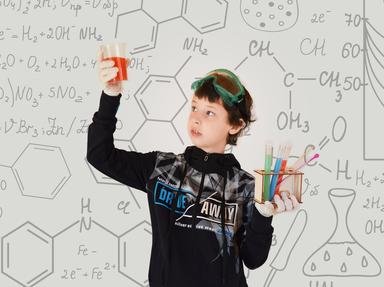
Maya, Ben and Leo join their teacher for a lab full of colour changes, mysterious bubbles and surprising results. Use the clues to help them explain what is happening in each test tube.

A multiple-choice quiz by SCIENCEKING_00. Estimated time: 3 mins.
  1. Home
  2. »
  3. Quizzes
  4. »
  5. For Children Trivia
  6. »
  7. Science for Kids
  8. »
  9. Chemistry for Kids

Time
3 mins
Type
Multiple Choice
Quiz #
426,346
Updated
Nov 08 26
# Qns
10
Difficulty
Easy
Avg Score
8 / 10
Plays
28
Last 3 plays: neon000 (7/10), Alcoholic63 (8/10), barchester (8/10).
Author's Note: These are classroom demonstrations supervised by a teacher. Each question contains all the clues you need; you do not need to remember earlier answers.
- -
Question 1 of 10
1. Maya sees lemon juice turn red cabbage indicator pink. Which sharp-smelling liquid, often used for pickling, should give a similar result? Hint


Question 2 of 10
2. The teacher puts a clean iron nail into copper sulfate solution. Which reddish-brown metal, commonly used inside electrical wires, coats the nail? Hint


Question 3 of 10
3. A gas turns the teacher's clear limewater milky. Which gas, also responsible for the fizz in sparkling water, has Ben identified? Hint


Question 4 of 10
4. When the teacher mixes citric acid solution with baking soda, the mixture cools because the overall process takes in heat.


Question 5 of 10
5. Leo wipes a sealed, ice-cold test tube dry, but droplets form outside again. Which change turns water vapour in the air into these drops? Hint


Question 6 of 10
6. Maya watches water carry a spot of washable black ink up a paper strip. Why do separate coloured bands appear? Hint


Question 7 of 10
7. Ben wants a sugar cube to dissolve faster in plenty of water. Which change would usually SLOW it down instead? Hint


Question 8 of 10
8. Adding vinegar to warm milk makes soft curds form. Which body-building nutrient in the milk has clumped together? Hint


Question 9 of 10
9. Maya sees bubbles after two liquids are mixed and says, "This MUST prove a chemical reaction has made a new substance." Is her claim true or false?


Question 10 of 10
10. The teacher adds iodine solution to starch. Which colour, as dark as a night sky, shows that the starch test is positive? Hint


Most Recent Scores
Today : neon000: 7/10
Today : Alcoholic63: 8/10
Today : barchester: 8/10
Today : mjgrimsey: 3/10
Today : Guest 142: 7/10
Today : karfre: 10/10
Today : briarwoodrose: 8/10
Today : Kabdanis: 6/10
Today : burnsbaron: 8/10

Quiz Answer Key and Fun Facts
1. Maya sees lemon juice turn red cabbage indicator pink. Which sharp-smelling liquid, often used for pickling, should give a similar result?

Answer: White vinegar

Lemon juice and vinegar both contain acids, although they contain different ones. Red cabbage contains a coloured substance that changes when it meets an acid or a base. This makes it an indicator: something that gives us a visible clue about a solution. Acids turn it pink or red. Baking soda solution is a base and gives a different colour, while plain salt water does not behave like vinegar.
2. The teacher puts a clean iron nail into copper sulfate solution. Which reddish-brown metal, commonly used inside electrical wires, coats the nail?

Answer: Copper

The coating is copper metal that was previously present in the solution in a different form. Iron reacts with the copper sulfate and takes the place of the copper in the solution. The copper then collects on the nail. This is called a displacement reaction: one metal replaces another in a compound. The coating is not rust, even though both can look reddish-brown.
3. A gas turns the teacher's clear limewater milky. Which gas, also responsible for the fizz in sparkling water, has Ben identified?

Answer: Carbon dioxide

Carbon dioxide reacts with limewater to make tiny particles of a white solid. These particles make the liquid look milky, so the test helps identify the gas. Limewater is a solution of calcium hydroxide, not water flavoured with lime fruit. The white solid is calcium carbonate, which is also found in chalk. Sparkling water contains dissolved carbon dioxide that escapes as bubbles when the pressure is released.
4. When the teacher mixes citric acid solution with baking soda, the mixture cools because the overall process takes in heat.

Answer: True

Not every reaction warms things up. The overall change when citric acid solution and baking soda are mixed takes in energy, and the temperature falls. A change that takes in heat is called endothermic. Heat can then flow into the cooler mixture from its surroundings. Citric acid is one of the acids found in citrus fruits, and baking soda is also called sodium bicarbonate.
5. Leo wipes a sealed, ice-cold test tube dry, but droplets form outside again. Which change turns water vapour in the air into these drops?

Answer: Condensation

The tube has not sprung a leak. Water vapour is water in its gas form, and some of it changes to liquid when it meets the cold glass. That change is condensation. Evaporation goes the other way, from liquid to gas; melting and freezing involve a solid. This also explains why a cold drink can leave a wet ring on a table even when nobody spills it.
6. Maya watches water carry a spot of washable black ink up a paper strip. Why do separate coloured bands appear?

Answer: Different dyes travel different distances

Black ink can contain several coloured dyes mixed together. As water soaks up the paper, it dissolves the dyes and carries them along. Each dye is attracted differently to the water and the paper: a dye that clings more strongly to the paper is held back, while one carried more easily by the water travels farther.

The dyes therefore separate into bands instead of moving together. The colours were already in the ink; the water has not created them. This method of separating substances in a mixture is called paper chromatography.
7. Ben wants a sugar cube to dissolve faster in plenty of water. Which change would usually SLOW it down instead?

Answer: Cooling the water

Cooling the water usually slows the dissolving of sugar. In warmer water, the tiny water particles move more quickly and help the sugar come apart. Stirring brings water that has less dissolved sugar into contact with the cube. Crushing exposes more of the sugar to the water at once.

These changes affect the speed of dissolving; they are not all ways to increase how much sugar the water can hold.
8. Adding vinegar to warm milk makes soft curds form. Which body-building nutrient in the milk has clumped together?

Answer: Protein

Milk contains a protein called casein. The acid in vinegar makes particles containing casein stick together, forming soft lumps called curds. The liquid left around them is called whey. This shows how changing acidity can separate parts of a mixture that looked uniform before. Proteins help our bodies grow and repair tissues, which is the clue in the question.
9. Maya sees bubbles after two liquids are mixed and says, "This MUST prove a chemical reaction has made a new substance." Is her claim true or false?

Answer: False

Bubbles are a clue worth investigating, but they are not proof on their own. Mixing can trap air, and a gas that was already dissolved in a liquid can also escape. Pouring sparkling water, for example, releases carbon dioxide that was already there. Some chemical reactions do produce a new gas. To tell the difference, the class needs more evidence about where the gas came from.
10. The teacher adds iodine solution to starch. Which colour, as dark as a night sky, shows that the starch test is positive?

Answer: Blue-black

Iodine solution is usually yellow-brown, but starch makes it turn a very dark blue that can look almost black. This gives chemists a way to find starch even when they cannot recognise it by sight. Plants make starch to store food, and potatoes and rice contain plenty of it. Table sugar does not give the same result, even though both sugar and starch are carbohydrates. Carbohydrates are a group of substances that can provide energy in our food.
Source: Author SCIENCEKING_00

This quiz was reviewed by FunTrivia editor looney_tunes before going online.
Any errors found in FunTrivia content are routinely corrected through our feedback system.
11/8/2026, Copyright 2026 FunTrivia, Inc. - Report an Error / Contact Us