FREE! Click here to Join FunTrivia. Thousands of games, quizzes, and lots more!
Quiz about Plates of Wrath

Plates of Wrath Trivia Quiz

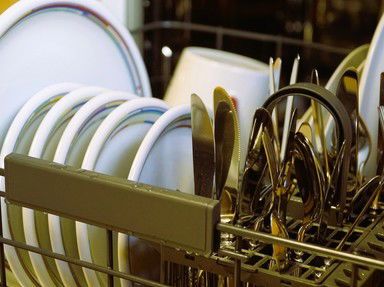
The Story of the Dishwasher

A whole quiz about dishwashers? Yeah, I know. I'm reaching. But the story of these little kitchen luxuries is quite interesting when you get into the weeds. In fact, I could really only scratch the surface... kinda like a 19th century dishwasher. Enjoy!

A multiple-choice quiz by JJHorner. Estimated time: 3 mins.
  1. Home
  2. »
  3. Quizzes
  4. »
  5. General Knowledge Trivia
  6. »
  7. Thematic Objects
  8. »
  9. Thematic Kitchen Items

Author
JJHorner
Time
3 mins
Type
Multiple Choice
Quiz #
423,401
Updated
Mar 11 26
# Qns
10
Difficulty
Average
Avg Score
7 / 10
Plays
35
Last 3 plays: GreenChair74 (4/10), canadie (7/10), Guest 24 (4/10).
- -
Question 1 of 10
1. The first mechanical dishwashers were powered by what? Hint


Question 2 of 10
2. Who is credited with inventing the first practical mechanical dishwasher in 1886? Hint


Question 3 of 10
3. At what major public event was the first practical dishwasher demonstrated to attract buyers? Hint


Question 4 of 10
4. What early problem caused by handwashing soap did the first dishwasher detergents attempt to solve? Hint


Question 5 of 10
5. Dishwashers were a luxury item until the 1950s. Which company played an important role in bringing electric dishwashers into American homes at that time by introducing the first under-counter models? Hint


Question 6 of 10
6. Why were phosphate-based dishwasher detergents widely adopted in the mid-20th century? Hint


Question 7 of 10
7. Besides insulation, what design change greatly reduced dishwasher noise in late-20th-century and modern models? Hint


Question 8 of 10
8. What modern dishwasher feature prevents food particles from redepositing onto dishes during the wash? Hint


Question 9 of 10
9. What innovation allows some modern dishwashers to dry dishes efficiently without exposed heating elements, often with the assistance of a mineral called zeolite? Hint


Question 10 of 10
10. What detergent innovation allowed modern dishwashers to clean effectively at lower temperatures? Hint


(Optional) Create a Free FunTrivia ID to save the points you are about to earn:

arrow Select a User ID:
arrow Choose a Password:
arrow Your Email:


Most Recent Scores
Today : GreenChair74: 4/10
Today : canadie: 7/10
Today : Guest 24: 4/10
Today : poetkah: 9/10
Today : kingmama: 6/10
Today : jwwells: 8/10
Today : Twotallgnome: 4/10
Today : Guest 104: 6/10
Today : Dizart: 8/10

Quiz Answer Key and Fun Facts
1. The first mechanical dishwashers were powered by what?

Answer: Hand crank

Yeah, thanks for the innovation, but next time, um... maybe don't help so much. The earliest mechanical dishwashers were indeed simple, hand-cranked deals. Patents and descriptions from the mid-19th century tell us of wooden boxes or barrels with a crank or wheel that splashed water over racks of dishes.

It was exactly the kind of contraption you'd invent if you just hated scrubbing but really, really liked turning handles. Joel Houghton's 1850 patent and later 19th-century improvements weren't exactly the time saver people were hoping for. If you like those battery-operated twirling spaghetti forks that just make everything more complicated, you might wanna see if you can get your hands on one.
2. Who is credited with inventing the first practical mechanical dishwasher in 1886?

Answer: Josephine Cochrane

Josephine Cochrane is the hero who invented the first practical mechanical dishwasher back in 1886. Cochrane's machine actually worked well enough to be USEFUL, which is one of those oft-forgotten details in many inventions, such as the battery-operated twirling spaghetti fork. Her design used water pressure to spray dishes held in wire racks.

Cochrane was famously motivated by a very particular pet peeve. Her servants kept chipping her fine china while washing the dishes. Rather than accept fate, buy sturdier plates, or perhaps find other servants, she instead found ambition and designed a machine that could wash dishes faster and more safely than those clumsy servant hands. And her timing was impeccable. Hotels and restaurants needed labor-saving devices, and electricity was just starting to come onto the scene.

It's worth noting that Cochrane was not a professional engineer by any means. She hired mechanics and worked through the designs with them. It doesn't make the invention any less hers. Her company eventually became part of what is now KitchenAid.
3. At what major public event was the first practical dishwasher demonstrated to attract buyers?

Answer: The 1893 World's Columbian Exposition in Chicago

It was demonstrated at the 1893 World's Columbian Exposition in Chicago. The expo was packed with new inventions, strange foods, and bold, if sometimes silly, predictions about the future. Josephine Cochrane showed off her dishwasher as a serious labor-saving machine aimed at hotels and restaurants. And it worked.

That mattered.

At the time, most homes didn't even have reliable hot water, let alone electricity. But hotels? They had both, and the dirty dishes never stopped piling up. Cochrane's machine could clean copious quantities quickly, and of course without breaking fine china, the whole point of Cochrane's invention. Those were also real concerns for upscale establishments. Buyers noticed. Orders followed.
4. What early problem caused by handwashing soap did the first dishwasher detergents attempt to solve?

Answer: Suds

When I was a kid, I wanted to run the dishwasher. You know... to help! The problem was we didn't have any dishwasher detergent, so I found the next best thing: dish soap. The ensuing scene resembled an '80s movie with the kitchen slowly filling with water and a mountain of suds. Luckily my parents weren't home, and I don't recall if I was ever asked about all the towels in the laundry.

Regular handwashing soap, used prior to dishwashing detergent, creates lots of foam. More so when high-pressure water is being sprayed. The suds can clog up the dishwasher's motor and pump, cause permanent damage, and... well, I told you MY story.

The point is, a kitchen full of foam is not a selling point.
5. Dishwashers were a luxury item until the 1950s. Which company played an important role in bringing electric dishwashers into American homes at that time by introducing the first under-counter models?

Answer: KitchenAid

In the 1950s, KitchenAid, then a part of Hobart Manufacturing Company, introduced the first under-counter dishwasher based on Josephine Cochrane's design from decades earlier. After World War II, it expanded its lineup beyond just lame boring laundry machines and became one of the big players in a whole range of household appliances, if you'll pardon the pun. (Range? Household appliances? Hello? Anyone?)

By the late 1940s and into the 1950s, it was making dishwashers under the KitchenAid name and quickly becoming very popular indeed. These models helped turn lowly dishwashers from rare, high-end oddities into must-have conveniences as post-war prosperity and compact kitchen designs became popular.

(On a completely unrelated and personal note, my wife will often rearrange the dishes after I load them, because I "did it wrong". What IS that?)
6. Why were phosphate-based dishwasher detergents widely adopted in the mid-20th century?

Answer: They softened water and improved cleaning efficiency

Phosphate-based dishwasher detergents were widely adopted because they softened water and made cleaning far more effective. In simple terms, phosphates - salts derived from phosphoric acid - bind with calcium and magnesium ions found in hard water, preventing those minerals from interfering with the detergent's ability to break down all that nasty grease and grime you forgot to rinse off your plates before you put them in the dishwasher. Without the interference from all that hard water, dishwashers could actually wash instead of just sloshing around a hot mess of disappointment inside a loud metal box.

This was a big deal in the mid-20th century because household dishwashers were becoming more common by the day, but water hardness varied wildly from place to place. My water comes from the Rockies, and it's hard enough to cut a diamond. Phosphates neutralized that threat, making detergents work reliably whether you lived somewhere with soft water or somewhere like here where liquid limestone oozes out of the tap. Cleaner dishes, fewer spots, happier homeowners. Who could ask for more?

Ah, but phosphates were eventually phased out in the 2010s after we learned more about their environmental impact. They're basically fertilizer for algae, and the resulting blooms created dead zones that damaged entire ecosystems. Perhaps surprisingly, it was the United States that was the first to begin banning them, leading Australia, Canada, and eventually the EU to follow suit.
7. Besides insulation, what design change greatly reduced dishwasher noise in late-20th-century and modern models?

Answer: Quieter pump motors

Quieter pump motors, particularly the move to brushless and/or inverter-style motors and better mounts, made an enormous difference in the commotion of dishwashers. Today's motors run smoother, with less vibration and fewer sudden speed changes, so there's less mechanical racket being transmitted through the dishwasher into the living room and into your ears while you're watching 'Seinfeld' reruns. In addition, dishwasher makers started tuning motor control and adding anti-vibration mounts, so they purr like happy kittens.

It's not ALL pumps and inverter-style motors, which I don't pretend to understand, that made a difference, though. Better tub materials (stainless steel absorbs the vibes better than cheap plastic), improved mounting and damping, and smarter wash-cycle control all pitched in to make our lives a little quieter, so my wife can tell me all about the cat's day without shouting (although she still reserves shouting as an option).
8. What modern dishwasher feature prevents food particles from redepositing onto dishes during the wash?

Answer: Self-cleaning filtration systems

Modern dishwashers often rely on self-cleaning filtration systems to keep food particles from redepositing onto dishes mid-cycle. Earlier machines often just blasted water around, optimistically hoping for the best, which meant bits of last night's lasagna could make a surprise comeback, as those of us with acid reflux understand.

Self-cleaning filters trap food debris and either grind it up or flush it away, so it does not get redeployed onto a freshly washed plate like the unwanted garnishes they serve at Mexican restaurants.

What am I gonna do with a chunk of lemon on a sad piece of lettuce?

But back to the filters. There are two main approaches here. Some systems use fine mesh filters that continuously rinse themselves clean during operation. Others combine filters with grinders that pulverize food scraps into particles small enough to be safely washed down the drain. The latter is the noisier choice.
9. What innovation allows some modern dishwashers to dry dishes efficiently without exposed heating elements, often with the assistance of a mineral called zeolite?

Answer: Condensation drying

Condensation drying is the main innovation that lets some modern dishwashers dry dishes without those elements that have killed many a spatula in my household. Instead of blasting everything with heat from exposed elements, these machines let physics do all the work. The dishwasher heats the final rinse water, making dishes very hot, then encourages moisture to migrate away from them and condense on cooler interior surfaces like those stainless steel walls. Gravity finishes the job. Rinse aid helps here, because it reduces the surface tension of water, allowing all that water to just slide off the dishes.

Zeolite, a volcanic mineral, is often used in conjunction with condensation drying, because its crystals absorb moisture and release heat, which is excellent for drying plastics. It's typically stored in a chamber at the bottom of the tub. After the wash cycle, a fan draws air into the chamber, the crystals absorb the moisture from the air, and that exothermic adsorption process produces hot, dry air upward of 175° F (79.4° C).

Condensation became common as the makers of dishwashers pushed hard for energy efficiency and quieter machines. No exposed elements? Fewer parts, less power, and no more melted spatulas. Mix in improved insulation and airflow, and we have that happy purring kitten again.
10. What detergent innovation allowed modern dishwashers to clean effectively at lower temperatures?

Answer: Enzyme-based detergents

Enzyme-based detergents make the magic of effective low-temperature dishwashing possible. These detergents, usually served à la 'pod', use enzymes like proteases and amylases to break down proteins and starches, the icky, sticky stuff that clings to plates when you skimp on the rinse. Unlike traditional detergents that rely on heat and beating up the grime with chemicals, enzymes are more chill and don't require near-boiling water to work well.

Energy-efficient and scrubiliciously clean, modern enzyme detergents are also surprisingly precise. They're engineered to "turn on" at specific points in the wash cycle and then "turn off" once their work is done. They're quiet, invisible, and very good at eating leftovers. In fact, they work best when you leave a little mess (no chunks) on the plates.

Science!
Source: Author JJHorner

This quiz was reviewed by FunTrivia editor agony before going online.
Any errors found in FunTrivia content are routinely corrected through our feedback system.
Related Quizzes
1. Cutlery Connections Easier
2. Pass the Bottle Easier
3. Who Invented the Dishwasher? Average
4. We Did All This for a Cup? Average
5. Fire Burn and Cauldron Bubble Average
6. Put a Cork in it! Average
7. Serving Size: 1 Can Average
8. Kitchen Things Difficult
9. Prized Connections Very Easy
10. Wax a Question Very Easy
11. Bar None! Very Easy
12. Stars, Stripes, and Smarts Easier

3/11/2026, Copyright 2026 FunTrivia, Inc. - Report an Error / Contact Us