FREE! Click here to Join FunTrivia. Thousands of games, quizzes, and lots more!
Quiz about Triumphantly Sound Fourth

Triumphantly Sound Fourth Trivia Quiz

Four-movement Symphonies

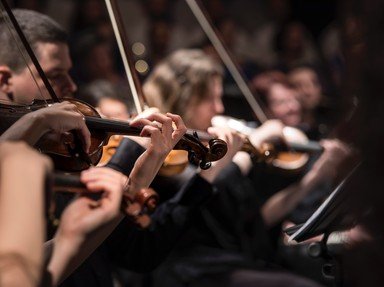
Most classical and romantic symphonies end triumphantly, some even in a musical blaze of glory. At this time, the symphonic form also became less rigid, often deviating from the four-movement form. Which ones end in a proper fourth-movement celebration?

A collection quiz by WesleyCrusher. Estimated time: 3 mins.
  1. Home
  2. »
  3. Quizzes
  4. »
  5. General Knowledge Trivia
  6. »
  7. Thematic Fun
  8. »
  9. Advent Calendar

Time
3 mins
Type
Quiz #
422,099
Updated
Dec 04 25
# Qns
12
Difficulty
Tough
Avg Score
7 / 12
Plays
32
Last 3 plays: Guest 4 (6/12), Guest 172 (6/12), Dizart (10/12).
Pick the symphonies that have a triumphant, upbeat fourth-movement finale (evil can triumph too, mweeheehee!), avoiding those that have a different number of movements. The movement count designated by the composer in the final published version is used.
There are 12 correct entries. Get 3 incorrect and the game ends.
Berlioz's ''Symphonie Funebre et Triomphale'' Shostakovich's 10th Brahms's 1st Bruckner's 8th ''Apocalyptic'' Saint-Saens's 3rd ''Organ'' Dvorak's 9th ''New World'' Tchaikovsky's 6th ''Pathetique'' Mahler's 7th ''Song of the Night'' Beethoven's 9th ''Choral'' Tchaikovsky's 2nd ''Little Russian'' Mendelssohn's 2nd ''Hymn of Praise'' Tchaikovsky's 1st ''Winter Dreams'' Mahler's 2nd ''Resurrection'' Brahms's 2nd Gade's 8th Mahler's 1st ''Titan'' Berlioz's ''Symphonie Fantastique'' Beethoven's 5th ''Fate'' Mendelssohn's 5th ''Reformation''

Left click to select the correct answers.
Right click if using a keyboard to cross out things you know are incorrect to help you narrow things down.

Most Recent Scores
Today : Guest 4: 6/12
Today : Guest 172: 6/12
Today : Dizart: 10/12
Today : Guest 171: 4/12
Today : spanishliz: 3/12
Today : purelyqing: 12/12
Today : MikeyGee: 4/12
Today : Guest 38: 6/12
Today : Guest 174: 8/12

Quiz Answer Key and Fun Facts
Answer:

Beethoven's 5th symphony is most well known for its introductory ta-ta-ta-taaaa motif, which evokes fate knocking at the door, and not in a good way. Beethoven wrote this work after realizing he would go deaf - a horrible thought for someone who lives music. In spite of this somber mood, the symphony ends on a proper triumph. Although many recordings only feature three tracks, the symphony does have four movements: The scherzo 3rd does directly lead into the finale 4th without an interval.

Beethoven's 9th is probably the best known symphony of the world with its jubilant "Ode to Joy" finale, an exuberance usually lasting between 22 and 28 minutes depending on conductor and involving four vocal soloists and a large choir - performances have been recorded with more than ten thousand singers. If you love classical music, I recommend Michael Gielen's Beethoven recordings which are quite powerful across the board, but his rendition of the Ninth with the Suedwestfunk Symphiony is truly special.

Brahms's 1st and 2nd symphonies both evoke and continue Beethoven's legacy, to the point that the former has been dubbed "Beethoven's 10th". Both have a very powerful finale, the first revolving around a chorale theme that is actually only played played twice - once early in the movement in a subdued, minor-key rendition and once close to the ending in a triumphant no holds barred major-key brass jubilation. The second, somewhat rarely played, symphony ends in a frenzy of musical energy in the hands of a strong conductor - I recommend Maurice Abravanel with the Utah Symphony for this one.

Tchaikovsky's 1st and 2nd symphony both feature jubilant, fast and furious finales. The first is based on Russian folk songs and, in spite of the composer suffering from depression at the time, resolves into a display of strength. The second also uses a folk song motif which is repeated and varied over thirty times in the rondo finale that culminates in a "fall, get up, adjust crown, continue" moment involving a descent over several octaves into a massive single strike on a huge gong.

In contrast, his 6th and last symphony is a five-movement work that, while featuring a very jubilant and triumphant fourth movement, does not end there, but rather tacks on a slow, agonized fifth movement. When composing the symphony, Tchaikovsky was aware of conductors attempting to avoid that fate and rearrange the movements, placing the fourth at the end - and precluded that by ending that movement in an unresolved harmony! If you wish to (re)experience his symphonies, I recommend Mariss Janson as a conductor.

Gustav Mahler has written many triumphant symphonies (and several that are the opposite), but only one of them - the 1st - is also a four-movement work, although at first it was not: The symphony was initially created as a five-movement piece, but the second "Blumine" movement was pulled by the composer after three performances, so it is now a four-movement symphony. His second, fifth and seventh symphonies all culminate in joyful, triumphant moments, but all of them are five-movement works. The second symphony ends in a choral finale that rivals and possibly exceeds Beethoven's Ninth while the fifth and seventh are purely instrumental works that incorporate a symmetry around an extensive third movement. I would be hard pressed to nominate any specific conductor for his work - just find one (or several) who recorded the complete cycle, preferably including "Song of the Earth" and pick the one that suits your mood of the day.

Felix Mendelssohn was born into a Jewish family but baptized as a Protestant Christian at age seven. Religion influenced many of his works, including two symphonies: the second and the fifth. The latter is a traditional four-movement work whose triumphant finale is based on Luther's "Ein feste Burg" chorale while the former consists of three purely orchestral symphonic movements followed by an extensive cantata. While some recordings treat the work as a four-movement piece, this is neither supported by the composer nor most music historians - it is generally either treated as having 11 or 13 parts, depending on whether the three movements of the "sinfonia" are seen as one or three. The "The Night is Departing" chorus (part 7 of the cantata) is probably one of the most jubilant pieces of music ever written.

Niels Gade was a mid to late 19th century Danish composer who was largely influenced by Beethoven. He wrote a total of eight symphonies, all of which follow the traditional four-movement format (although two of them have an additional, "apocryphal" movement that was discarded by the composer). I picked his 8th and final symphony for this quiz because it has a very joyful finale that uses the B major chord, played in ascending order as the main theme - but I could really have picked any of these eight by an underappreciated composer. If you like Beethoven's work - especially the earlier symphonies - give his works a listen!

In spite of being a late romantic work, Dvorak's ninth "From the New World" symphony uses a very traditional movement scheme, having both the opener and finale in sonata form, a slow second and a scherzo third movement. It is scored for a large orchestra with an extended brass section - four horns and three differently pitched trombones provide the necessary power for the grand finale which features the main theme in an augmented (lengthened) rendition.

Dimitri Shostakovich was a Soviet composer who, at times, was quite at odds with Stalin's government and had to withdraw some of his works which were considered too modern, western or dissonant by the state policies. From 1936 to Stalin's death in 1953, he was hampered by restrictions to his work and life. His tenth symphony was the first work to be published after Stalin's death although it was likely written earlier - sketches exist as far back as 1949. The work's tone reminds of film soundtrack music and the symphony ends in a frenzy of sound that would well fit the triumph of an evil or mad anti-hero. Like in many of his works, the composer employs a D - E flat - C - B motif which, read in German notation becomes D - Es - C - H, a transcription of the beginning of Shostakovich's name.

Bruckner's eighth symphony ends in a finale movement that consolidates and combines all ideas presented in the work overall into a single musical expression that, in the coda, ultimately leads to all the major themes appearing overlaid with each other in a roughly twelve-second triumphant finale, certainly a fitting positive ending for a setting based on the end of the world.

Among the wrong answers, in addition to those already named, there are three symphonies by French composers which rate among the most triumphant finales ever written, but none of them is truly a four-movement work.

Camille Saint-Saens's famous "organ" symphony comes closest, because each of the two movements identified by the composer is in itself split into two distinct parts, so some recordings actually do present it as a four-movement symphony, although it is more commonly recorded with three (splitting only the second movement) or only two parts. In addition to the titular organ, the symphony also requires a piano, played with four hands in some passages.

Finally, Hector Berlioz has written four works he called symphonies, but none of them is a traditional four-movement work for orchestra. His most famous symphony is certainly the "Symphonie Fantastique", a five-movement orchestral poem that culminates in a chaotic witches' sabbath prominently featuring the "Dies Irae" theme. The last of his four symphonies, the "(Grande) Symphonie funèbre et triomphale" in turn has only three movements - a funeral march, a funeral oration and finally, a triumphant "Apothéose" suitable for an ascension to a higher layer of existence. Originally scored just for a wind band, the work did receive a string section later and optionally also features a choir in the final section.

It is rumored that a very small number of selected FunTrivia players have had the joy to listen to a particularly glorious recording of that last mentioned work on a special occasion.
Source: Author WesleyCrusher

This quiz was reviewed by FunTrivia editor agony before going online.
Any errors found in FunTrivia content are routinely corrected through our feedback system.
12/4/2025, Copyright 2025 FunTrivia, Inc. - Report an Error / Contact Us