FREE! Click here to Join FunTrivia. Thousands of games, quizzes, and lots more!
Quiz about Night Sky  Spain

Night Sky - Spain Trivia Quiz


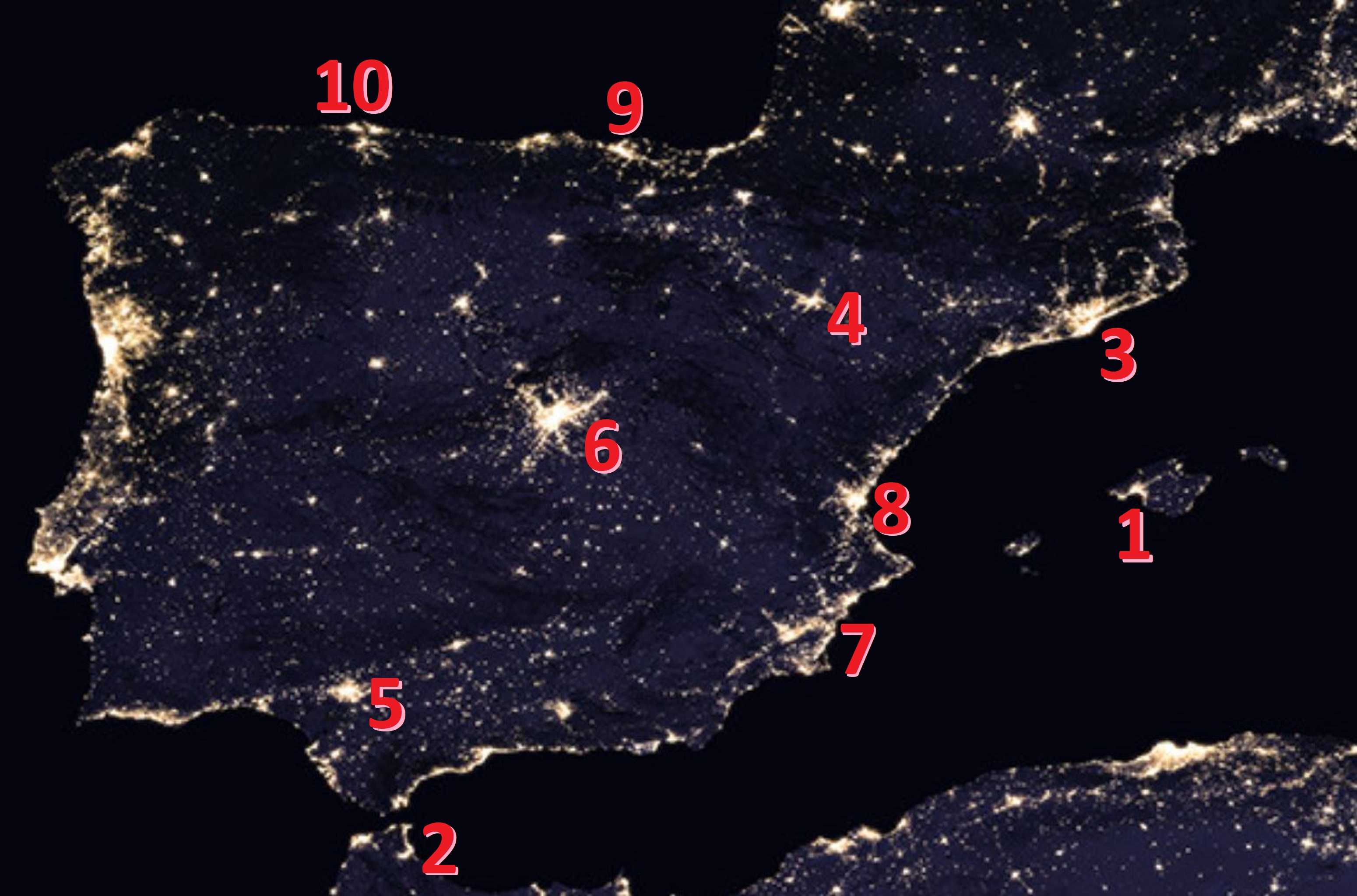
At night, the urban lights light up your area, but, from space, they show where population centers are. Can you identify the large population centers from only the city lights?

A label quiz by LeoDaVinci. Estimated time: 3 mins.
  1. Home
  2. »
  3. Quizzes
  4. »
  5. Geography Trivia
  6. »
  7. Europe
  8. »
  9. Spain

Author
LeoDaVinci
Time
3 mins
Type
Label Quiz
Quiz #
422,812
Updated
Feb 05 26
# Qns
10
Difficulty
Easy
Avg Score
8 / 10
Plays
20
Last 3 plays: cardsfan_027 (10/10), lethisen250582 (10/10), miner8265 (10/10).
Identify the cities of Spain from the light of the city.
Click on image to zoom
Valencia Palma Murcia Ceuta Bilbao Zaragoza Sevilla Madrid Gijón Barcelona
* Drag / drop or click on the choices above to move them to the answer list.
View Image Attributions for This Quiz
1.   
2.   
3.   
4.   
5.   
6.   
7.   
8.   
9.   
10.   

Most Recent Scores
Today : cardsfan_027: 10/10
Today : lethisen250582: 10/10
Today : miner8265: 10/10
Today : RedHook13: 5/10
Today : Steelflower75: 10/10
Today : Guest 174: 10/10
Today : GoodVibe: 5/10
Today : CardoQ: 10/10
Today : Ampelos: 10/10

Quiz Answer Key and Fun Facts
1. Palma

Palma, the capital of the Balearic Islands autonomous community, is a major Mediterranean port city situated on the southern coast of the island of Mallorca. It was founded by the Romans as Palmaria. The city features a complex urban tapestry reflecting the different centuries of Roman, Byzantine, Moorish, and Christian rule. The historical center of the city is dominated by the Catedral de Santa María (La Seu), a Catalan Gothic building notable for its vast rose window and twentieth-century modifications by Antoni Gaudí.

For the Balearic Islands, Palma is an essential hub for administration. Tourism and trade go through here, as does most of the region's money. For the tourists, the city features one of the world's only circular castles, Castell de Bellver, and you can also take a stroll in the Llotja de Palma, a 15th-century administration building with Gothic architecture.
2. Ceuta

Ceuta is one of the world's most fascinating geopolitical anomalies. Located on the northern tip of Morocco, this 18.5 square kilometer Spanish autonomous city sits directly across the Strait of Gibraltar from mainland Europe. Ceuta is famously known as the "City of the Four Cultures". It combines Christian, Muslim, Hindu, and Jewish communities in one cohesive place. While Morocco has often tried to negotiate for its transfer, Spain has maintained ownership of this slice of Africa.

Originally a Phoenician colony, Ceuta passed through Roman, Visigoth, and Arab hands. Then, the Portuguese seized it in 1415. This was an event often cited as the spark that ignited the Age of Discovery. It officially became Spanish in the 17th century. Today, its landscape is dominated by the Murallas Reales (Royal Walls), a massive fortification system complete with a navigable sea moat that separates the old town from the modern peninsula.
3. Barcelona

Barcelona is the seaside capital of Catalonia, the autonomous region, and the second-largest city of Spain. It is a city where Roman history, medieval mystery, and modernism collide. There is a legend that the city was founded by Hercules, however, the archaeological evidence points to the fact that the city was actually founded by the Romans.

The city's identity is inextricably linked to the visionary architect Antoni Gaudí, whose works - like the towering, still-unfinished Sagrada Família and the mosaic-filled Park Güell, show what Mediterranean potential this city has. For sports fans, the ultimate pilgrimage site is the Spotify Camp Nou, where FC Barcelona play.
4. Zaragoza

In the autonomous community of Aragon, Zaragoza is the capital. This city is situated on the Ebro River in northeastern Spain. Historically, it was founded as the Roman colony Caesaraugusta; since then, it has remained a critical industrial and logistics center due to its strategic location between Madrid, Barcelona, and Bilbao.

Zaragoza's skyline is dominated by the Basilica of Our Lady of the Pillar, a major Baroque pilgrimage site. Its history is further reflected in the Aljafería Palace, an 11th-century Moorish residence that exemplifies Mudejar architecture and is recognized as a UNESCO World Heritage site. Mudéjar architecture is a hybrid style that emerged in medieval Spain, characterized by the integration of Islamic decorative motifs and construction techniques into Christian architectural frameworks. Zaragoza is well-known for intricate examples of this kind of building technique.

Recently, in 2008, the city hosted an International Expo. This event introduced modern urban designs and infrastructure focused on water and sustainable development, a major feather in the cap for the city.
5. Sevilla

Sevilla is the proud capital of the Andalusian region. It is defined by its deep fusion of Moorish and Christian heritage. It was originally called Hispalis before it was conquered in 712 CE by the Islamic forces of Musa ibn Nusayr, and was renamed Ishbiliya. When the city returned to Christian rule, the name was Latinized and that's how the city got its name - Sevilla.

The city is home to the Seville Cathedral, the world's largest Gothic religious building and the burial site of the explorer Christopher Columbus. Its bell tower, the Giralda, was originally built as a minaret for a 12th-century mosque. The Royal Alcázar, a UNESCO World Heritage site, remains a functional royal palace featuring premier Mudéjar architecture. Sevilla is also known as the worldwide capital of the flamenco dance, and also for its bitter oranges.
6. Madrid

Located geographically right in the middle of Spain, it is no coincidence that Madrid is the cultural, political, and economic heart of the country. Established as the capital by Philip II in 1561, Madrid is a city of deliberate grandeur. Its layout offers a visual timeline: the narrow, winding streets of the medieval Madrid de los Austrias contrast with the sweeping, neoclassical boulevards of the Gran Vía and the colossal Royal Palace.

Despite the urbanization that is prevalent around the world, Madrid takes care to make sure its public spaces are kept green and clean. For example, the Retiro Park, designated a UNESCO World Heritage site, provides an 125-hectare reprieve from the bustling streets. The culture in the city is quite prevalent, with museums like the Prado, Reina Sofia, and Thyssen-Bornemisza covering a wide variety of art. Of course, if sports are your thing, the Santiago Bernabéu is a must-see. The city even has an authentic 2nd-century BCE Egyptian temple, the Temple of Debod, which was moved piece by piece as a gift from the Egyptians. Tapas are able to be found everywhere, as a Spanish staple, but the Mercado de San Miguel is perhaps the best-known of them all.

Part of Spanish culture is bullfighting, and the Plaza de Toros de Las Ventas in Madrid is the most prestigious of them all. From Spring to Autumn there is a full docket of bullfights that are well-attended by the locals and tourists alike.
7. Murcia

In the southeast of Spain, "Europe's Orchard" is the city of Murcia. It earned that name due to its fertile plains and massive export of fruits and vegetables. Through the city flows the Segura River, and the climate is warm and usually dry. One of the iconic landmarks in the city is the Cathedral of Saint Mary, which features an iconic Baroque façade and a 90-meter bell tower which is the second-highest in Spain.

Entierro de la Sardina (Burial of the Sardine) is a unique tradition to this city. It is the grand finale of Murcia's Fiestas de Primavera (Spring Festivals). It is a surreal, joyous, and slightly chaotic event that serves as a perfect case study for Spanish folklore. It is an all-day celebration with floats passing by and events like the Toy Rain where literally millions of plastic toys are thrown into the crowd of onlookers. At 1AM, a massive wooden sardine effigy is burned and fireworks are set off. Burying the fish marks the end of the fast of Lent.
8. Valencia

Valencia is Spain's third-largest city. It is a vibrant coastal metropolis located on the Mediterranean Sea. It is well-known as the birthplace of paella, a dish synonymous with Spanish culture.

Historically, Valencia was founded by Romans and later influenced by Moorish rule (the Islamic invaders of the Iberian peninsula in the 8th-17th centuries), visible in its winding old town streets and the Gothic Silk Exchange. A unique feature is the Turia Gardens, a nine-kilometer urban park created from a diverted riverbed that snakes through the city center. In the city, the most iconic landmark is the City of Arts and Sciences, a sprawling complex of avant-garde structures designed by Santiago Calatrava.
9. Bilbao

When you get to Bilbao, you'll find the industrial titan turned cultural jewel of the Basque Country! Once upon a time it was a gritty port city, however, Bilbao underwent a world-class transformation,, now anchored by the shimmering, titanium-clad Guggenheim Museum. The old lives on in the medieval "Seven Streets" where history shows its grandeur in edifices like the Gothic Santiago Cathedral, the anchor of the Casco Viejo neighbourhood.

Officially, Bilbao was founded in 1300 by the Lord of Biscay. There had been a fishing village where the city was, and he created the chartered town by laying down the "Siete Calles" (seven streets) that became the heart of the city. Its location close to the ocean helped the city grow, particularly through the wool and iron trade that were centered there. The focus on iron eventually led to an extensive steel and shipbuilding industry boom.

You cannot leave Bilbao without experiencing the culinary soul of the city: the pintxo. Unlike standard tapas, these miniature masterpieces are skewered to bread and enjoyed with a glass of crisp, local Txakoli wine.
10. Gijón

Gijón is the largest city in Spain's southern Asturias region. Sitting on the Bay of Biscay, it is the heart of what is called "Green Spain" as it (and its area) contrasts beautifully with the arid expanses around it. When you go there, the Mediterranean climate is temperate and the landscapes are lush.

Gijón's historic center is the Cimavilla district, a peninsula that contains significant archaeological remains from the Roman era. Historically, it was a fisherman's quarter. Now, this area is noted for its high concentration of sidrerías (cider houses) and their interesting aeration methods. The beach, Playa de San Lorenzo, is a 1.5 kilometer-long urban meeting spot for locals and tourists alike.
Source: Author LeoDaVinci

This quiz was reviewed by FunTrivia editor agony before going online.
Any errors found in FunTrivia content are routinely corrected through our feedback system.
Related Quizzes
1. Cities of Spain Easier
2. Lost in Spain Average
3. Spain Average
4. Spain Geographically Average
5. Basic Spanish Geography Average
6. It's All In Barcelona Average
7. Geography of Spain Average
8. Madrid, A Beautiful City Average
9. Spanish Cities Average
10. A Grand Tour of Spain I Average
11. A Grand Tour of Spain II Average
12. Autonomous Communities of Spain Average

2/5/2026, Copyright 2026 FunTrivia, Inc. - Report an Error / Contact Us