FREE! Click here to Join FunTrivia. Thousands of games, quizzes, and lots more!
Quiz about Ancient Egypt IS Ancient History

Ancient Egypt IS Ancient History Quiz


When the word ancient is used in discussion, often times it reflects what went on in Egypt and the continent of Africa. I believe I've added a nice combination of questions to whet your appetites on the subject! Look out for a little math too!

A photo quiz by BullsGold. Estimated time: 3 mins.
  1. Home
  2. »
  3. Quizzes
  4. »
  5. History Trivia
  6. »
  7. Ancient History
  8. »
  9. Ancient Egypt

Author
BullsGold
Time
3 mins
Type
Photo Quiz
Quiz #
412,714
Updated
Dec 12 25
# Qns
10
Difficulty
Easy
Avg Score
8 / 10
Plays
22
Last 3 plays: pixiecat (10/10), Bowler413 (9/10), odysseas (9/10).
-
Question 1 of 10
1. What is the Hebrew name for Egypt used by scholars when describing the writings of biblical Egypt, as well as the name of a biblical figure who was a son of Ham and grandson of Noah? Hint


Question 2 of 10
2. In Egypt during ancient times, what designation of name was given by the Greeks as early as the time of Homer? This word literally means the land of the Nile. Hint


Question 3 of 10
3. Cleopatra VII traveled the Mediterranean Sea from Greece to Egypt. She was born in Alexandria, Egypt, but she was not Egyptian.


Question 4 of 10
4. Which ancient town is known for a major Ptolemaic temple complex which was built between 237 BC and 57 BC? It is said that of all the temples remaining in Egypt, the Temple of Horus is the most completely preserved. Hint


Question 5 of 10
5. The ancient Egyptians often buried their dead in a raised, flat, rectangular shaped tombs. Can you name this form of burial plot, usually placed on the west of the Nile River?

Hint


Question 6 of 10
6. One important landmark in ancient Egypt stood over 3,300 years, but was threatened by the building of the Aswan High Dam on the Nile River. What ancient colossus, over twenty meters high, was carved into the surrounding rock, and saved by modern technology? Hint


Question 7 of 10
7. Cleopatra, who was Egypt's last pharaoh, lived closer to the beginning of the 21 century than she did near the times when the Pyramids of Giza were built.


Question 8 of 10
8. This deity was the ancient Egyptian god of the afterlife and associated with mummification, embalming, and the protection of the dead. He was typically depicted as a jackal-headed man and played a crucial role in guiding souls through the underworld to be judged. What was his name? Hint


Question 9 of 10
9. Crocodiles were actually killed and mummified as a token to the Gods. What was the name of the Egyptian god associated with the sacrifice of the Nile crocodile? Hint


Question 10 of 10
10. Life was not all work in ancient Egypt, and oftentimes Egyptians relaxed playing board games. Which board game was NOT played during those ancient times? Hint


(Optional) Create a Free FunTrivia ID to save the points you are about to earn:

arrow Select a User ID:
arrow Choose a Password:
arrow Your Email:


View Image Attributions for This Quiz

Most Recent Scores
Today : pixiecat: 10/10
Today : Bowler413: 9/10
Today : odysseas: 9/10
Today : odo5435: 6/10
Today : jonathanw55: 4/10
Today : Guest 90: 5/10
Today : Guest 72: 5/10
Today : Guest 162: 5/10
Today : Guest 76: 8/10

Quiz Answer Key and Fun Facts
1. What is the Hebrew name for Egypt used by scholars when describing the writings of biblical Egypt, as well as the name of a biblical figure who was a son of Ham and grandson of Noah?

Answer: Mizraim

Mizraim, is a Hebrew and Aramaic linguistic derivation now named for the land of Egypt, meaning "Ta-Wy"(the two lands). In Genesis 10, Mizraim was the son of Ham, and the younger brother of Cush. When seen as a figure, Mizraim is considered the ancestor of the Egyptian people and several other tribes of Egypt. His name often used as the proper name for Egypt in the Bible, possibly as a dual form to signify Upper and Lower Egypt.

Japheth is considered to have been the older of the three sons of Noah in rabbinic literature. He is one of the sons blessed by Noah - post flood - in the story of Noah's drunkenness. Shem was the other son, with Ham also being one of Noah's three sons. Gomer was the son of Japheth, who was an ancestor of the Cimmerians.
2. In Egypt during ancient times, what designation of name was given by the Greeks as early as the time of Homer? This word literally means the land of the Nile.

Answer: Aiguptos

It is important to understand that the name of the country of Egypt actually came from the Greek "Aiguptos", and is the ancient Greek word for Egypt. It is also the root of the English word Egypt.

Aiguptos literally means the land of the Nile. The name used for ancient Egypt by the Greeks as early as the time of Homer was Aegyptus (Greek: Aígyptos). Aiguptos is a feminine noun that defined a country on the northeast of Africa (Egypt). The word Aeguptos was derived from "Hwt-Ka-Ptah," which means Temple of the Ka (spirit) of Ptah in ancient Memphis. Ptah was the god of creation, architecture, and craftsmen in ancient Egypt.

Ebronah was the 13th station of the Israelites in the wilderness. It was north of Ezion-geber (Numbers 33:34-35). Ramoth of the Negev is a region that borders the desert of the south of Judah (Joshua 19:8). Akrabbim, meaning scorpions, is an ascent on the southeast frontier of Judah near the south point of the Dead Sea (Judges 1:36).
3. Cleopatra VII traveled the Mediterranean Sea from Greece to Egypt. She was born in Alexandria, Egypt, but she was not Egyptian.

Answer: True

Cleopatra VII might have been born in Alexandria, Egypt, but she was a Macedonian Greek. She was a descendant of Ptolemy I Soter, who, at the time, was a lieutenant and eventually a general of Alexander the Great. She was one of the first Greeks from the Ptolemaic Dynasty to know the Egyptian language at the time of her reign.
4. Which ancient town is known for a major Ptolemaic temple complex which was built between 237 BC and 57 BC? It is said that of all the temples remaining in Egypt, the Temple of Horus is the most completely preserved.

Answer: Edfu

The ancient remains of the settlement of Edfu are located about 50 meters to the west of the Ptolemaic temple. It is left of the older temple pylon. In Edfu, Upper Egypt, the Temple of Edfu is located on the west bank of the Nile. The city was known in the Hellenistic period, mostly for the major Ptolemaic temple.

The temple took about 180 years to complete, and was built between 237 BC and 57 BC, into the reign of Cleopatra VII. Of all of the monuments in Egypt, the Temple of Horus at Edfu is the most completely preserved. It was built from sandstone blocks, and oriented east to west, facing towards the river.
5. The ancient Egyptians often buried their dead in a raised, flat, rectangular shaped tombs. Can you name this form of burial plot, usually placed on the west of the Nile River?

Answer: mastaba

The mastaba was usually placed on the west side of the Nile because that was where the sun set, and the superstition was that the sun fell into the underworld. The most well known mastaba is the Mastaba of Kaninisut, located at Giza West Field of the Great Pyramid of Giza. It was built of the finest quality white Tura limestone during the 4th Dynasty during the reign of Khufu for his relatives. It houses 77 tombs, and is looked at as a cemetery. Mastaba is Arabic for bench. They were usually made from limestone or mud bricks.

An amphora is a form of a vase usually filled with grains, water, oil, or other liquids. Sometimes they had two handles, and were often placed at the site where a buried body lay. A dolmen is a monument made in pre-historic times that was built of two or more vertical rock pillars, usually placed with a flat, or near flat, horizontal stone slab on top of it. Most are found in France or Britain. Often used for the common people to see as a tribute, a catafalque can be a quite ornate structure that is used to hold a casket, sometimes closed or open, so people can pay respects for those lying in state. On occasion they can be seen by moving as in a "funeral car."
6. One important landmark in ancient Egypt stood over 3,300 years, but was threatened by the building of the Aswan High Dam on the Nile River. What ancient colossus, over twenty meters high, was carved into the surrounding rock, and saved by modern technology?

Answer: Abu Simbel

Abu Simbel is two monuments, with one dedicated to his favorite wife, Nefertari, while the other one was dedicated to Ramesses II. The carvings were formed out of the front of the cliff-face and were decorated from floor to ceiling.

More during our day and current age, the Aswan High Dam was constructed. Doing so created a lake behind it as is natural when dams are built. Because of this unfortunate event, there were many archaeological remains situated on the banks of the Nile which would end up underwater. Archaeologists identified which ones they wanted to save. Abu Simbel was one of them. However, because this monument was carved into the rock, engineers carefully cut it into blocks and moved it uphill to an artificial mound where it stands today.
7. Cleopatra, who was Egypt's last pharaoh, lived closer to the beginning of the 21 century than she did near the times when the Pyramids of Giza were built.

Answer: True

It is true. Cleopatra was living closer to our current day and age than she was to the Pyramids of Giza being built. Today, since we are virtually near the beginning of the second millennium, and Cleopatra was ALMOST ruling at the time of Jesus' birth (withing 100 years), it makes it harder to fathom that Cleopatra was alive closer to our current time set.

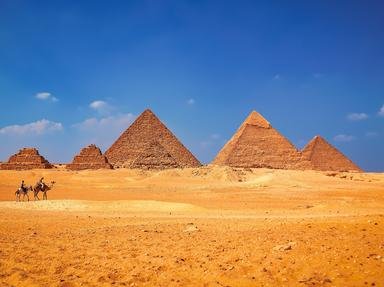
The Pyramids of Giza were built around 2,750 BC, during the 4th Dynasty. Pharaoh Cleopatra, was Queen of the Ptolemaic Kingdom of Egypt from 51 to 30 BC. The pyramids were built near 2,700 years before the reign of Cleopatra. That means Cleopatra lived, roughly, about 2,075 years since the birth of Jesus Christ.
8. This deity was the ancient Egyptian god of the afterlife and associated with mummification, embalming, and the protection of the dead. He was typically depicted as a jackal-headed man and played a crucial role in guiding souls through the underworld to be judged. What was his name?

Answer: Anubis

Anubis was also associated with the underworld in ancient Egyptian religion, and depicted as a canine or a man with a longer canine head. It is said that he attended the weighing scale during the weighing of the heart, in which it was determined whether a soul would be allowed to enter the realm of the dead. Anubis is said to be one of the most often depicted and talked about gods in the Egyptian pantheon.

Ptah is pronounced "Tah", and was considered a major ancient Egyptian creator god, as well as a chief deity of Memphis. Thoth is usually shown as a man with an ibis's head or as a baboon. Horus is usually seen as a major ancient Egyptian sky god, often depicted as a falcon or a falcon-headed man.
9. Crocodiles were actually killed and mummified as a token to the Gods. What was the name of the Egyptian god associated with the sacrifice of the Nile crocodile?

Answer: Sobek

Sobek was an Egyptian god of crocodiles, often seen on the walls of tombs. Some say he was the creator of the Nile River, and was often depicted as having a head of a crocodile. His sweat was said to have created the Nile River, thus making him crucial to how the fertility of the land might be through the annual floods. He was also known as a symbol of royal power and was integrated with other gods like Horus and Ra.

Astarte is an Egyptian god of horses, lions, and chariots. Bastet is an Egyptian goddess of cats. Hequet is an Egyptian goddess of frogs.
10. Life was not all work in ancient Egypt, and oftentimes Egyptians relaxed playing board games. Which board game was NOT played during those ancient times?

Answer: Lagori

Lagori is a game played between two teams that involves a ball and seven flat stones. It comes from the Indian subcontinent and is played is a traded outside. It is also called Lingocha. one might often have seen children trying to topple off a stack of stones. One player from the team gets three chances to knock down the seven stones. The idea is that the other team has to try to stack them up again without getting out.

Senet has been dated as old as 3,500 BC and was played on a long board with 30 squares. Queen Nefertari has been depicted playing the game in paintings during that era.

Mehen was associated with the snake deity Mehen, but it is not know if the game comes from the snake god, or if the name of the snake god comes from the game. The rules on how the game was played are not known, even though today there are rules that have been made to play the game.

The ancient game Dogs and Jackals is now called Hounds and Jackals. It is a table game consisting of two sets of 29 holes. During the movie, "The Ten Commandments", it was shown with Pharaoh Seti and Nefertari playing the game. There is abundant evidence for the "Dogs and Jackals" game (also called "58 Holes") in ancient Egypt, and many cases have been found through numerous archaeological discoveries of game boards - parts of dog and jackal heads and other related items have been found in tombs across Egypt. Findings have been dated all the way back to the Middle Kingdom around 2000 BC.
Source: Author BullsGold

This quiz was reviewed by FunTrivia editor ponycargirl before going online.
Any errors found in FunTrivia content are routinely corrected through our feedback system.
12/12/2025, Copyright 2025 FunTrivia, Inc. - Report an Error / Contact Us