FREE! Click here to Join FunTrivia. Thousands of games, quizzes, and lots more!
Battles on Greek Soil Trivia Quiz
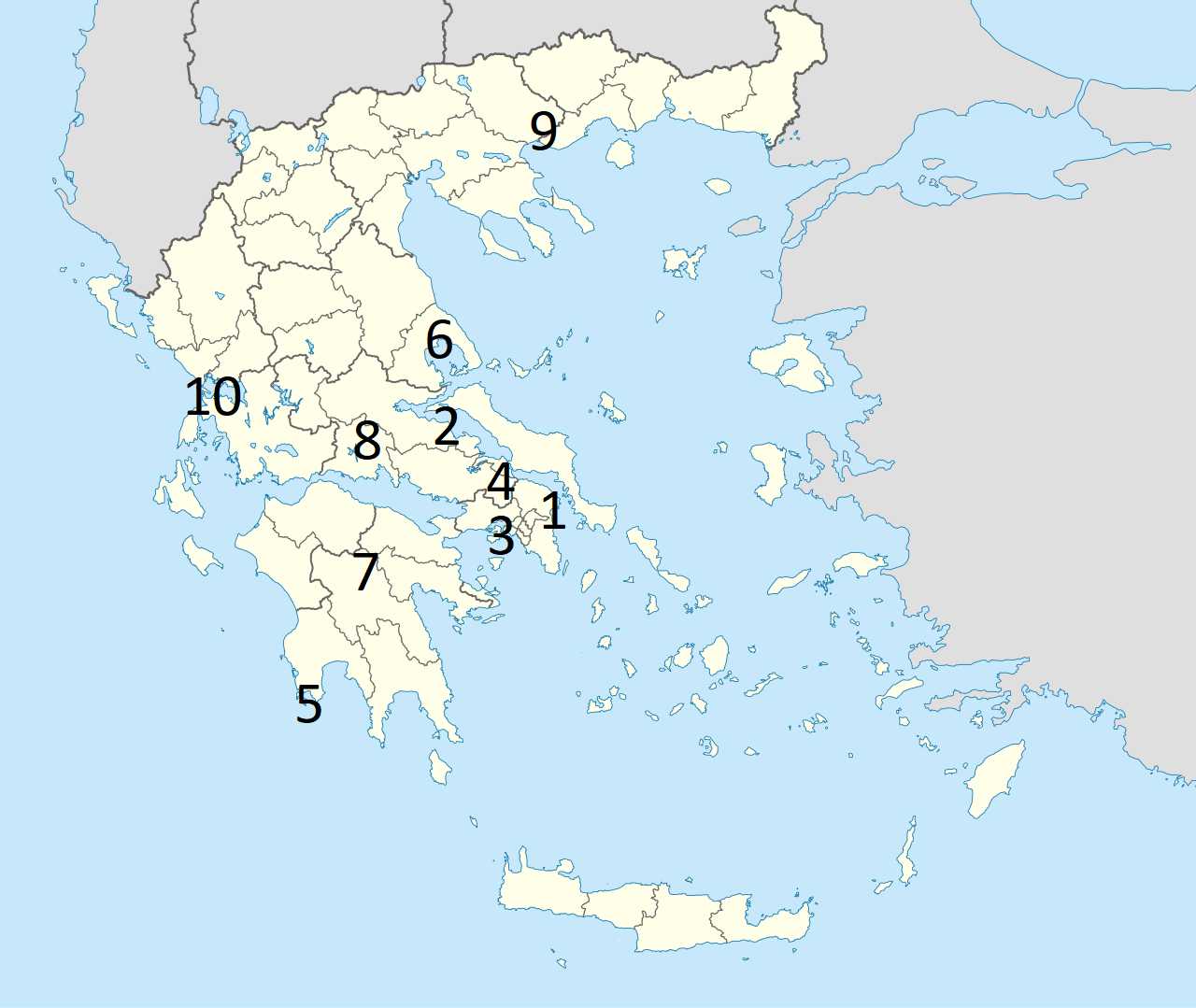
Battles on Greek soil represent a timeline stretching from Antiquity to the 20th century. For thousands of years, the region's strategic position at the crossroads of Europe, Asia, and Africa has made it a frequent theater for monumental conflicts.
Last 3 plays: wellenbrecher (10/10), xchasbox (0/10), Reamar42 (10/10).
Click on image to zoom
PylosMantineaThermopylaeChaeroneaCynoscephalaeMarathonPlataeaActiumSalamisPhilippi* Drag / drop or click on the choices above to move them to the answer list. View Image Attributions for This Quiz
The battle of Marathon was the first of a series of battles between the Greeks and the Persians. In 490 BC the Persian Empire, lead by King Darius the Great, launched an invasion of Greece. After capturing the city of Eretria, they landed on the beach near Marathon, which was close to Athens. The Athenians together with the army of Plataea faced the Persians. They totalled ten thousand men against a Persian army than numbered more than twice as many. The leadership of the Greek army was given to Miltiades who decided to attack immediately, rather than wait for further help from other city states.
Having observed that the Persians lined up with their main strength concentrated in the middle, Miltiades strengthened the wings and thinned the middle. The Greeks attacked with ferocity using the two wings while ceding ground to the middle. The two wings pushed the Persians back and then turned towards the middle encircling the enemy. The Persians panicked and fled the battle ground leaving behind 6,400 dead soldiers. This win gave the Greeks the confidence to face the Persians in the battles that followed.
2. Thermopylae
Ten years after the battle of Marathon, the Persians invaded Greece once again, seeking revenge for their earlier defeat. The Persian troops made swift progress and reached a narrow pass, Thermopylae, that was guarded by Spartan troops aided by allies. After a few days wait the Persians attacked, but the narrow passage didn't allow them to fully deploy their troops; they were restricted to a very small line of attack, that was easily defended by the Greeks.
Wave after wave of attacks were pushed back by the defenders, who held the passage for two days. They were betrayed by a Greek named Ephialtes, who received a reward, and showed the Persians a mountain path that led them behind the Greek lines. The 300 Spartans and 700 warriors from Thespiae fought bravely, but succumbed to the superior forces of the enemy.
3. Salamis
Following the battle at Thermopylae, Persian king Xerxes and his army continued their southward push overrunning much of Greece and capturing the city of Athens. At the same time his navy of about 800 galleys confined the smaller Greek fleet of about 370 triremes in the Saronic Gulf. The Greek commander, Athenian general Themistocles, lured the Persian fleet into the narrow waters of the strait at Salamis, where the massed Persian ships had assembled.
Following the battle at Thermopylae, Persian king Xerxes and his army continued their southward push overrunning much of Greece and capturing the city of Athens. At the same time his navy of about 800 galleys confined the smaller Greek fleet of about 370 triremes in the Saronic Gulf. The Greek commander, Athenian general Themistocles, lured the Persian fleet into the narrow waters of the strait at Salamis, where the massed Persian ships had difficulty manoeuvring. The Greek fleet then attacked ferociously, ramming and/or sinking many Persian vessels and boarding others. The Greeks sank about 300 Persian vessels while losing only about 40 of their own. The rest of the Persian fleet was scattered, and as a result Xerxes had to postpone his planned land offensives for a year, a delay that gave the Greek city-states time to unite against him. The Battle of Salamis was the first great naval battle recorded in history.
4. Plataea
After the battle of Salamis, King Xerxes returned to Persia, leaving behind a strong force under the leadership of general Mardonius, to continue the war against the Greeks. In July 479 BC the armies met at Plataea, not very far from Thebes, for what was the decisive battle of the Greek-Persian wars.
The Persian cavalry had some initial success by cutting off supply routes and blocking water springs. Following an unsuccessful manoeuvre but the Greek forces, the Persians attacked. The Athenian and Spartan forces were massed at the flanks, with a smaller force lined up in the middle.
In the ferocious battle that ensued the Greeks, who were better fighters at close quarters, managed to inflict heavy casualties on their enemies leaving 30 thousand Persians dead, while they only lost 2 thousand soldiers.
5. Pylos
The battle of Pylos, 425 BC, was a land and naval battle fought during the Peloponnesian War between Athens and Sparta and their respective allies. Athens always had a better and stronger Navy and Sparta normally excelled in land battles. In this instance though, the Athenians overcame the Spartans in the sea battle, but also managed to get a Spartan land force to surrender.
A small Athenian force had previously set up a base at Pylos, the Spartans feeling uneasy to have an enemy base so close home, attacked but were repulsed and at the same time the Athenian navy defeated the Spartan fleet with a small land forced being stranded at the small island of Sphacteria, which was captured by the Athenians after negotiations for the surrender failed.
6. Cynoscephalae
The battle of Cynoscephalae, in 197 BC, marked the end of the second Macedonian War between Romans and Greeks. Cynoscephalae lied on a range of hills in Thessaly, Greece, about 7 miles (11 km) west of the modern city of Vólos. Roman forces under the leadership of Titus Quinctius Flamininus defeated Philip V of Macedon here, ending the Second Macedonian War. Each side had about 26,000 men.
The Romans won when a detachment, under an unknown tribune, cut through the flank and rear of the Macedonian right.
7. Mantinea
The Battle of Mantinea, fought in 362 BC, was a crucial confrontation in ancient Greek military history involving the cities of Mantinea and Tegea, which were embroiled in a dispute that led to the formation of rival coalitions. Sparta and Athens allied with Mantinea, while Thebes and its Boeotian allies supported Tegea. Under the command of Epaminondas, the Theban forces aimed to capture Mantinea but encountered Spartan resistance led by King Agesilaus II.
The battle commenced with a strategic deception by Epaminondas, who initially gave the impression that he would not engage, only to launch a surprise attack with a heavily laden left wing that overwhelmed the Spartans. Despite securing a tactical victory, Epaminondas was mortally wounded during the fight, which led to a loss of momentum for the Thebans as they chose not to pursue their fleeing enemies. The outcome of the battle underscored Epaminondas's military genius but also marked a turning point for Thebes, leading to its decline in influence within Greek affairs. This battle remains significant for its demonstration of shifting power dynamics in classical Greece.
8. Chaeronea
Battle of Chaeronea, (August 338 BC), was a battle in Boeotia, central Greece, in which Philip II of Macedonia defeated a coalition of Greek city-states led by Thebes and Athens. The victory, partly credited to Philip's 18-year-old son Alexander the Great, cemented the Macedonian hegemony in Greece and ended effective military resistance to Philip in the region.
9. Philippi
The ultimate confrontation in the war that followed the assassination of Julius Caesar in 44 BC, Philippi saw end of those who favoured the old Republican constitution of Rome. It was a brutal killing match with much confusion and little strategic nous on either side.Caesar loyalists Mark Antony, Octavian Caesar, and Marcus Lepidus formed a triumvirate.
They seized control of Rome and the empire's western provinces, then set off to defeat Caesar's killers, Marcus Brutus and Gaius Cassius, who had joined with other opponents of Caesar in raising the eastern provinces of the empire in rebellion.
10. Actium
Battle of Actium, (September 2, 31 BC), was a naval battle off a promontory in the north of Acarnania, on the western coast of Greece, where Octavian (known as the emperor Augustus after 27 BC), by his decisive victory over Mark Antony, became the undisputed master of the Roman world.
Antony and Cleopatra commanded a massive but heavy fleet of quinqueremes. Octavian and Agrippa brought smaller, faster, and more manoeuvrable Liburnian ships. Outnumbered and running out of supplies, Antony attempted to break the blockade to escape into the open sea, but Cleopatra's reserve squadron left suddenly the battle and Antony followed leaving his fleet to be totally destroyed by the opposing forces.
This quiz was reviewed by FunTrivia editor gtho4 before going online.
Any errors found in FunTrivia content are routinely corrected through our feedback system.