FREE! Click here to Join FunTrivia. Thousands of games, quizzes, and lots more!
Northmen! Trivia Quiz
Viking Days and Ways
Northmen, Norsemen, Vikings, and Scandinavians are all general names used to describe the people who lived in Northern Europe and rose to prominence during the 8-11 centuries AD. Of course, some would also call them pirates or marauders!
A collection quiz
by ponycargirl.
Estimated time: 3 mins.
Last 3 plays: kingmama (10/10), Guest 185 (8/10), gwendylyn14 (7/10).
Your task is to find the ten words that describe culture traits or achievements made by the Northmen during their heyday.
There are 10 correct entries. Get 3 incorrect and the game ends.
SilkSagasDays of the WeekAlthingGreenlandCombsSkiingTrade RoutesUrban CentersLongshipDemocracyGothic ArchitectureAstrolabeSun CompassThree-field System
Left click to select the correct answers. Right click if using a keyboard to cross out things you know are incorrect to help you narrow things down.
The Vikings were early seamen who lived in Scandinavia, which is modern day Denmark, Norway, and Sweden. It appears their ancestors began settling in the area after the last Ice Age drew to a close approximately 14,000 years ago. People who lived in Scandinavia at that time made a living by hunting reindeer, plant gathering, and fishing. They began to settle down during the Bronze Age (c. 3,000 BC) after they learned how to farm; they also traded the local resources, amber and furs, with other Europeans in exchange for metal tools while developing their cultural traditions.
By the 700s, a growing population, lack of fertile farmland, scarcity of natural resources, and political issues led to a need for more land. The people had the technology needed for raiding and establishing new settlements, and there were areas nearby that could provide wealth in the form of slaves and precious metals. Why not give it a try?
Although they had been building boats and going out on raids in the early 700s AD, the event that traditionally marks the beginning of the Viking Age is the assault on Lindisfarne Monastery, located on Holy Island, on June 8, 793. What easier source of wealth could there be? The monks who were not killed were captured and sold into slavery. The holy relics, many of them made of gold and silver, were also stolen. The raid on the sacred site was so savage and thorough that it was not until the late 1000s that it was reestablished as a monastery.
Sagas, long written narratives about the Northmen c. 800-1000 AD, are the most important sources that tell about Viking life, although modern historians agree that some of the stories are not completely accurate, as they are filled with references to their mythology, legends, and folklore. Nevertheless, sagas are a good source for information about leaders and Northmen culture. Sagas were recorded from approximately 1100-1300. One of the most famous, the "Njáls Saga", that dates to the 1200s, tells the story of blood feuding in Iceland from 930 and 1020. There is also "Ragnars saga loðbrókar", or "The Saga of Ragnar Lodbrok", which tells about the famous leader and his sons. The "Prose Edda" and "Poetic Edda" are packed with information about Viking legends and mythology. Approximately 150 sagas have been found, along with short stories about Viking exploits and culture.
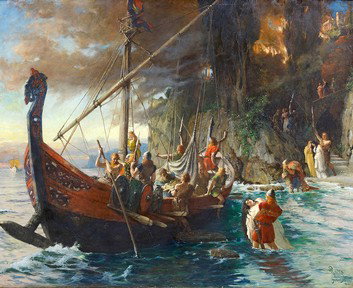
Of course, one of the reasons that the Northmen raids were so successful was because of their use of the longship, which is also called a dragon ship. Vikings had been building ships for centuries using the clinker-built method of overlapping wooden planks. Sometime around 700 AD the shipbuilders added a woolen sail, which made rowing a bit easier. About the same time they also invented a T-shaped or V-shaped wooden keel that ran along the bottom of the hull, something that was different from any other ship in the world at the time. The keels strengthened the hulls of the ships, which meant that they could be taken across the open seas, but they were also shallow enough to allow the boat to land directly on beaches - great for their surprise attacks and quick getaways. Only 2-3 feet of water were needed to make the boat float! And, because the bow and the stern of the longships were basically symmetrical, the rowers could simply change the direction in which they were rowing and go the other way without turning the boat around. Longships were even light enough for the crew to carry across land if that was a better option!
Long before the magnetic compass was once again available, the Northmen used the sun to stay their course when traveling through large bodies of water. Cloudy days, however, were a real problem as a longship could seriously stray off course. According to the sagas, the Vikings used what they called a sunstone to navigate, but they never offered any further explanation. The discovery of a crystal in a shipwreck in 2013 began to open the door on this mystery. Modern scientists believe calcite crystals could have been used to navigate on cloudy days because they produce what is called a birefringence. That means the crystals can be used to detect polarization, which shows the light around the sun, even on a cloudy day. Brilliant!
Using longships and calcite crystals the Northmen could travel long distances across large bodies of water. They founded three major trade routes; one was called the Volga Trade Route. It stretched from the Baltic Sea to the Volga River to the Caspian Sea, and then on to Baghdad. Another route was the Dnieper River Route, also called the Route from the Varangians to the Greeks. This route connected Scandinavia with Eastern Europe to the Black Sea, all the way to Constantinople. We can't forget the Western and Maritime Routes, across the North and Baltic Seas to Britain, Ireland, continental Europe, Iceland, and all the way to Greenland. So, what did the Vikings trade? They traded raw materials like amber, timber, and fur, along with slaves in exchange for silver and luxury goods like wine and silk. Of course, the profitable trade routes then led to the establishment of trade centers.
Northmen founded many urban centers during their explorations - one settlement was established on the River Liffey in 841 AD. They named it Dubh Linn, which means Black Pool, after the water where they kept their boats. The Vikings built a longphort, a shore camp, there, which was the site of a huge slave market. They kept control of the area until losing it to the Irish in 1014 at the Battle of Clontarf. Limerick, Cork, and Wexford also began in Ireland as Northmen settlements.
Surely you have heard the story about Eric the Red's family in Iceland? His father, Thorvald Asvaldsson, was banished to Iceland c. 960s for murdering a man in Norway. Eric was about ten years old at the time. Much of the great farmland in Iceland was already taken, so the family settled in a rather remote region and went about trying to make a living. In approximately 982 Eric became involved in a blood feud with his neighbor, and moved to the nearby island of Oxney, where he became involved in another feud during which he murdered several people. Banished from the area for three years, he could not return to Norway because of his father's crimes, and decided to sail west. He landed on the island of Greenland and explored the island for three years, finding some areas of fertile land along the southwest coast. After naming the island Greenland in hopes of attracting settlement, he returned to Iceland after three years and organized an expedition of 25 ships and 500 people to colonize a settlement at Brattahlid. Eric reigned as a chieftain there until his death c. 1003 AD. The people stayed in Greenland until the early 15th century, when colder weather, along with less demand in Europe for walrus tusk ivory, led to the abandonment of the colony.
The Vikings did not invent combs; they date back to about 10,000 years ago and were made of a variety of materials, such as bones, ivory, jade, and even metal. Vikings were, however, the ones who popularized their use in the West. Important as a grooming tool, they also crafted small cases that protected the fragile comb teeth and wore them on their belts for ready use. Men and women used combs made of wood, bone, or deer antlers to detangle their hair, remove lice, and the men (of course) would groom their beards. One Anglo-Saxon chronicler went so far as to suggest that the hygienic practices of Viking men - combing their hair, weekly bathing, and wearing clean clothes - made them more attractive to Anglo-Saxon women! Combs have been found in Northmen graves, sometimes in the hands of the deceased.
The Chaldeans in ancient Mesopotamia invented the seven day week c. 2300 BC. Over time it was adopted by the ancient Romans, who named the days of the week after the sun and moon, which the vast majority of ancients also worshiped, and their important deities. When the Northmen adopted the calendar, they changed some of the names of the week days according to their beliefs, and they have stayed that way ever since in English-speaking parts of the world. Sunday and Monday stayed as they were, but Tuesday became Tyr's day. He was their god of war and justice. Wednesday was named for Odin, the god of wisdom, and Thor, the god of thunder, storms, and strength, was worshiped on Thursday. Friday was Freyja's day. She was the Norse goddess of love and beauty. Saturday kept its Roman name after the god Saturn. Of course, it helped that the Anglo-Saxons worshiped basically the same deities, and adopted similar names for their days of the week!
The Parliament of Iceland, called the Althing, is the oldest surviving institution of its type in the world. Iceland was previously populated by a few Irish monks, who moved away when the Northmen appeared; sources credit Ingólfr Arnarson with building the first permanent homestead in Reykjavík in 874 AD in order to get away from heavy taxes in Norway and find better farmland. (Remember - they called the land Iceland to keep people out!) Founded in 930 AD at Thingvellir in southwest Iceland, the Althing was comprised of free men and leaders. They would gather once a year to enact laws, settle conflicts, and take care of other necessary business. Sometime around 1262 the Althing lost some of its power when Iceland entered into a union with Norway, and it was subsequently controlled by Denmark during the 1380s-1660s. Although it was completed dissolved in 1800, it was reinstated as an advisory body in 1845, and has been around in some shape or form ever since.
Even though evidence of skiing dates back thousands of years in Russia and China, the Vikings made important contributions that have affected modern life. The oldest evidence in Scandinavia is a rock carving in Norway that dates to c. 4,000 BC. The modern word ski comes from the Norse words "skríða á skíðum", which means to stride on skis. Used for much more than recreation, the Northmen hunted and even engaged in warfare on skis. They were also extremely important for winter transportation. Usually made from pine or birch wood, skis were about six feet long; some, however, used an unevenly sized pair, with the long ski for gliding and the shorter ski for climbing uphill. Skiing was so important that it even had guardian deities in the Norse pantheon - Ullr was associated with skiing and archery and Skaði was the goddess of winter hunting. Today the Vikings are credited with giving the idea for ski troops as part of military warfare. By the 1600s the Danish-Norwegian army had specialized ski troops and within a hundred years there were regular companies of dedicated ski troops in the military, which led to skiing competitions like the biathlon.
Although the Vikings did give rights to free men, the idea of a democratic government dates back to ancient Athens beginning in the sixth century BC. Likewise, the invention of the astrolabe dates back to ancient Greece, was rediscovered in the Islamic world in the 8th century AD, and didn't return to Europe until the 12th century. While the Vikings traded for silk along their Russian trade routes and in Constantinople, they did not manufacture it. Gothic architecture originated in northern France during the 12th century, and there generally wasn't enough good farmland in Scandinavia to institute the three-field system. As they came into contact with people in England or France and settled in those locations the Northmen might have adopted their ways of farming, but they did not introduce its use.
This quiz was reviewed by FunTrivia editor gtho4 before going online.
Any errors found in FunTrivia content are routinely corrected through our feedback system.