FREE! Click here to Join FunTrivia. Thousands of games, quizzes, and lots more!
Sort the Civ: The Maya Trivia Quiz
The Maya civilization has vanished long ago, but millions of descendants of the Maya survive. I'll bet you know more about them than you think! This quiz focuses on the Classic Period, from about 250 AD to 1000 AD.
A classification quiz
by etymonlego.
Estimated time: 3 mins.
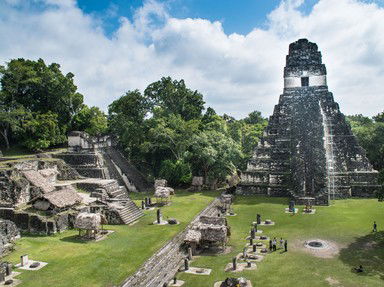
Located in modern Guatemala, Tikal was a center of Mayan influence during the height of the Classic period. Although almost all Mayanists do so, to call any Maya cite a "city" is more of a modern metaphor than an accurate descriptor. "Neither the Classic Maya nor a number of other early civilizations had anything we can call by that name," according to Michael D. Coe's book "The Maya." He estimates the peak population of Tikal at just 11,000 people. Spanning about six square miles, there are more than 3,000 structures at Tikal, ranging from its massive pyramids to the thatched huts that served as residence for both the poor and elite.
Rather than tombs, Maya "pyramids" (some consider this a misnomer, too, but they are typically pyramidal) served as temples. Tikal is the site of six large pyramids, the tallest standing 230 feet (70 meters) high. Much like our towering cathedrals and skyscrapers, the Mayan spirit was uplifted by the height of the things it could build. Thus they placed their altars in their pyramids at the tops of huge stairways, with tall ornamentations looking down from the top.
While the largest structures were pyramids, most structures at a large site like Tikal are palaces - limestone structures resembling the pyramids without the lower platforms. Yet again, "palace" is probably a misnomer. Coe writes "Did the rulers live in these? They seem singularly uncomfortable (and bat-infested) to those archaeologists forced by circumstances to camp in them." Maya religious structures were richly decorated with frescoes, murals, stone sculptures and "roof combs."
2. Chichen Itza
Answer: Cities
Situated on the Yucatan Peninsula, Chichen Itza is probably the most familiar Maya site in the modern day, with over 2 million visiting annually. The centerpiece is the temple called El Castillo or the Temple of Kukulkan, the snake god whom we shall discuss in more detail later. The north-facing stairway is designed in a way so that a thin, serpentine section of the stairs glows gold at sunset around the equinoxes, meeting with a statue of a serpent's head at the pyramid's base.
The temples, tombs, and palaces of Mayan "cities" were placed down higgledy-pigledy, with expansion into the jungles occurring rapidly as the need arose. Within their civil centers, they erected huge limestone roadways, usually referred to as causeways (though they weren't over water), known as sacbeob (singular sacbe), and adorned them with large gates. There is much debate over why sacbeob were so large, considering the Maya had no access to horses to justify large conduits. Many suspect a religious motivation.
Chichen Itza is also the site of the Great Ball Court (flanked by the curiously named "Temple of the Bearded Man"), the largest such court built by the Maya. The Maya LOVED a certain game played with a rubber ball (usually just called "the Maya ballgame") and rings arranged in a vaguely Quidditch-like fashion. Apparently courts were a necessary installation at all large settlements. The "Popol Vuh" recounts that the Hero Twins Hunahpu and Xbalanque played at the ballgame all day, causing a din that infuriated the gods of the Underworld. While in hell, the gods forced them to play a long cycle of matches that ended in draws. Eventually, the Twins won by decapitating Hunahpu, then using his head as the ball! By the way, it's also understood that if you captained the winning team in a major ballgame, your reward would be to get beheaded.
3. Uxmal
Answer: Cities
Cities built in the region of the Yucatan called Puuc had a unique architectural style, of which the Uxmal site is the largest exemplar. At its center was the Pyramid of the Magician, constructed over many centuries by building new pyramids on top of the old ones. Structures in the Puuc style are almost bare towards the bottom but have extremely ornate tops, almost like many modern Art Deco skyscrapers. Their use of concrete also showed a greater degree of engineering sophistication than most Maya pyramids, which carried their loads simply with large stones.
There's also a temple there decorated entirely with turtles. According to the "Popol Vuh," at the time of his rebirth, the Maize god burst out of a turtle.
4. K'iche'an
Answer: Languages
The K'iche'an language family included about 3 million speakers, being the dominant language of the Guatemalan highlands (where Tikal stands today). The "Popol Vuh" is written in K'iche', and part of its intrigue comes from the fact that the K'iche' had no written script.
Instead the K'iche' text was rendered into the script of the conquistadors. Nowadays, K'iche'an languages are the most widely spoken by far, with millions of indigenous Guatemalan speakers.
5. Yucatec
Answer: Languages
The Yucatecan language family was spoken on the Yucatan Peninsula, those limestone-rich lowlands that jut into the Caribbean Sea. Of the approximately 800,000 modern Yucatecan speakers, about 770,000 of them speak Yucatec proper. Several Yucatec dialects, including Itzá and Lacandón, are on the brink of total extinction. You've heard Yucatec spoken if you've seen the movie "Apocalypto" (2006).
6. Ch'olan
Answer: Languages
In contrast with the living languages of K'iche' and Yucatec, Ch'olan language has mostly vanished from the modern world, though the derived form Ch'ol still has a few hundred thousand speakers. However, Ch'olan has a distinction of crucial importance when talking Maya: the famous Maya writing system, whose decipherment was a cause for international fanfare, was the Ch'olan writing system.. Many Maya who spoke Yucatec, K'iche, and other language still used Ch'olan when written decoration was necessary.
For many decades it was widely believed that it was impossible to translate the written script of Ch'olan, because no translatable texts existed, and each letter represented a unique ideogram. It turns out the latter assumption was untrue. It was a Soviet, far from the misapprehensions of American academics, that first cracked the code. First, Yuri Knorozov deduced that Maya was a logo-syllabic script, not an ideographic one. About a decade later, the Russian-American Mayanist Tatiana Proskouriakoff studied Maya stelae and determined the existence of repeating words, such as a sequence of three labels that commonly appeared next to three dates. What three dates are important when speaking of a king? Why, their birth date, ascendancy date, and death date, of course.
7. Atlatl
Answer: Inventions
An atlatl is a Mesoamerican spear thrower, a simple device in which a long dart can be laid. The atlatl is shaped like a gun barrel and notched on one side to hold the weapon. The wielder swings the atlatl overhand, and that directs the force of the spear forward in a straight line. Based on findings at the besieged site of Aguateca, Maya warriors had bows and arrows, but, unlike many ancient cultures, still favored the atlatl. One advantage is that differently sized darts could be used for different purposes: while lightweight arrows achieve a higher velocity, atlatl projectiles maintained greater momentum to hunt large game... or large primates. Ancestors of the Maya used atlatls to hunt mammoths.
Maya culture emphasized the combat-readiness of its elites. Aristocrats were warriors, and kings were generals. As the elite were literate, we know that the Maya also developed much of their own military science. Wars were brutal: the losers were publicly humiliated, and defeated kings were tortured and sacrificed.
8. Long Count
Answer: Inventions
The Long Count is one of the several calendars that the Maya used - I should say still use, as the modern Maya continue to employ the Maya calendars today. In essence, the Maya conception of time was cyclical, not linear. For a given cycle (or "Calendar Round"), each date would have its own identifiers, its own unique associations. A date might have the negative association of a flood or the positive association of a war victory. Dates so influenced the lives of Maya that some people were even named for the date they were born. And not just because they were "Addams Family" fans.
A Mayan Calendar Round lasted 52 years, then repeated. The cyclical nature created ambiguity when dating things long-term - a problem that worsened when the Maya sought to date the lives of kings or the occasions of battles. For this purpose only, the Long Count was used. This same Long Count is the reason many a cheap article, TV documentary, and movie were made about the Maya's apocalyptic prophecies (but to imply that "the Mayan calendar ends" is misleading for five reasons I can see, not least of which is that it was not their primary calendar). We must remember that the Maya conceived of the time cyclically, and it wasn't really in their nature to anticipate an apocalypse. Rather, they believed 2012 would be an anniversary of creation - an occasion worthy of ritual fascination.
9. Zero
Answer: Inventions
Independently discovered in India and Mesopotamia, the Maya made use of the number zero in much the way we use it now. The Maya had an elegant system of dots and bars to represent digits in their base-twenty number system. On top of that, they used a conch shell to represent zero. I probably don't need to tell you that their interest in zero probably emerged from their interest in calendars.
The earliest date in the Maya Long Count was 13.0.0.0.0, with each of the zeroes representing a different unit of time.
The largest is the b'ak'tun, amounting to 394.52 Gregorian years. So the date of creation was the first day of the thirteenth b'ak'tun - and the thirteenth b'ak'tun following that happened to fall on December 21, 2012.
10. Kukulkan (Vision Serpent)
Answer: Deities
Kukulkan, who was rendered as male or female in different regions, was a powerful creation god of wind and knowledge. One of the god's aspects is as an embodiment of pure knowledge, and this creative spark lead to its creation of the world. The cult of Kukulkan was one of the most widespread religions in the Classic Period. The analogous god Gucumatz, also spelled Q'uq'umatz, was the feathered serpent deity of the K'iche Maya. Vast temples were erected to both gods in their respective cultural centers. Kukulkan's followers were centered at Chichen Itza, where they honored the deity with one of the largest temples, El Castillo (seen in the cover photo for this quiz). Uxmal also had a temple to Kukulkan, and the K'iche capital, Q'umarkaj, had a temple to Gucumatz.
The "Popol Vuh," the K'iche' creation epic, describes Gucumatz and Tepeu as creating the world from an endless ocean. Feathered "Vision Serpents" were a constant throughout Mesoamerican cultures; Kukulkan/Gucumatz are the Maya equivalent to Quetzacoatl of the Aztecs, and all three gods' names are made up of words for "quetzal" or "feathered" and "snake."
11. Huracán
Answer: Deities
Huracán, known by the epithet Heart of the Sky, was the god of storms and fire, embodiments of sheer power. But like Kukulkan, Huracan was also involved in the creation of humans. Along with Kukulkan and Tepeu, these three ancient ones sought to make beings to worship them and count the days (hence the religious fervor surrounding their calendars). Three attempts were made to create humanity. The first, a race of mud people, were destroyed by Huracán in a flood. The second try were made of wood, but betrayed the animals they lived with, so Huracán smote them by raining down tar-like, flammable pine resin - call it a Maya take on fire and brimstone. Supposedly, the wood people are the ancestors of monkeys.
The final, successful attempt to make humans was achieved by grinding maize and making a masa dough. In other words, unlike the Christian tradition that also has humans coming from mud, the Maya understood with religious intuition that we are what we eat. Jealous gods that they were, these perfect masa men had perfect visions, which the gods were sure to cloud.
That the word looks and sounds similar to "hurricane" is probably, but not necessarily, a coincidence: "hurricane" actually derives from the Taino (Carib) word "huracán," and there isn't further linguistic crossover with K'iche elsewhere. The K'iche words "hun raqan" actually mean "one-legged," as in a lightning bolt.
12. Chaac
Answer: Deities
Chaac was the rain god of the Yucatec, but unlike the gods discussed so far, was closely linked with agriculture and fertility. Instead of rain as a destructive and creative element, Chaac embodied rain as an everyday necessity for survival. Wells at Uxmal were erected in Chaac's honor where rain ceremonies were practiced.
One of the stelae at Tikal demonstrates how gods were used to spread the influence of southern Mexico's warring cultures. This stelae features a huge face of Tlaloc, the analogous rain god of the Teotihuacan and Aztec.
Given the sheer number of Mesoamerican tribes, not to mention the ability of many Mesoamerican religious figures to literally shapeshift, it's no wonder there's much crossover of attributes and major themes. I've chosen three gods of weather not to make you think this was the only obsession of the Maya, but so that you can compare and contrast some of the major figures in this volatile region.
13. Stelae
Answer: Art and Architecture
A stela was a highly detailed sculpture relief placed in places of prominence at many Maya sites. Cultures throughout the world have erected stelae, but those of the Maya are notable for two main reasons: they are extremely ornate, and we have precious little other record of their history.
Although we have preserved only four books from the Maya, their stelae are the kind of thing you occasionally hear has been unearthed by a construction crew or curious child. Their exact function - religious, record-keeping, or just ornamental - is something of a mystery, although we can at least see they venerated gods and kings.
The details on many of these stelae are as brutal as they are beautiful; many depicted rulers trampling their opponents after battle.
14. Roof Combs
Answer: Art and Architecture
A testament to the intricacy of Maya temples, one of the features that easily distinguishes them from the ruins of other cultures are the so-called "roof combs". Above the top layer of pyramids and other buildings, a grid like a square honeycomb was built where vibrantly decorated stone figures could be set. Today these figures have fallen off, leaving only the empty, criss-crossed capstone.
Many aspects of the Maya architecture emphasized height; there are tall pyramids where these roof combs span nearly a quarter of the structure's full height!
15. "Popol Vuh"
Answer: Art and Architecture
The "Popol Vuh," meaning "Book of Counsel," is a K'iche book of myths and folk history. It is a consistent theme in Mesoamerican studies that many texts which survived destruction by the Spaniards were rescued, translated, or transcribed by the very religious, and so it is the case here. In the 1500s, K'iche nobleman gathered to preserve what remained of their oral tradition in a secret text. Later, a Spanish friar named Francisco Ximénez entered the good graces of the men who had kept the "Popol Vuh" secret, and was able to transcribe it into Spanish.
I have recounted the basic story of two of the sections already. The first part deals with the attempts to create man and the world by Huracan, Tepeu, and the Vision Serpent. The second, set in the time before man, are tales of the Hero Twins, those lovers of the ball-game, who entered the Underworld and overthrew its rulers. The saga ends with the Twins resurrected their father, whom the Underworld gods had previously defeated. Their father then becomes the God of Maize, and therefore, allows for the eventual creation of humans. Much of the rest of the book records oral history, beginning with the legendary settlement of K'iche by the first maize-men, and continuing up to conquests and legends of kings.
This quiz was reviewed by FunTrivia editor ponycargirl before going online.
Any errors found in FunTrivia content are routinely corrected through our feedback system.