FREE! Click here to Join FunTrivia. Thousands of games, quizzes, and lots more!
Quiz about The Names of Apollo Part 2  Lunar Modules

The Names of Apollo Part 2 - Lunar Modules Quiz


Between 1969 and 1972, a total of nine Apollo Lunar Modules received names. Can you answer these general knowledge questions about their names, rather than the spacecraft?

A multiple-choice quiz by Red_John. Estimated time: 3 mins.
  1. Home
  2. »
  3. Quizzes
  4. »
  5. History Trivia
  6. »
  7. Man in Space
  8. »
  9. Apollo Missions

Author
Red_John
Time
3 mins
Type
Multiple Choice
Quiz #
422,948
Updated
Mar 16 26
# Qns
10
Difficulty
New Game
Avg Score
8 / 10
Plays
14
Awards
Editor's Choice
Last 3 plays: k7gygeno (2/10), Guest 176 (0/10), xchasbox (10/10).
- -
Question 1 of 10
1. Apollo 9 - Spider: Queen's Park FC is nicknamed "The Spiders" and is the oldest Scottish football club. The club is the only one from Scotland to have reached the English FA Cup final, when they came runners-up twice in succession to which founding member of the Football League? Hint


Question 2 of 10
2. Apollo 10 - Snoopy: In 1968, NASA established a new award to celebrate outstanding achievement related to flight safety or mission success among its employees and contractors. The award was named for Snoopy, who had been adopted as NASA's mascot, but what is the award actually called? Hint


Question 3 of 10
3. Apollo 11 - Eagle: Eagles are divided into four major groups. True eagles, sea eagles and serpent eagles are three, but which mythological creature is the fourth named for? Hint


Question 4 of 10
4. Apollo 12 - Intrepid: In 1862, Thaddeus S.C. Lowe used the observation balloon "Intrepid" to help prevent a Union Army defeat by the Confederates at which battle of the Peninsula Campaign? Hint


Question 5 of 10
5. Apollo 13 - Aquarius: Gilese 876, a star located in the constellation of Aquarius, is one of the closest stars to Earth known to have a planetary system. With four known planets, it was the first of what type of star to be proven to have more than two planets? Hint


Question 6 of 10
6. Apollo 14 - Antares: Antares is the name of a French indoor arena, primarily used for basketball. It is located within the estate of which motor sport circuit? Hint


Question 7 of 10
7. Apollo 15 - Falcon: The Falcon is the nom de plume of the protagonist of a series of B-movies from the 1940s, first starring George Sanders, who was followed by his brother Tom Conway. For which studio were they produced? Hint


Question 8 of 10
8. Apollo 16 - Orion: A total of four films produced and distributed by Orion Pictures have won the Best Picture Oscar (as of 2026). Which of the four ultimately won the most Oscars? Hint


Question 9 of 10
9. Apollo 17 - Challenger: In 1994, the 46-year old George Foreman regained the World Heavyweight championship as the challenger in a title fight against which reigning champion? Hint


Question 10 of 10
10. A total of eight of the nine Lunar Modules made a trip as far as the Moon, with six ultimately landing. Which is the only one of these whose ascent stage is known to have survived? Hint


(Optional) Create a Free FunTrivia ID to save the points you are about to earn:

arrow Select a User ID:
arrow Choose a Password:
arrow Your Email:


Most Recent Scores
Today : k7gygeno: 2/10
Today : Guest 176: 0/10
Today : xchasbox: 10/10
Today : Mad-martigan: 7/10
Today : pfryguy: 6/10
Today : Chloe4770: 10/10
Today : parrarobbie: 6/10
Today : bernie73: 4/10
Today : Guest 166: 4/10

Quiz Answer Key and Fun Facts
1. Apollo 9 - Spider: Queen's Park FC is nicknamed "The Spiders" and is the oldest Scottish football club. The club is the only one from Scotland to have reached the English FA Cup final, when they came runners-up twice in succession to which founding member of the Football League?

Answer: Blackburn Rovers

Queen's Park FC was founded in July 1867 by gentlemen that had played football in the Queen's Park area of Glasgow through their membership of the local YMCA. As one of the first clubs to be formed in Scotland, Queen's Park had a significant measure of control over the rules of the game in Scotland, the management of a nascent Scottish national team, and the eventual foundation of the Scottish Football Association and with it the Scottish Cup. However, the club also often found itself invited to play south of the border in England's FA Cup, the first such competition instituted anywhere. The club's first appearance in the FA Cup came in the competition's first season in 1871-72, when they reached the semi-final against eventual winners Wanderers. Having drawn 0-0 in London, the club was forced to withdraw from the replay as it could not afford to make a second such journey. Queen's Park ultimately reached the final twice in 1884 and 1885, both times facing Blackburn Rovers. In 1884, the English side won 2-1, while the following year the result was 2-0. Queen's Park made their last appearance in the competition in 1886.

Owing to Apollo 9's place as the first mission of the Apollo programme to have both the Command Module and Lunar Module flying together, it became necessary to provide each spacecraft with its own name, or call-sign, for ease of communication when both were being operated. Command Module Pilot Dave Scott took responsibility for naming the Command Module, while Commander Jim McDivitt and Lunar Module Pilot Rusty Schweickart gave LM-3 its name - Spider. This came from the spacecraft's spidery looking appearance when its landing legs were deployed. NASA's public affairs team were unhappy with the seeming flippant nature of the name, and got management to insist on more formal names for future missions, starting with Apollo 11.
2. Apollo 10 - Snoopy: In 1968, NASA established a new award to celebrate outstanding achievement related to flight safety or mission success among its employees and contractors. The award was named for Snoopy, who had been adopted as NASA's mascot, but what is the award actually called?

Answer: Silver Snoopy Award

Following the successful completion of the Mercury and Gemini programmes, NASA turned its attention to Apollo, and began looking for a way to promote the upcoming programme with the public. Additionally, NASA also wanted to promote awareness among its employees and contractors that they all had an impact on flight safety. So, the Director of Public Affairs at the Manned Spacecraft Center in Houston, Al Chop, came up with the idea of an award that astronauts could present to NASA staff and contractors to recognise outstanding contributions. Charles M. Schulz, the creator of the "Peanuts" comic strip, was an avid supporter of the space program; when Chop suggested the idea of using Snoopy as the basis for the award, Schulz readily agreed, and allowed the use of the character at no cost, also producing the image of "Snoopy the Astronaut" that was used to create the award pin. The Silver Snoopy Award was first presented in 1968, and is given to either an employee of NASA or one of its contractors for having fulfilled one or more of a number of criteria related to flight safety and quality, increased reliability or efficiency, or high quality performance. Recipients receive a sterling silver "Silver Snoopy" lapel pin of "Snoopy the Astronaut" that has been flown during a NASA spaceflight.

Because of Charles Schulz's wholehearted support for the space program, during Apollo 10 the characters of Charlie Brown and Snoopy were adopted as mascots for the mission. In spite of NASA's public affairs division frowning on the choice of names for the spacecraft, the popularity of "Peanuts" meant that the choice of Snoopy for the LM-4 was readily embraced by the public. Additionally, given that the purpose of the Apollo 10 Lunar Module was to "snoop" the planned landing site for Apollo 11, the choice of Snoopy as the spacecraft's name seemed appropriate.
3. Apollo 11 - Eagle: Eagles are divided into four major groups. True eagles, sea eagles and serpent eagles are three, but which mythological creature is the fourth named for?

Answer: Harpy

Harpy eagles, also known as giant forest eagles, are large eagles that generally inhabit tropical forests. However, unlike other groups, the various species that make up the harpy eagle group tend to occupy similar niches, rather than all being related. The group gets its name from a species also called the harpy eagle, which can also be referred to as the American harpy eagle. The harpy eagle is native to Central and South America, with a range extending from southern Mexico to the far north of Argentina. One of the largest birds of prey, it is related to the Papuan eagle, also known as the Papuan harpy eagle, which is native to New Guinea, and the crested eagle, with a range primarily encompassing the north of South America. Other species, including the two types of solitary eagle and the Philippine eagle, are grouped alongside the actual harpy eagles, but are not related. The name "harpy eagle" was first applied by Carl Linnaeus in 1758, when he named the species after the mythological harpy, a wind spirit from Greek mythology with the head and breasts of a woman, and the body, wings and talons of a bird of prey.

Starting with Apollo 11, the planned first manned lunar landing, NASA sought to have less flippant names applied to the two spacecraft that would undertake the flight. Although named as "Haystack" during early mission planning, LM-5 was eventually named as Eagle. This came primarily from the mission's insignia, which had been designed by Command Module Pilot Michael Collins, and featured a bald eagle, the national bird of the United States.
4. Apollo 12 - Intrepid: In 1862, Thaddeus S.C. Lowe used the observation balloon "Intrepid" to help prevent a Union Army defeat by the Confederates at which battle of the Peninsula Campaign?

Answer: Seven Pines

In October 1861, six months after the start of the American Civil War, the Union Army established the Balloon Corps, under the aegis of Thaddeus S.C. Lowe, a self-educated scientist and inventor appointed by President Lincoln to serve as "Chief Aeronaut". The purpose of the Balloon Corps was to utilise gas filled balloons for aerial reconnaissance. A total of seven balloons were constructed; three small examples were intended for low altitude, one-man ascents, while four larger balloons were to be used at higher altitudes with a two-man crew and telegraph equipment. One of the larger balloons, the one favoured by Lowe, was named as "Intrepid", and was utilised at the Battle of Seven Pines (also known as the Battle of Fair Oaks). This took place between 31 May and 1 June 1862 as part of the Peninsula Campaign. During the battle, Lowe took Intrepid aloft, remaining in the air for two hours on the first day, and noting the positions of the Confederate Army and when they formed line. Lowe's observations allowed General McClellan to issue orders for the Union Army's II Corps, under Major-General Sumner, to march across the Chickahominy River to support Major-General Heintzelman's hard-pressed III Corps. Following the battle, several high ranking Union officers, including McClellan and Heintzelman, wrote to Lowe indicating how important the aerial reconnaissance provided by balloons had been.

The naming of the spacecraft used for Apollo 12 came from a competition run among the contractors that were responsible for their design and construction, with the winners selected by the crew. The crew of Apollo 12 was the first Apollo crew to all represent a single service, in this case the US Navy, and so the names chosen both had references to the sea. For LM-6, the crew chose "Intrepid", which had been suggested by Robert Lambert, a planning officer at Grumman. The name was intended to evoke America's "resolute determination for continued exploration of space, stressing our astronauts' fortitude and endurance of hardship".
5. Apollo 13 - Aquarius: Gilese 876, a star located in the constellation of Aquarius, is one of the closest stars to Earth known to have a planetary system. With four known planets, it was the first of what type of star to be proven to have more than two planets?

Answer: Red dwarf

Gilese 876 is a red dwarf star located just over 15 light years from Earth in Aquarius. As a red dwarf, the star has around 35% of the mass of the Sun, and has a luminosity of just 1.3%. Because the star is so faint, it is impossible to observe with the naked eye, and can only be seen with the use of a telescope. In 1998, it was announced that two teams had independently discovered a planet orbiting Gilese 876 through the use of doppler spectroscopy; the planet was named as Gilese 876b. Three years later, a second planet was discovered inside 876b's orbit, being given the name Gilese 876c. Both were identified to be Jupiter-like in their characteristics, despite being within the star's habitable zone. In 2005, a third planet, orbiting inside the orbits of both 876b and 876c, was discovered, while a fourth, outer planet was discovered in 2010. Gilese 876d had the lowest mass of any known exoplanet at the time of its discovery, and was categorised as a "Super-Earth", while Gilese 876e is believed to have a mass similar to that of Uranus.

During the preparations for Apollo 13, the flight's Commander, Jim Lovell, was responsible for selecting the names of the two spacecraft. The mission patch included the motto "Ex luna, scientia" ("From the moon, knowledge"), which was adapted from the motto of the US Naval Academy, "Ex scientia, tridens" (From knowledge, sea power"). Because of the naval connotation of the mission motto, Lovell selected the name Aquarius for LM-7, taken from the constellation, whose name is the Latin for "water-carrier". However, some in the media suggested that name was inspired by a song of the same name from the musical "Hair".
6. Apollo 14 - Antares: Antares is the name of a French indoor arena, primarily used for basketball. It is located within the estate of which motor sport circuit?

Answer: Circuit de la Sarthe

The Circuit de la Sarthe is a motor sport circuit located in Le Mans in northwestern France. The circuit is home to the 24 Hours of Le Mans race, which takes place over a 13.6km track made up of both private elements of the track itself and public roads that are used only for the race itself; the main part of the circuit is the permanent, 4.1km Bugatti Circuit, which is used for both the 24 Hours of Le Mans motorcycle race, and a round of the MotoGP world championship. In 1995, to add to the facilities at the circuit, a multiuse indoor arena was constructed on the infield, adjacent to the Mulsanne Straight. The arena, which was given the name Antarès, was built with a capacity of just over 6,000, making it the largest such arena in the Pays de la Loire region, and was developed as the new home court of Le Mans Sarthe Basket, the local basketball team playing in the LNB Pro A league.

The crew of Apollo 14 were given the chance to name their spacecraft, with the task of christening LM-8 falling to Lunar Module Pilot Edgar Mitchell. Apollo 14 was scheduled to land in the Fra Mauro Highlands; during the manouveres that the crew would have to make during the landing phase of the mission, one of Mitchell's tasks would be to take a star sighting of the red supergiant star Antares, located in the constellation Scorpius, making sure that the spacecraft was properly oriented for landing. As a result, Mitchell elected to name the spacecraft he and Alan Shepard would land in as Antares, after the star they would use to ensure a safe landing on the Moon.
7. Apollo 15 - Falcon: The Falcon is the nom de plume of the protagonist of a series of B-movies from the 1940s, first starring George Sanders, who was followed by his brother Tom Conway. For which studio were they produced?

Answer: RKO Radio Pictures

Gay Stanhope Falcon is a character created by author Michael Arlen, first appearing in the 1940 short story "Gay Falcon". The character is described as a freelance adventurer and troubleshooter, who makes a living solving dangerous problems. The success of Arlen's character quickly led to RKO Radio Pictures buying the film rights. At the time, the studio had produced a number of successful 'B' movies starring actor George Sanders as Simon Templar, aka 'The Saint'. However, a dispute between the studio and Leslie Charteris, who had created the Saint character, led to them electing to end their Saint series; retaining Sanders, they transplanted the format into a series in which the actor portrayed Gay Lawrence, who goes by the nom de plume of 'The Falcon'. Additionally, the character was portrayed as less troubleshooter and more gentleman detective. Sanders' first appearance was in 1941's "The Gay Falcon", after which he appeared in three more films. The last of these was 1942's "The Falcon's Brother", which also starred Sanders' own brother, Tom Conway, as Tom Lawrence. Following Sanders' departure, Conway continued the series, with Tom Lawrence taking the mantle of The Falcon, for a further nine films. The series finally ended with "The Falcon's Adventure" in 1946.

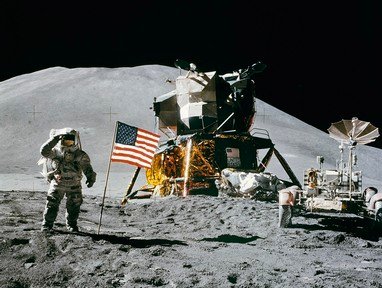
When Apollo 15 was announced, it was initially planned as the last of the so-called H-missions, which would feature a two-day stay on the Moon, and astronauts primarily traversing the surface on foot. However, cancellations saw the mission moved to become the first J-mission, with the stay on the Moon extended to three days, longer and more EVAs, and the presence of the Lunar Rover. To that end, the flight also utilised the first extended duration Lunar Module, LM-10, which was given the name Falcon. Part of the material that Falcon carried was a pair of falcon feathers, partly in recognition of the fact that all three crew members were from the US Air Force. One of the falcon feathers was also used in a famous experiment, where Dave Scott, the flight's commander, demonstrated Galileo's theory that objects fall at the same rate in the absence of aerodynamic drag, no matter their mass - Scott used one of the feathers alongside one of his geology hammers, dropping both at the same time, with them hitting the ground simultaneously.
8. Apollo 16 - Orion: A total of four films produced and distributed by Orion Pictures have won the Best Picture Oscar (as of 2026). Which of the four ultimately won the most Oscars?

Answer: Amadeus

Orion Pictures was originally founded in 1978 by three former executives of United Artists. The company was founded primarily as a production house, with its founders signing a distribution deal with Warner Brothers. Subsequently, it agreed deals with artists, directors and writers and, by the end of its first year, had fifteen pictures in production, with its first, "A Little Romance", released in April 1979. By 1982, Orion had split with Warner and begun to distribute its own films, with several proving to be box office successes. In 1984, one of its releases, an adaptation of Peter Shaffer's play "Amadeus", directed by Milos Forman, about the relationship between the composers Mozart and Salieri, was released to significant success, taking in close to $100m worldwide. At the 57th Academy Awards, the film was nominated for a total of eleven, ultimately winning eight, including Best Picture, making it the first Orion picture to win the accolade. Two years later, Oliver Stone's Vietnam War drama "Platoon" received eight nominations, winning five; 1990's "Dances With Wolves" received twelve nominations and won seven, while the following year's "The Silence of the Lambs" had seven nominations, winning five.

The choice of name for the spacecraft that would land on the Moon as part of Apollo 16 was entrusted to the two men that would walk there, Commander John Young and Lunar Module Pilot Charlie Duke. The pair looked for a name that was connected with the stars, and centered on one of the most prominent constellations visible from Earth, which would also be visible to the crew throughout their trip to the Moon. Additionally, the name was determined to be easy to pronounce and transmit. As a result, LM-11 was christened as Orion.
9. Apollo 17 - Challenger: In 1994, the 46-year old George Foreman regained the World Heavyweight championship as the challenger in a title fight against which reigning champion?

Answer: Michael Moorer

Having won the 1968 Olympic heavyweight title, George Foreman's professional career began in 1969, and led to his winning the world title by beating Joe Frazier in Kingston, Jamaica in January 1973. He defended the title twice before facing Muhammad Ali in 'The Rumble in the Jungle' in October 1974. Although he sought a rematch, he never fought Ali again. In 1976, a comeback saw him win the vacant NBAF heavyweight title; however, a loss to Jimmy Young in March 1977 saw him retire, ostensibly for good. Unwell in the period after the Young fight, he had a near-death experience that led him to discover God and become a born-again Christian, becoming an ordained minister. But, in 1987, he announced a return to the ring, primarily as a way of raising money for a youth centre he had founded. This comeback included a fight against champion Evander Holyfield for the world title in 1991 that was unsuccessful. In 1994, he gained another world title opportunity by directly challenging then WBA and IBF champion Michael Moorer. At 19 years the champion's senior, there seemed little jeopardy for Moorer who, for the first nine rounds, easily outboxed Foreman. Then, in the 10th, Foreman came back, getting a number of hits in before a short right hand caught Moorer on the chin and knocked him out. As a result, 20 years after first losing the title to Ali, Foreman became world heavyweight champion at the age of 45, the oldest challenger to ever win the title.

The crew of Apollo 17 looked to commemorate the American people for their support of the Apollo programme in the naming of the two spacecraft. Initially, LM-12 was christened Heritage; the crew however sought a better name, and focused on Challenger, which Commander Gene Cernan said "seemed to describe more of what the future for America really held...a challenge". Challenger was the final lunar module to fly, as landing missions following on from Apollo 17 were ultimately cancelled. As a result, the name was evoked again, this time by Lunar Module Pilot Harrison Schmitt as he stepped down from Challenger onto the lunar surface and said "I think the next generation ought to accept this as a challenge. Let's see them leave footprints like these."
10. A total of eight of the nine Lunar Modules made a trip as far as the Moon, with six ultimately landing. Which is the only one of these whose ascent stage is known to have survived?

Answer: Snoopy

Apollo 10 was flown as the "dress rehearsal" for the first lunar landing. As a result, Snoopy was not fully fueled - once the spacecraft had been taken down to as close as 9 miles from the surface, the flight plan called for the crew to jettison the descent stage and use the ascent stage to return to orbit to rendezvous with the Command Module, Charlie Brown. Once Snoopy had rendezvoused with Charlie Brown and the crew transferred over, the Lunar Module was jettisoned and its engine fired again, burning off its remaining fuel and putting it into a heliocentric orbit around the Sun. Snoopy was not tracked after 1969, and contact with it was lost. However, in June 2019 the Royal Astronomical Society announced that an asteroid given the name 2018 AV2 had been identified with 98% certainty as the missing Apollo 10 Lunar Module. As of 2026, Snoopy is the only formerly crewed spacecraft to remain in space unmanned.

Of the other Lunar Modules that made a trip to the Moon, Aquarius made it back to Earth having been used as a 'lifeboat' during the flight of Apollo 13, and burned up in the atmosphere over Fiji, while Eagle likely made an uncontrolled impact onto the lunar surface after it was released, although there is speculation that it may have survived. The others were all used to aid the seismological experiments left on the surface by having their engines fired and being steered deliberately at the Moon, which created tremors that were picked up by the seismographs left by the astronauts as part of the Apollo Lunar Surface Experiments Packages (ALSEP) instruments left during each mission.
Source: Author Red_John

This quiz was reviewed by FunTrivia editor ponycargirl before going online.
Any errors found in FunTrivia content are routinely corrected through our feedback system.
Related Quizzes
1. After Neil and Buzz Average
2. Apollo 1 Difficult
3. Apollo 10 Average
4. Apollo 11 Tough
5. Apollo 11 - Four Decades Ago Average
6. Apollo 11: The Lunar Expedition Average
7. Apollo 12 Average
8. Apollo 13 Tough
9. Apollo 13 Difficult
10. Apollo 14 Tough
11. Apollo 15 Average
12. Apollo 16 Tough

3/16/2026, Copyright 2026 FunTrivia, Inc. - Report an Error / Contact Us