FREE! Click here to Join FunTrivia. Thousands of games, quizzes, and lots more!
You Can Do More on the Moon than Moonwalk Quiz
The Apollo astronauts got up to quite a few hijinks during their extraterrestrial visits. Here's a mix of some real and some fake. Pick out the genuine oddities, anomalies, and firsts from the surface of Luna.
A collection quiz
by etymonlego.
Estimated time: 3 mins.
Click on things astronauts did on the moon during the Apollo landings.
There are 10 correct entries. Get 3 incorrect and the game ends.
Dissected a pig's heartThrew an improvised javelinAttempted to communicate with Earth telepathicallyBuried Buzz Aldrin up to his neck in moon dustPerformed the rite of communionTook a napSmuggled a golf club to the surfaceDropped a Slinky down the lander's ladderDropped a feather and a hammerHid a memorial to dead astronautsHeld a Grand Prix in the roverRuined the TV camera using sunlightJousted on lunar roversSecretly planted a baobab treeLeft a wheel of Roquefort cheese to ageWon a $500 betBroke the sound barrier with a golf ball
Left click to select the correct answers. Right click if using a keyboard to cross out things you know are incorrect to help you narrow things down.
Each Apollo landing was longer than the last: Apollo 11 spent less than a full day on the moon, while Apollo 17 stayed for more than three days. The astronauts spent only a portion of each landing outside the lunar module (about a third of the total time for most of the landings).
When they weren't moonwalking, NASA required the astronauts to sleep - or at least try to sleep. Success varied from astronaut to astronaut and mission to mission. The Apollo 11 crew tracked an incredible amount of moon dust into the module and had to sleep with their helmets down, which made their suits even colder. Aldrin told NASA he only managed "mentally fitful drowsing"; Armstrong didn't sleep at all. Apollo 12 was the first to plan for the bad sleeping conditions: they brought hammocks.
The hours of waiting prompted Aldrin to relieve his boredom another way. On the moon, he observed the rite of communion in the Presbyterian fashion. He called on "each person listening in" to "give thanks in his own individual way," then took the ceremonial bread and wine, the first food eaten on the moon. It was never actually broadcast on TV: NASA was still embroiled in a lawsuit for reading from the Bible on Apollo 8!
The $500 bet was won by the third man on the moon, Pete Conrad of Apollo 12, as soon as he stepped out of the lander. An Italian journalist accused the astronauts of being coached on what to say, so Conrad bet her he'd make his first words something ridiculous. They were: "Whoopee! Man, that may have been a small one for Neil, but that's a long one for me." ("Small" because Conrad was a short guy, 5'6'' tall.) The journalist never paid out.
Also on Apollo 12, a new camera setup (on a stand instead of built into the module) ruined the entire broadcast. While setting up the camera, Alan Bean accidentally pointed the lens at the sun for a few seconds, and there was no backup. This event has actually been blamed for declining viewership of the Apollo missions. As penance, Bean went on to produce several paintings depicting the events of Apollo 12.
Apollo 13 never made it to the moon, but Apollo 14 made up for it. Alan Shepard's famous golf swings were done without NASA's foreknowledge, and he smuggled his collapsible club in a sock. Shepard said into the comms the balls went for "miles and miles and miles," but his partner, Edgar Mitchell, said it went "about 4 inches" shorter than his improvised javelin throw. Mitchell broke off a piece of equipment from an experiment and threw it a few dozen yards/meters (no one is sure how far). So you can say it was Mitchell who "won" the "lunar Olympics."
That wasn't Mitchell's only off-script idea. He arranged for an experiment in extrasensory perception, attempting to communicate symbols on Zener cards to four Earthlings - think the beginning of "Ghostbusters," just much further away. Mitchell claims the subjects performed slightly better than chance. After he left NASA, Mitchell founded the Institute for Noetic Studies (the one later featured in a Dan Brown book).
Apollo 15 saw even more unauthorized activity. David Scott and Alfred Worden secretly placed a plaque with the names of fourteen space explorers who perished, along with a 3.5-inch statue, "Fallen Astronaut," designed by Paul Van Hoeydonck. Astronauts and cosmonauts alike are memorialized. The statue is still there - a replica is at the Smithsonian.
On to a story that went as NASA planned. Speaking directly to the TV camera, David Scott demonstrated Galileo's (at the time, hypothetical) experiment, that any two objects in a vaccuum will fall at the same rate regardless of mass. "One of the reasons we got here today was because of a gentleman named Galileo, a long time ago [...] and we thought, 'Where would be a better place to confirm his findings than on the moon?'" As expected, both objects hit the ground at the exact same time. "How 'bout that?"
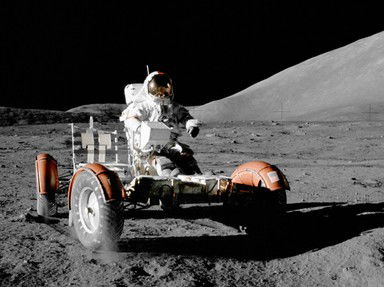
Finally, a little something neither NASA nor the astronauts planned. John Young of Apollo 16 put the lunar rover through its paces in what was dubbed the "Lunar Grand Prix." He maxed out the brakes, the steering, and the speed, reaching its astonishing top speed of 8 mph (that's just under 10 km/h). At one point he hit a crater and went completely airborne for a split-second, the first lunar stunt jump. Young is not the offworld land speed record-holder though: Eugene Cernan of Apollo 17 achieved 11, possibly even 12, mph.
This quiz was reviewed by FunTrivia editor gtho4 before going online.
Any errors found in FunTrivia content are routinely corrected through our feedback system.