FREE! Click here to Join FunTrivia. Thousands of games, quizzes, and lots more!
Detectives' Domiciles Trivia Quiz
Can you match each of these fictional detectives with their primary place of residence? Some of them travel a bit, but the map shows where they are based.
A label quiz
by looney_tunes.
Estimated time: 3 mins.
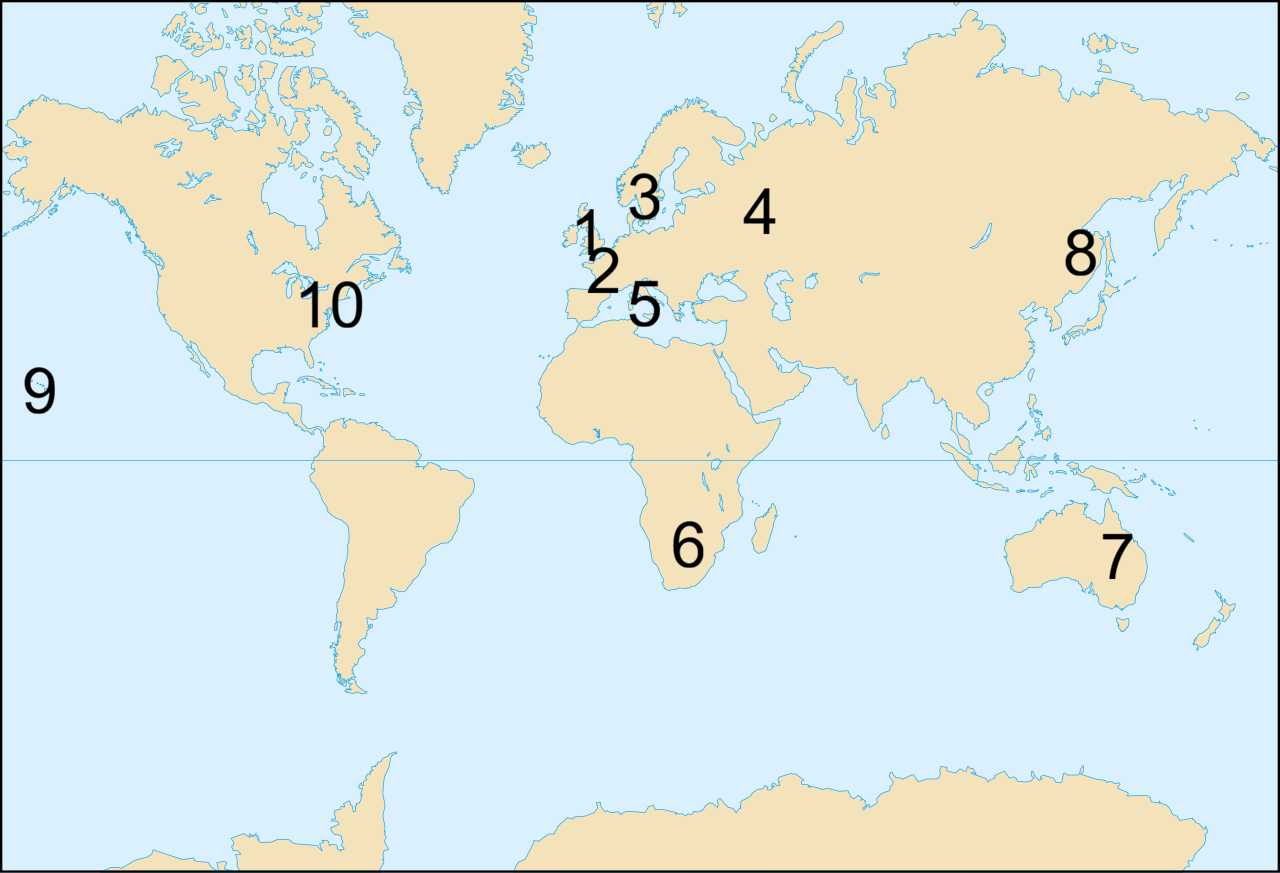
C. Auguste DupinMme Precious RamotsweSherlock HolmesInspector Chen CaoNapoleon 'Bony' BonaparteInspector MontalbanoArkady RenkoNero WolfeKurt WallanderCharlie Chan* Drag / drop or click on the choices above to move them to the answer list. View Image Attributions for This Quiz
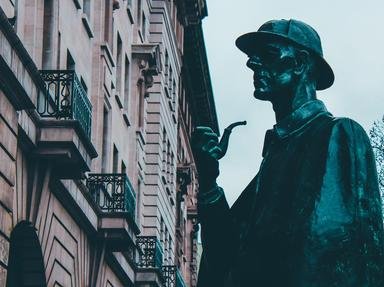
Since this quiz was inspired by the final stop on the Globetrot Trivia 7 challenge, at 221B Baker Street, it is only fitting that we start there, at the home of perhaps the most famous detective of all time, Sherlock Holmes. His residential address is stated in the first story to appear in print, 'A Study in Scarlet' (1887), and many of the four novels and 56 short stories written by Sir Arthur Conan Doyle about his adventures refer to the residence, often starting in his rooms. For a long time he shared the rooms with Dr Watson, the sidekick who is ostensibly recounting most of the stories; In the first novel, this arrangement is undertaken from financial need, but it clearly suited them both - until Watson married and set up his own establishment.
Sherlock Holmes is known for his keen observation of even the most minute details, and his ability to apply logical deduction in arriving at his sometimes surprising (but almost always correct) conclusions. Since his investigations took place in the Victorian and Edwardian eras, he did not have the benefit of the kind of technology available to the modern forensics experts - but his magnifying glass, microscope and chemical analysis skills allowed him to demonstrate forensic skills at the (then) forefront of criminal investigation.
2. C. Auguste Dupin
Edgar Allan Poe's Chevalier Auguste Dupin (a title indicating that he is a knight in the French Legion of Honor) does not call himself a detective - indeed, that concept did not yet really exist yet - but he is generally recognised as the prototype of the gentleman detective, and the inspiration for the creation of Sherlock Holmes, among others to follow in his tracks.
Dupin's first appearance was in the 1841 short story 'The Murders in the Rue Morgue', where his activities were described as ratiocination, the application of logical thought to find the solution to an intriguing puzzle, in assisting the gendarmerie with intractable cases. This case (and the other two in which he appears, an astonishingly small body of work for such an influential character) established a number of tropes that became common in the area of detective fiction that was starting to develop: the narrator friend, the inept police, the announcement of the solution that is then followed by an explanation of the logic that led to it.
3. Kurt Wallander
The Swedish police inspector Kurt Wallander, the creation of Henning Mankell, officially resides at Mariagatan 11C, 271 40 Ystad, Sweden. Fans of the multiple television series that have brought him to the screen have turned the town into a tourist attraction, with tours pointing out the various places mentioned in the novels as he goes about his business. Like Cabot Cove, Ystad is a town with an amazing amount of crime, which keeps the police busy. Wallander first appeared in the 1991 novel 'Mördare utan ansikte' (translated into English in 1997 by Steven T. Murray as 'Faceless Killers'), which won the inaugural Glass Key Award for crime writers from Nordic countries.
Wallander is a police detective, and often ponders on the grim nature of his job, and how contemporary social problems are manifested in the events. He is 42 when we first meet him (although some later instalments of the series take us back to earlier years), a divorced man with a troubled relationship with his adult daughter - and his relationship with his father wasn't all that great, either. After he kills a man in the line of duty (in 'The Man Who Smiled'), he becomes increasingly depressed, eating and drinking and smoking too much; he considers resigning, but hangs in there. His daughter joins the police in the later novels, and his personal battles expand to involve medical problems of diabetes and developing Alzheimers disease.
4. Arkady Renko
Martin Cruz Smith first brought us Arkady Renko in the 1981 novel 'Gorky Park', in which he was a chief investigator in charge of homicide for the Moscow police. In later novels, his work sees him travel to other parts of the USSR (and internationally) in the course of his work, but he is fundamentally based in Moscow. The eleventh and final novel, 'Hotel Ukraine', was published in 2025, days before the author's death.
Arkady is in frequent conflict with his father, who was a Red Army General under Stalin (and who remains a staunch Stalinist after retirement) nicknamed 'the Butcher of Ukraine'. His father would sees the career of a policeman as less worthy than the military or politics, and Arkady's determined exposure of corruption and malfeasance among members of the elite stratum of communist society known as the nomenklatura, of which he is himself, by birth, a member. Each novel deals with perceived political issues relating to the contemporary regime, from the first trilogy following the seemingly-inevitable downfall of the USSR to the final novel exploring atrocities associated with the Russian invasion of Ukraine.
5. Inspector Montalbano
Andrea Camilleri wrote about this Sicilian police officer, chief of police in the fictional town of Vigata, in a mixture of Italian, formal Sicilian, and Sicilian-Italian, to reflect the multiple layers of society with which Salvo Montalbano must deal. Unlike many detective protagonists, he is not a daring and dedicated pursuer of justice, but an irritable middle-aged man coping with the vicissitudes of his job. The English translations of the books by Stephen Sartarelli retain the mixture of Italian and Sicilian in parts of the dialogue, to convey that same cultural clash between various characters. The first novel, 'La forma dell'acqua', was published in 1994, and translated into English as 'The Shape of Water' in 2002.
An Italian television series adapting the books, 'Il commissario Montalbano', ran from 1999 until 2021, with 37 episodes covering all the published novels and short stories. English dubbings and subtitled Italian versions are available in various places. While the early episodes do not follow the publication order of the books (and there is no real reason why they should, as the events are independent), they do finish with an adaptation of the last completed book, 'Il metodo Catalanotti' ('The Sicilian Method'); the final two books were completed and published posthumously, and not adapted to television.
6. Mme Precious Ramotswe
Due to the constraints of locating detectives around the world, only one female detective made her way into this quiz, but what a woman! In the first novel of Alexander McCall Smith's books featuring her, 'The No. 1 Ladies' Detective Agency', Precious Ramotswe uses the money she inherits from the father she had lived with and cared for over many years to set herself up as a private detective, moving to Botswana's capital, Gabarone, to do so. Subsequent novels follow her as she takes on cases (usually for women who are not taken seriously by male PIs) which she solves by using her understanding of human nature - what she calls intuition and common sense. Her personal life also becomes increasingly complex, and the mysteries are often more of a plot device to further character development in the expanding circle of her family and friends than a seriously challenging mystery.
The first novel was published in 1998, and have been coming out roughly one a year ever since. As of 2026, there are 25 books in the series, which has won numerous rewards, including the 2004 Crime Writers' Association Dagger in the Library Award. This award is given to "the author of crime fiction whose work is currently giving the greatest enjoyment to readers", and is voted on by UK librarians.
7. Napoleon 'Bony' Bonaparte
Arthur Upfield's first novel about Detective Inspector Napoleon 'Bony' Bonaparte, 'The Barrakee Mystery', was published in 1929, and took place in outback New South Wales (near the Queensland border, which is why the Queensland police despatched a specialist to assist the NSW force). Bony is portrayed as a character who is ambivalent about himself and his place in society - not surprising given what we learn about his background. He was born at a time when the relationship between his white father and his Aboriginal mother (details of her people are skimmed over) was illegal. He was taken from his dead mother's arms as a young child and raised by nuns, gaining a BA and joining the Queensland police force.
Bony uses his white training and his black tracking skills to find clues and solve mysteries that others cannot. When I first read these books, in the 1970s, I found them quite cringeful as they dealt with this, but 50 years earlier readers were clearly not disturbed by it. And the actual mysteries remain intriguing. Because the Australian outback is so vast, he often finds himself seconded to work in other states, allowing Upfield to use a variety of locations for the setting of his novels, but remains a member of the Queensland force.
The series has been adapted for television twice, both times with some controversy over casting. In 1971 'Boney' (sic) cast New Zealand actor James Laurenson in the title role, wearing dark makeup. In a 1990 telemovie and 1992 series, the character was reimagined as a white man who had been raised by Aboriginal people, to explain his skills; the role was played by Cameron Daddo.
8. Inspector Chen Cao
Qiu Xialong's 'Death of a Red Heroine', first published in 2000, won the 2001 Anthony Award for best first novel. It introduced Chief Inspector Chen Cao of the Shanghai Police Bureau, whose position there was a diversion from his originally-planned diplomatic career. That career was derailed when his uncle was revealed to be counter-revolutionary, and the political tensions in China during the 1990s are integral to the inspector's investigations.
Qiu Xialong was born in Shanghai, and was in the United States doing research for a book about TS Eliot when the 1989 Tiananmen Square massacre caused him to decide to remain in the US - and start writing in English. The novels in the Inspector Chen Cao series are written in a style to reflect traditional Chinese writing conventions such as the use of epigrammatic poems (written by the inspector, in most cases) at the start and end of the chapter and the inclusion of quotes from Confucius. In 2003 'Death of a Red Heroine' was translated into Chinese as 'Hong ying zhi si', with the city changed to an unnamed location, and some of the more stringent observations of Chinese politics modified.
9. Charlie Chan
Earl Derr Biggers based his fictional detective on a real Chinese-Hawaiian detective named Chang Apana, about whom he read while visiting Hawaii to write 'The House Without a Key' in 1925. He has said that he specifically created the character to counteract the then-popular trope of the Asian villain (such as Fu Manchu) and concern about the possible threat posed by the large population of China which he saw all around him when he moved to California. Charlie Chan is an amiable, yet astute and heroic as needed, character, who appealed to the audience of his time. Modern critics, however, tend to see him as being a different racial stereotype - he may not be a threatening villain, but he is still unable to master the English language, and subservient in demeanour.
These criticisms are based at least as much on the character's portrayal in film and television as on his appearance in Der Biggers' six novels. some early films featuring Asian actors (and with Chan a secondary character) were unsuccessful, but between 1931 and 1938 the Swedish-American actor Warner Oland (who had previously portrayed Fu Manchu) starred in 16 Charlie Chan films. Following his death, another 22 films starring Sydney Toler were made; when he also died, Roland Winters took on the role for the final six films in the late 1940s. Although his Chinese heritage was integral to the character, it was not until 1972 that a Hannah-Barbera animated series called 'The Amazing Chan and the Chan Clan', which focused on his children, had Charlie Chan portrayed by a Chinese actor - Keye Luke, who had portrayed Chan's "Number One Son" Lee in a number of the films.
10. Nero Wolfe
To be precise, Nero Wolfe resides in a brownstone on West 35th Street, in the heart of Manhattan. He is famously unwilling to leave home, employing an assistant, Archie Goodwin, to do the footwork (and narrate most of the books). Wolfe solves the cases almost casually, while his active attention seems to be devoted to his orchids and the gourmet meals produced by his cook.
Rex Stout wrote 33 novels and 41 shorter works (novellas and short stories) featuring Nero Wolfe between 1934 and 1975, almost all set in Manhattan. In 1954's 'The Black Mountain', however, he visits his native Montenegro (a name whose English meaning is black mountain) to avenge the death of his compatriot and longtime friend Marko Vukcic.
To bring this quiz full circle, it has been suggested by some (Sherlock Holmes-obsessed) critics that there is a connection between Nero Wolfe and Sherlock Holmes - but the speculation offers a range of possibilities, and there is no evidence that Rex Stout actually had any such connection in mind, although Archie's desk does have a portrait of Holmes hanging above it. to give you an example of the type of evidence being explored, note the similarity of their names - Nero Wolfe and Sherlock Holmes have the same vowels in the same order. While speculation abounds about the possible literary backstory, one popular suggestion is that he is the product of an affair between Sherlock and Irene Adler in Montenegro in 1892.
This quiz was reviewed by FunTrivia editor MotherGoose before going online.
Any errors found in FunTrivia content are routinely corrected through our feedback system.