FREE! Click here to Join FunTrivia. Thousands of games, quizzes, and lots more!
Quiz about Wicked Ladies

Wicked Ladies Trivia Quiz

In Praise of Anti-Heroines

Literature abounds in morally grey female characters who are often more memorable than the "good" ones. Prostitution, questionable politics, obsession, psychological manipulation, murder... this quiz has it all. Spoilers ahead!

A matching quiz by LadyNym. Estimated time: 4 mins.
  1. Home
  2. »
  3. Quizzes
  4. »
  5. Literature Trivia
  6. »
  7. Literary Characters
  8. »
  9. Fictional Females

Author
LadyNym
Time
4 mins
Type
Match Quiz
Quiz #
424,076
Updated
May 26 26
# Qns
10
Difficulty
Average
Avg Score
8 / 10
Plays
43
Last 3 plays: bchilds1996_ (0/10), Guest 201 (5/10), califpete (8/10).
(a) Drag-and-drop from the right to the left, or (b) click on a right side answer box and then on a left side box to move it.
QuestionsChoices
1. A willful, spoiled young woman, she unwittingly rejects the man she loves and who loves her passionately to marry for status   
  Scarlett O'Hara ("Gone with the Wind")
2. Obsessed with her cousin's husband, this strong-willed but self-absorbed lady ends up pushing away the only man who truly loves her   
  Cleopatra ("Antony and Cleopatra")
3. A teacher at a girls' school, this lady gives her students lessons about rather unconventional topics, such as her own love life and fascism   
  Catherine Earnshaw ("Wuthering Heights")
4. Haunted by her father's murder, a young princess plots with her brother to kill their mother and her lover in revenge  
  Electra ("The Libation Bearers")
5. A former prostitute with a successful career as a brothel owner, this lady finds herself at odds with her educated, independent daughter  
  Estella ("Great Expectations")
6. Orphaned at a young age, this lady manipulates the people around her to climb the social ladder by using her intelligence and feminine wiles  
  Agrafena "Grushenka" Svetlova ("The Brothers Karamazov")
7. An experienced, charismatic woman, she manipulates her lover with her peerless seductive powers, leading to his and her own downfall  
  Gertrude, the Nun of Monza ("The Betrothed")
8. Forced into religious life by her father, a young noblewoman embarks on a secret love affair that culminates in blackmail and murder  
  Becky Sharp ("Vanity Fair")
9. A beautiful orphan, she is raised to break men's hearts by her adoptive mother in revenge against all men  
  Kitty Warren ("Mrs Warren's Profession")
10. Bitter towards men, this beautiful, seductive young woman unleashes a fierce rivalry between a dissolute older man and her hot-headed eldest son  
  Jean Brodie ("The Prime of Miss Jean Brodie")


Select each answer

1. A willful, spoiled young woman, she unwittingly rejects the man she loves and who loves her passionately to marry for status
2. Obsessed with her cousin's husband, this strong-willed but self-absorbed lady ends up pushing away the only man who truly loves her
3. A teacher at a girls' school, this lady gives her students lessons about rather unconventional topics, such as her own love life and fascism
4. Haunted by her father's murder, a young princess plots with her brother to kill their mother and her lover in revenge
5. A former prostitute with a successful career as a brothel owner, this lady finds herself at odds with her educated, independent daughter
6. Orphaned at a young age, this lady manipulates the people around her to climb the social ladder by using her intelligence and feminine wiles
7. An experienced, charismatic woman, she manipulates her lover with her peerless seductive powers, leading to his and her own downfall
8. Forced into religious life by her father, a young noblewoman embarks on a secret love affair that culminates in blackmail and murder
9. A beautiful orphan, she is raised to break men's hearts by her adoptive mother in revenge against all men
10. Bitter towards men, this beautiful, seductive young woman unleashes a fierce rivalry between a dissolute older man and her hot-headed eldest son

Most Recent Scores
Today : bchilds1996_: 0/10
Today : Guest 201: 5/10
Today : califpete: 8/10
Today : Guest 69: 10/10
Today : krajack99: 10/10
Today : Guest 82: 5/10
Today : Guest 46: 10/10
Today : debbitts: 8/10
Today : Gina16: 8/10

Quiz Answer Key and Fun Facts
1. A willful, spoiled young woman, she unwittingly rejects the man she loves and who loves her passionately to marry for status

Answer: Catherine Earnshaw ("Wuthering Heights")

Often hailed as an uber-romantic story of star-crossed love, Emily Bronte's "Wuthering Heights" (1847) is a Gothic tale of obsession and revenge that might have been penned by Edgar Allan Poe, driven by two rather unsympathetic main characters. While Heathcliff has frequently been described as the ultimate Byronic hero, Catherine Earnshaw (referred to as Cathy) is in many ways his female counterpart - self-centred and somewhat mentally unstable, driven by passions as wild and uncontrollable as the weather that gives her home its ominous name.

Indeed, as Cathy herself states in a famous passage of the novel, her soul and Heathcliff's share the same nature; he is always in her mind, not as a pleasure, but as her own being. In modern terms, their relationship would be called toxic and codependent. In the same speech, Cathy tells Nelly, the housekeeper of Wuthering Heights and the main narrator of the story, about a dream she had of being in heaven and being so desperately unhappy that the angels threw her back down to earth.

Though she only appears in the first half of the novel, Cathy's presence pervades the story. Trying to find a measure of peace, as well as improve her social status, the 17-year-old girl marries the wealthy, gentlemanly Edgar Linton. Heathcliff's unexpected return when she is pregnant drives Cathy half-insane, and she dies in childbirth. Her death unleashes Heathcliff's revenge on both the Linton and Earnshaw families, feeding into his obsession with her. Increasingly haunted by Cathy's ghost, he disturbs her grave twice, and is eventually found dead in her old room - ending the cycle of hatred and revenge and allowing the younger generation to find their own happy ending.
2. Obsessed with her cousin's husband, this strong-willed but self-absorbed lady ends up pushing away the only man who truly loves her

Answer: Scarlett O'Hara ("Gone with the Wind")

The protagonist of Margaret Mitchell's only novel (published in 1936), Scarlett O'Hara is one of literature's most famous anti-heroines - not quite a villainess, but definitely grey in the moral stakes. The daughter of a hotheaded Irish immigrant and a lady of French ancestry, Scarlett is spoiled and headstrong, and likes to toy with men's affections - in particular after Ashley Wilkes, her county neighbour, shuns her in favour of her cousin Melanie. She marries her first husband (Melanie's brother) out of spite, acting recklessly when still expected to be in mourning for him after his death in the Civil War.

One of Scarlett's few saving graces is her deep love for Tara, her family plantation, which she will stop at nothing to save from ruin during the war and in its aftermath. This includes scheming to marry her younger sister's wealthy fiancé in order to pay the exorbitant taxes levied on the plantation. After her second husband is killed during a Ku Klux Klan raid, Scarlett marries notorious gambler Rhett Butler, who has been her admirer for many years. Their marriage is nothing short of tempestuous, as Scarlett - still infatuated with Ashley - is blind to Rhett's love. When she finally realizes her own feelings towards her husband, it is too late... The well-known ending of the novel, however, leaves things open for the two characters.

While Mitchell steadfastly refused to write a sequel, one was published in 1991, simply titled "Scarlett" and written by Alexandra Ripley with the authorization of Mitchell's estate. Needless to say, this novel gives Scarlett and Rhett the happy ending that was conspicuously absent in the original.
3. A teacher at a girls' school, this lady gives her students lessons about rather unconventional topics, such as her own love life and fascism

Answer: Jean Brodie ("The Prime of Miss Jean Brodie")

The titular character of Muriel Spark's 1961 novel, Jean Brodie (based on one of the author's teachers at high school) is a woman who likes to describe herself as being in her prime, working as a teacher at Edinburgh's Marcia Blaine School for Girls. The action starts in the 1930s, when Brodie is in charge of a group of six 10-year-old girls who will become known as the "Brodie set", an elite group that she proceeds to mould in her image, adopting a very unconventional teaching approach for the times. While her ideas about education (intended in its original meaning of "leading out") might not sound outlandish in the 21st century, her controlling, manipulative nature eventually leads to her downfall.

What puts Brodie at odds with the school's headmistress is not only her rather colourful private life (she is in a relationship with one of her colleagues, but pines for another, who is married), but her manipulation of her charges into believing they are better than the rest, and - of course - her overt attraction to fascism. Literary critics have also pointed out her rather delusional belief in her own infallible judgment: in fact, the girl Brodie chooses as her special confidante, Sandy Stranger, compares her to the God of Calvin, who chooses his elect solely according to his will and not because of their inherent qualities. Rejecting both Calvinism and Brodie, Sandy will convert to Catholicism and become a nun: before that, however, she betrays her former teacher to the headmistress for Brodie's fascist sympathies, causing her dismissal.
4. Haunted by her father's murder, a young princess plots with her brother to kill their mother and her lover in revenge

Answer: Electra ("The Libation Bearers")

In Greek mythology, Electra ("amber") was one of the daughters of Agamemnon, king of Mycenae, and his wife Clytemnestra, Helen's half-sister. Electra's sister Iphigenia had been sacrificed to Artemis by her father prior to the start of the Trojan War, angering Clytemnestra and leading her to take a lover - Agamemnon's cousin Aegisthus - and with him plan her husband's murder. Absent from Mycenae at the time of her father's death, Electra was devastated and wanted to avenge him: her brother Orestes' return home provided her with the perfect opportunity.

One of the most powerful female characters in the history of literature, Electra has a prominent role in a number of works, both ancient and modern. The three great Ancient Greek tragedians of the 5th century BC all wrote about her: Aeschylus, the oldest of the three, in "The Libation Bearers", the second play in the "Oresteia" trilogy, while Sophocles and Euripides both wrote tragedies titled after her. In Aeschylus' tragedy, Electra is more nuanced than in the two later plays. She meets Orestes while bringing libations - sent by Clytemnestra in the hopes of appeasing Agamemnon's ghost - to her father's tomb. Though yearning for revenge, and incited by the chorus, she is reluctant to take an active role in the killing of her mother, no matter how much she despises her. She thus relies on her brother and his friend Pylades to do the deed. On the other hand, Sophocles' Electra is a veritable avenging angel, consumed by hatred for her mother and obsessed with the idea of revenge. Euripides' interpretation of the character is cold and rational, and sees revenge as a necessity - going as far as to be the one to arrange Clytemnestra's death.

Such an intense female figure - conflicted and ruthless at the same time - has left her mark in the field of psychology with the Electra complex theorized by Carl Gustav Jung, in which a girl competes with her mother for sexual possession of her father.
5. A former prostitute with a successful career as a brothel owner, this lady finds herself at odds with her educated, independent daughter

Answer: Kitty Warren ("Mrs Warren's Profession")

Like most other plays by George Bernard Shaw, "Mrs Warren's Profession" (1893) strongly focuses on social and political issues - in this case, the hypocrisy of Victorian society regarding women's path to financial independence and the double standard with which prostitution was regarded. Not surprisingly, the play's frank discussion of the issue sparked much controversy, leading to it being banned from public performance in the UK until 1925. At the centre of "Mrs Warren's Profession" lies the conflicted relationship between Kitty Warren, a former prostitute who now runs a successful chain of brothels throughout Europe, and her daughter Vivie, an emancipated young woman who has graduated from the University of Cambridge with high honours.

Though Kitty has always been a distant figure in Vivie's life, she arranges to visit the young woman at her country home to introduce her to a friend of hers. During Mrs Warren's visit, the two women have an argument, and Vivie learns of her mother's past. Born in poverty, after witnessing the sad fate of two of her sisters who led "respectable" lives, she follows the example of another sister and becomes a prostitute - eventually saving enough money to set up her own business. She defends her decision to Vivie, maintaining that marriage for upper-class women is also a form of sex work. Vivie is at first admiring of her mother's courage and strength of will, but quickly changes her mind when Kitty proudly states that she loves her work and has no intention of giving it up. Vivie refuses to accept the reality of her mother's life, accusing her of hypocrisy, and the two women part bitterly.
6. Orphaned at a young age, this lady manipulates the people around her to climb the social ladder by using her intelligence and feminine wiles

Answer: Becky Sharp ("Vanity Fair")

Rebecca (Becky) Sharp, the main character of William Makepeace Thackeray's satirical novel "Vanity Fair" (1847-1848), is one of literature's greatest anti-heroines. The daughter of an English art teacher and a French opera dancer, Becky loses her parents at a young age, and is left to make her way in the society of Regency-era England - which she does by any means necessary. Portrayed as a consummate social climber, she is not a raving beauty, but uses her wit, intelligence and artistic talent to her advantage, especially in her dealings with men.

In the novel, the amoral, manipulative Becky has her foil in Amelia (Emmy) Sedley, a pretty, sweet-natured but not very bright, upper-class girl who marries a dashing, selfish young officer and is left a widow by his death in the battle of Waterloo. While the long-suffering Amelia gets her own happy ending of sorts, Becky's machinations eventually backfire, landing her in dire financial straits - from which, however, she bounces back, albeit through the implied murder of her second husband (Amelia's gullible but wealthy brother) and prostitution.

Because of her larger-than-life personality and boundless vitality, Becky Sharp has been described as the heroine of a picaresque novel, who makes her way into a corrupt society by her wits and less than admirable means. Her character is believed to have been inspired by a number of notorious women of the late 18th century and the Regency era - including Madame du Barry, the last mistress of King Louis XV of France.
7. An experienced, charismatic woman, she manipulates her lover with her peerless seductive powers, leading to his and her own downfall

Answer: Cleopatra ("Antony and Cleopatra")

The heroine of William Shakespeare's historical tragedy "Antony and Cleopatra" (first performed in 1607) is an extremely well-rounded, realistic character with a multifaceted personality - overambitious, self-absorbed and histrionic, but also deeply in love with Antony. While she is portrayed as a consummate seductress who manipulates men with her wiles, she is also a leader capable of commanding devotion from her subjects: her two faithful handmaidens, Charmian and Iras, follow her in death. Cleopatra's luxurious lifestyle and exotic court sharply contrast with the austerity of military-inclined Rome. Indeed, the respectable Roman maiden Octavia, Antony's fourth wife, stands no chance if compared with the Egyptian queen's powers of seduction - as Enobarbus, Antony's lieutenant, points out in one of the tragedy's best-known passages.

In the second half of the play, Cleopatra's ambition gets the better of her, putting her at odds with Antony, who is so humiliated and angry at her unpredictable behaviour that he plans to kill her. Cleopatra's ploy of pretending to have committed suicide to regain Antony's love backfires and leads to his death. Cleopatra redeems herself in her darkest hour, when grief at her lover's loss and her royal pride push her to choose death rather than humiliation as a Roman captive. The lovers' tragic fate earns the respect of Octavius, their enemy, who recognizes their greatness.

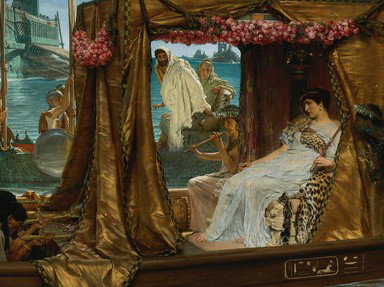
The cover photo of this quiz, a painting by Lawrence Alma-Tadema, depicts the first meeting of Antony and Cleopatra, described by Enobarbus in Act II, Scene II of the play.
8. Forced into religious life by her father, a young noblewoman embarks on a secret love affair that culminates in blackmail and murder

Answer: Gertrude, the Nun of Monza ("The Betrothed")

Though she appears in only five chapters of Alessandro Manzoni's historical novel "The Betrothed" (1827), Gertrude, the Nun of Monza, is probably the most memorable character of Manzoni's masterpiece, easily overshadowing the heroine, the virginal Lucia, with her commanding presence and tragic backstory. Her character is based on a real historical figure, a young woman named Marianna de Leyva y Marino, the daughter of a Spanish nobleman, who was forced to become a nun and spent 14 years walled in her cell after the scandal in which she was involved came to light.

What makes Gertrude so striking is Manzoni's chillingly accurate description of the psychological violence she is subjected to by her family, in particular her father, from a very young age. Her backstory is narrated in exquisite detail, up to the point in which she is seduced by the villainous Egidio, who lives next door to her convent in Monza. Manzoni chooses to leave the obvious unsaid but for a single but iconic sentence: "The unfortunate woman responded". When a novice catches wind of the affair and tries to blackmail Gertrude, it is implied that the nun and her lover arrange for her to be silenced forever.

The proud Gertrude befriends Lucia who - unwillingly pursued by a local nobleman - has sought refuge in her convent, seemingly fascinated by the young woman's purity and innocence. However, in keeping with her passivity in the face of adverse circumstances, the nun (who in the novel is referred to as "the Lady") is forced to betray Lucia to her enemies. After that, she disappears from the story, until at the end of the novel Lucia learns of her fate - which, she is told, Gertrude met willingly in repentance for her sins.
9. A beautiful orphan, she is raised to break men's hearts by her adoptive mother in revenge against all men

Answer: Estella ("Great Expectations")

In Charles Dickens' "Great Expectations" (1861), Estella - whose surname is never mentioned - is a beautiful girl whom wealthy Miss Havisham has adopted as her daughter after being left at the altar by her fiancé. The eccentric lady, who lives in squalor in her dilapidated house, still wearing her wedding dress, has made Estella the conduit of her hatred of all men, bringing her up to be a heartless tease who toys with men's feelings and spurns them when they have fallen in love with her. Pip, the novel's protagonist, falls in love with Estella, but the young woman remains indifferent to him, and warns him repeatedly not to expect anything from her. In fact, Estella is not only incapable of affection towards men, but is also cold towards her benefactress.

As unpleasant as Estella's hard-hearted attitude to Pip may be, the reader cannot help feeling sorry for her, since she has been given every material advantage by Miss Havisham, but also deprived of the ability to give and receive love. She eventually breaks Miss Havisham's hold on her by marrying a man only interested in her money, who abuses her. At the end of the novel, Pip meets the widowed Estella who asks for his forgiveness. A kind of happy ending for the pair is implied.

Estella's character is widely believed to have been inspired by Ellen Lawless Ternan, a young actress who was in a relationship (very likely platonic) with Dickens from 1857 until the author's death.
10. Bitter towards men, this beautiful, seductive young woman unleashes a fierce rivalry between a dissolute older man and her hot-headed eldest son

Answer: Agrafena "Grushenka" Svetlova ("The Brothers Karamazov")

In Fyodor Dostoevsky's novel "The Brothers Karamazov" (1880), Agrafena Alexandrovna Svetlova - known as Grushenka - is a beautiful 22-year-old woman with a rather shady past. After being jilted by a Polish officer, she became the protégée of an older, miserly merchant. In spite of the irresistible attraction she exerts over men, she also has the reputation of being unapproachable and keen to preserve her independence. Though she is mentioned various times at the beginning of the book as the cause of the conflict between Fyodor Pavlovich Karamazov, an unrepentant libertine, and his eldest son, Dmitri, her introduction in person occurs at the end of Book 3.

Described as a perfect example of Russian womanhood, with a voluptuous figure and pink and white complexion, in the novel she also provides a foil for the other main female character, Katerina Ivanovna Verkhotseva, Dmitri's proud, respectable fiancée, who eventually falls in love with Ivan, the middle Karamazov brother. The love triangle between Grushenka, Fyodor and Dmitri ends in tragedy when Fyodor is murdered and Dmitri (who is innocent) is convicted of the crime. By that time, however, Grushenka has realized that she truly loves Dmitri. Influenced by her friendship with the youngest of the Karamazov brothers, the gentle, compassionate Alexei, the hard-hearted temptress changes into a woman who is ready to leave everything behind to join her beloved in exile.
Source: Author LadyNym

This quiz was reviewed by FunTrivia editor LeoDaVinci before going online.
Any errors found in FunTrivia content are routinely corrected through our feedback system.
5/26/2026, Copyright 2026 FunTrivia, Inc. - Report an Error / Contact Us