FREE! Click here to Join FunTrivia. Thousands of games, quizzes, and lots more!
Quiz about Over There

"Over There!" Trivia Quiz

Songs of World War I

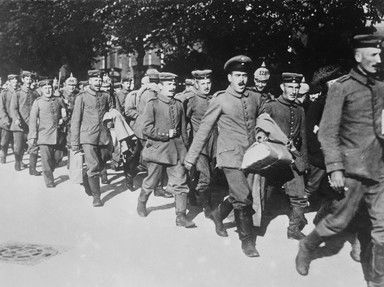
The world was at war, and soldiers slogged through landscapes fit for Hell with no end in sight. Luckily, there was music, the great escape from the Great War. Here are ten songs, sung in trenches and at home, that help capture the spirit of the times.

A multiple-choice quiz by JJHorner. Estimated time: 4 mins.
  1. Home
  2. »
  3. Quizzes
  4. »
  5. Music Trivia
  6. »
  7. History of Music
  8. »
  9. Music Associated with Wartime

Author
JJHorner
Time
4 mins
Type
Multiple Choice
Quiz #
422,435
Updated
Dec 24 25
# Qns
10
Difficulty
New Game
Avg Score
9 / 10
Plays
18
Last 3 plays: 7Kat7 (10/10), Calicokitten (8/10), invinoveritas (10/10).
- -
Question 1 of 10
1. This crude and sometimes bawdy British song about an innkeeper's daughter is thought to originate with the French Army in the 1830s and was resurrected during the Great War by British soldiers. Sometimes known as "Hinky Dinkey Parley-Voo" and first recorded by Jack Charman, what's the name of the song? Hint


Question 2 of 10
2. Written by Louis Bousquet and Camille Robert, what French soldiers' song, centered on a cheerful barmaid adored by troops, became one of the most recognizable popular songs of the French Army during World War I? Hint


Question 3 of 10
3. What majestic and patriotic song written by Welsh composer Ivor Novello and American lyricist Lena Ford became one of the most popular songs in the UK during World War I? Hint


Question 4 of 10
4. Which German patriotic song, originally a poem by Max Schneckenburger and long predating World War I, was widely sung by Imperial German troops and associated with defense of the western frontier? Hint


Question 5 of 10
5. Which British music-hall song, written in 1915 by Welsh songwriter George Powell and his brother Felix, became famous for encouraging soldiers to remain cheerful despite hardship, repeating the line "smile, smile, smile"? Hint


Question 6 of 10
6. Which popular Australian recruiting song was written in 1915 by Reginald Stoneham to boost enlistment and honor ANZAC forces at Gallipoli? Hint


Question 7 of 10
7. This song about an Irishman who misses his girlfriend was written in 1912 by Jack Judge and Harry Williams. It quickly became popular among British and ANZAC forces, especially in the early days of the war. What's the song? Hint


Question 8 of 10
8. What Māori song, well known by 1914, was sung by many New Zealand soldiers during World War I and became associated with longing and affection? Hint


Question 9 of 10
9. When Irving Berlin was drafted in 1918, he wrote a song that was never meant to be published but had become so popular among the soldiers that it eventually became part of three different Broadway shows. What's the name of this humorous song? Hint


Question 10 of 10
10. Which American patriotic song, written in 1917 by George M. Cohan and urging U.S. soldiers to aid the Allies overseas, became the most iconic American song of World War I? Hint


(Optional) Create a Free FunTrivia ID to save the points you are about to earn:

arrow Select a User ID:
arrow Choose a Password:
arrow Your Email:


Most Recent Scores
Today : 7Kat7: 10/10
Today : Calicokitten: 8/10
Today : invinoveritas: 10/10
Today : Dizart: 10/10
Today : GoodwinPD: 10/10
Today : Guest 68: 4/10
Today : spanishliz: 10/10
Today : Guest 86: 6/10
Today : CountFosco: 10/10

Quiz Answer Key and Fun Facts
1. This crude and sometimes bawdy British song about an innkeeper's daughter is thought to originate with the French Army in the 1830s and was resurrected during the Great War by British soldiers. Sometimes known as "Hinky Dinkey Parley-Voo" and first recorded by Jack Charman, what's the name of the song?

Answer: Mademoiselle from Armentieres

"She had four chins, her knees would knock,
And her face would stop a cuckoo clock,
Hinky, dinky, parley-voo."

- Author unknown

"Mademoiselle from Armentieres" is a soldier's song with purported origins rooted in the French military of the early 19th century, where earlier versions made the rounds as ribald marching and of course drinking songs. British troops encountered and reworked it during World War I, turning it into one of the best examples of trench humor.

The song focuses on the daughter of an innkeeper in the town of Armentieres, portrayed with deliberate hyperbole and comic cruelty, very much in the tradition of barracks satire. It lent itself well to improvisation, and that creative license was employed extensively, no doubt at the expense of the poor Mademoiselle in question.
2. Written by Louis Bousquet and Camille Robert, what French soldiers' song, centered on a cheerful barmaid adored by troops, became one of the most recognizable popular songs of the French Army during World War I?

Answer: La Madelon

"The Recruit's is the name of the Cabaret
The waitress is young and pretty, as light as a butterfly"

- Louis Bousquet and Camille Robert (translated)

"La Madelon" was written in 1914, with lyrics by Louis Bousquet and music by Camille Robert, and it quickly found an enthusiastic acceptance among French soldiers during The Great War. The song tells the story of Madelon, a spirited and good-natured barmaid working at a soldiers' cabaret, who is admired by all and belongs to none. Rather than romance or tragedy, the tone is playful and affectionate, presenting Madelon as a symbol of warmth, normalcy, and good cheer... everything missing from the front lines.

The song was a charming escape from the grim realities of trench warfare. Madelon was a comforting figure, someone who listened, laughed, and poured drinks, without the complications of heartbreak, lust, or loss. In that sense, the song functioned as a morale booster that avoided overt patriotism in favor of just being human again. Ah, les femmes!
3. What majestic and patriotic song written by Welsh composer Ivor Novello and American lyricist Lena Ford became one of the most popular songs in the UK during World War I?

Answer: Keep the Home-Fires Burning (Till the Boys Come Home)

"And although your heart is breaking,
Make it sing this cheery song"

- Ivor Novello and Lena Ford

"Keep the Home Fires Burning (Till the Boys Come Home)" was written in 1914 by Ivor Novello, with lyrics by American-born writer Lena Guilbert Ford. Unlike many frontline songs aimed at soldiers, this one was directed right at those on the home front, particularly families and loved ones waiting at home for a happy reunion. Its message preached quiet endurance, emotional strength, and faith that separation would one day end.

The song quickly became a staple of concerts, sheet music sales, and community sing-alongs across Britain. Its sentimental lyrics were a hit with civilians coping with loss, uncertainty, and long periods of waiting. Rather than celebrating battle or heroics, the song framed the war as something to be endured patiently, with dignity and hope.

In 1918, lyricist Lena Guilbert Ford was killed in a German air raid at 48.
4. Which German patriotic song, originally a poem by Max Schneckenburger and long predating World War I, was widely sung by Imperial German troops and associated with defense of the western frontier?

Answer: Die Wacht am Rhein

"As abundant with water is your flood,
So is Germany in heroes' blood."

- Max Schneckenburger (translated)

"Die Wacht am Rhein" began life as a poem written in 1840 by Max Schneckenburger during a period of severe tension between France and the German states over control of the Rhine region. Set to music in the 1850s, it quickly became a powerful patriotic song emphasizing strength and sacrifice in defense of Germany's western border. Long before World War I, the song was already closely tied to ideas of national unity and resistance to foreign threats.

By the time the Great War broke out, "Die Wacht am Rhein" was well entrenched (no pun intended) in German military culture. Imperial German soldiers sang it during marches, ceremonies, and moments meant to reinforce morale, particularly on the Western Front where that wet symbolic Rhine frontier loomed large in the national imagination. The lyrics present the river not just as a geographic feature, but as a line of honor to be defended by blood.
5. Which British music-hall song, written in 1915 by Welsh songwriter George Powell and his brother Felix, became famous for encouraging soldiers to remain cheerful despite hardship, repeating the line "smile, smile, smile"?

Answer: Pack Up Your Troubles in Your Old Kit-Bag

"Smile, Boys, that's the style.
What's the use of worrying?
It never was worthwhile."

- George and Felix Powell

"Pack Up Your Troubles in Your Old Kit-Bag" was written in 1915 by brothers George Asaf Powell and Felix Powell, with George providing the lyrics and Felix composing the music. The song was made popular by music hall performers like George Baker and Florrie Forde and spread quickly among the Tommies during the First World War. Its central message was simple and sickeningly upbeat: no matter how grim things become, a smile and a song make everything better.

The tune became one of the defining morale boosters of the war, sung in trenches, on marches, and in camps by troops far from home. While its cheerfulness sometimes bordered on abject denial, that was exactly the appeal. At a time when conditions were muddy, terrifying, and often monotonous, the song offered a moment of lightness and a reminder of home and ironic humor. It also won a national competition for the best morale-building/marching song, so... smile, smile, smile!
6. Which popular Australian recruiting song was written in 1915 by Reginald Stoneham to boost enlistment and honor ANZAC forces at Gallipoli?

Answer: Heroes of the Dardanelles

"To arms, ye sons of empire.
The foe is at the gate,
With sword and fire, and murder!"

- Reginald Stoneham

Written in 1915 by Australian songwriter Reginald Stoneham in response to the Gallipoli campaign, "Heroes of the Dardanelles" (sometimes called "Boys of the Dardanelles") was intended as both a recruiting tool and a tribute to the soldiers of the Australian and New Zealand Army Corps (ANZAC) troops at Gallipoli. Its lyrics are forthright and dramatic, urging young men to enlist while lauding the courage and sacrifice of those already fighting.

The song quickly became popular in Australia, where it was performed at concerts, rallies, and public gatherings during the war. Unlike many of the folk songs that emerged organically among soldiers, "Heroes of the Dardanelles" was very much a home front creation, shaped to stir patriotic feeling and support the war effort. Its language reflects the imperial mentality of the time, emphasizing duty to empire alongside recognition for the ANZACs.
7. This song about an Irishman who misses his girlfriend was written in 1912 by Jack Judge and Harry Williams. It quickly became popular among British and ANZAC forces, especially in the early days of the war. What's the song?

Answer: It's a Long Way to Tipperary

"Farewell, Leicester Square!
It's a long, long way to Tipperary,
But my heart's right there."

- Jack Judge and Harry Williams

"It's a Long Way to Tipperary" was written in 1912 by Jack Judge with lyrics credited to Judge and Harry Williams. The song tells the simple story of an Irishman far from home who longs for his sweetheart back in Tipperary.

When World War I began, British soldiers adopted the song almost immediately, and it spread rapidly among Commonwealth troops, including Australian and New Zealand forces. For soldiers far from home, its catchy tune contrasted sharply with the realities of military life, which once again, probably explains its appeal.
8. What Māori song, well known by 1914, was sung by many New Zealand soldiers during World War I and became associated with longing and affection?

Answer: Pōkarekare Ana

"My love will never
be dried by the sun,
it will be forever moistened
by my tears."

- Author unknown (translated)

"Pōkarekare Ana" is a traditional Māori love song that was already widely known in New Zealand before the outbreak of World War I. Its lyrics express yearning and emotional pain caused by separation, themes that soldiers serving far from home could certainly relate to. During the war, Māori and Pakeha troops alike sang the song, and it became a symbol of the experience of absence, waiting, and enduring love across great distances.

The song gained particular prominence among New Zealand forces stationed overseas, where it functioned as both a reminder of home and a quiet emotional release. Unlike loud patriotic anthems, "Pōkarekare Ana" spoke directly to personal feeling rather than duty and sacrifice. Its melody and imagery made it suitable for informal singing, whether in camps, hospitals, or quiet moments of reflection.
9. When Irving Berlin was drafted in 1918, he wrote a song that was never meant to be published but had become so popular among the soldiers that it eventually became part of three different Broadway shows. What's the name of this humorous song?

Answer: Oh! How I Hate to Get Up in the Morning

"Someday I'm going to murder the bugler."

- Irving Berlin

Not a patriotic song at all, "Oh How I Hate to Get Up in the Morning" was written by Irving Berlin while he was serving in the U.S. Army at Camp Upton in 1918. Originally intended as a private joke and a way to vent his frustration with military routine, the song hilariously describes a soldier who abhors reveille, drill, and especially the bugler who wakes everyone up at dawn. Berlin performed the song himself, often stopping mid-number to glare theatrically at an imagined bugler.

The song of course delighted enlisted men who recognized their own daily miseries in its exaggerated complaints. Its popularity spread fast beyond the camp, and Berlin included it in the military revue "Yip Yip Yaphank", which featured an all-soldier cast and toured to raise funds for the war effort. Audiences, both military and civilian, adored the song for its simple honesty and comic relief.
10. Which American patriotic song, written in 1917 by George M. Cohan and urging U.S. soldiers to aid the Allies overseas, became the most iconic American song of World War I?

Answer: Over There

"Johnny, get your gun,
Get your gun, get your gun,
Take it on the run,
On the run, on the run."

- George M. Cohan

"Over There" was written in 1917 by George M. Cohan shortly after the United States entered the Great War. The song was meant to be patriotic, catchy, and unmistakably confident, announcing America's arrival on the world stage with ringing optimism and perhaps just a touch of American arrogance. Its lyrics directly address American soldiers, encouraging them to cross the Atlantic and stand alongside Allied forces in what was framed as a righteous and necessary fight.

The song spread through sheet music, recordings, and live performances, becoming a hit at rallies, military camps, and theaters. Its upbeat tempo and repetitive chorus made it easy to sing and a little too hard to get out of your head. "Over There" was a propagandist's dream, helping to shape public perception of the war effort and projecting enthusiasm and unity at a moment when the nation was still adjusting to the reality of a new overseas conflict.
Source: Author JJHorner

This quiz was reviewed by FunTrivia editor agony before going online.
Any errors found in FunTrivia content are routinely corrected through our feedback system.
12/24/2025, Copyright 2025 FunTrivia, Inc. - Report an Error / Contact Us