FREE! Click here to Join FunTrivia. Thousands of games, quizzes, and lots more!
Purely Theoretical Trivia Quiz
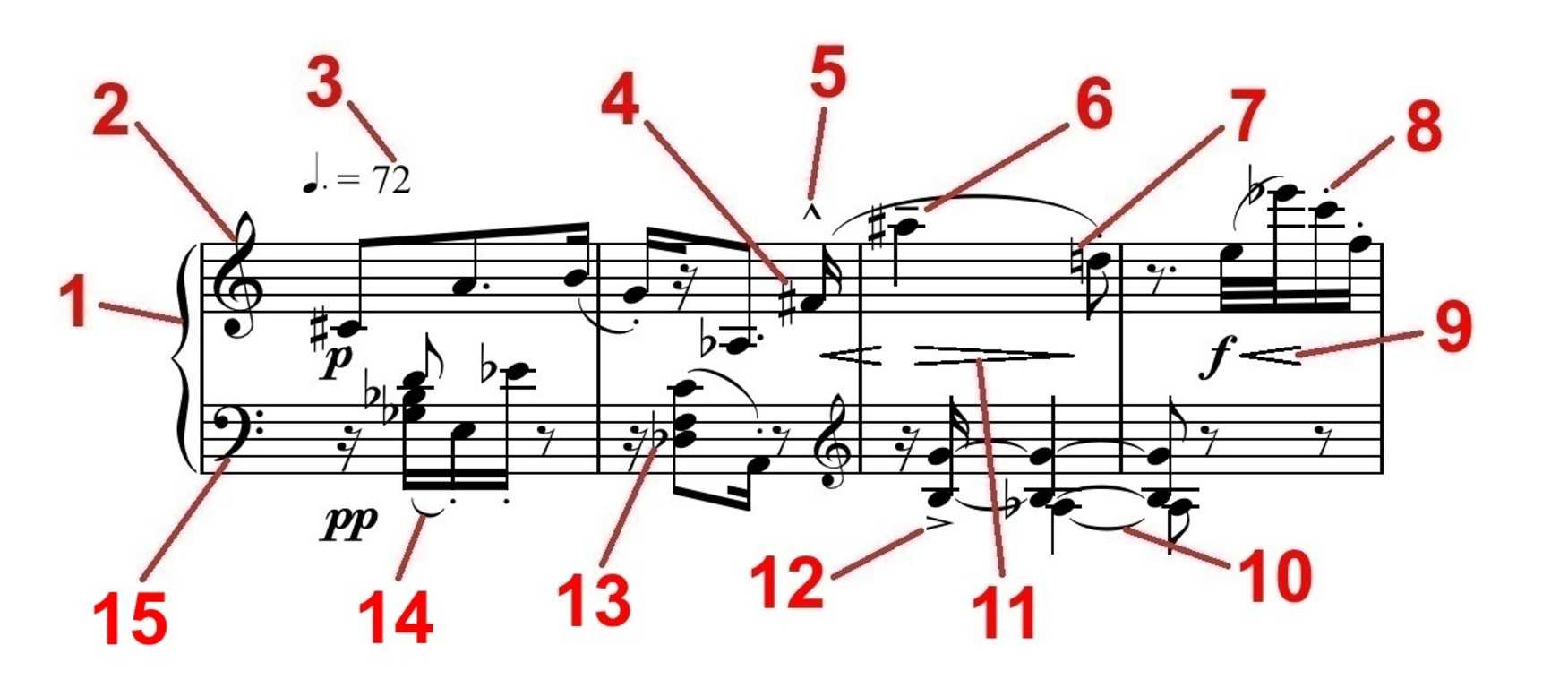
Music is more than just notes and time. Composers try to indicate what their music *should* sound like, and musicians do their best to interpret that. Musical symbols are used to try to relay this information, so it is important to know how to read them.
Last 3 plays: dee1304 (6/15), mfc (13/15), Jdoerr (12/15).
Match the musical symbol to its name.
Click on image to zoom
SharpMarcatoBass clefGrand staffDecrescendoStaccatoTempo markingTenutoTreble clefSlurAccentNaturalTieFlatCrescendo* Drag / drop or click on the choices above to move them to the answer list. View Image Attributions for This Quiz
The bracket is used to connect a treble clef and a bass clef staff - typically for a pianist - indicating one connected system for the musician(s) to play together. Between the two staves, starting from the bottom line of the bass clef staff to the top line of the treble clef staff, there is a range of nearly three octaves, although that is not the limit of range for music notation. Simply add ledger lines above or below a staff to keep going.
2. Treble clef
The treble clef is a symbol that provides a key to the staff for a specific range of instrumental or vocal music. The symbol itself is a stylized letter 'G,' which is also why the treble clef is called the 'G' clef. It shows where 'G' can be found on the staff - the second line from the bottom - with the bottom circle of the clef combining with the vertical stroke to make a kind of 'cross-hair' that clearly points to that second line.
While there are mnemonics to help learning musicians to easily know the lines and spaces of the treble clef staff, one doesn't need those to know where the letters are on the staff, because the clef is the key that gives us a starting point. From there it is just a ladder going up and down, alphabetically.
3. Tempo marking
Many pieces of music provide an indication of what the tempo - how many beats per minute - should be, according to the composer's intent. In the case given here, the 'beat' is a dotted quarter note, with a tempo of 72 beats per minute.
Unless someone plays along with a metronome clicking accurate time, a tempo marking is difficult to maintain perfectly, and often the music itself asks for changes in that tempo. For something like 72 BPM, a musician can think about it as just a little faster than one beat per second, which is an amount of time most people have a good feel for.
4. Sharp
The sharp symbol gives the effect of raising a natural note up a semitone, or half-step.
Visually, if you can picture a keyboard, the natural notes are all the white keys, and the black keys are half-steps between them. Of course, there are a couple of white keys that have no black keys between them, and these natural half-steps occur between B and C, and between E and F.
Suffice it to say, when you want to raise the pitch of a note by a half-step, the sharp sign indicates for the musician when and where it must happen. If it appears in the written parts separate from the provided key (typically given at the beginning), then it is an 'accidental' and it is only good for one measure of music.
5. Marcato
'Marcato' is Italian for 'marked.'
When the chevron-shaped marcato symbol is placed above (or below) a note's head, it is an indication for the musician to give it a stronger emphasis - a more forceful attack than a regular accent - and sometimes with a slightly shorter duration, creating a bit of a 'hammer' effect.
6. Tenuto
'Tenuto' is Italian for 'to hold.'
A short, flat line placed above (or below) a note head instructs a musician to give that note its full value, often with a slight emphasis (compared to the notes around it), although less than a regular accent. It is often used to indicate music that is meant to have a smooth, connected articulation (but not slurred).
7. Natural
The natural symbol is used to negate the effects of a sharp or flat, returning the note to (one of the piano white keys) its unaltered state. This is always used as an 'accidental,' as natural symbols are not used in key signatures. It can change a note that would otherwise be affected by the given key signature, or can be used to cancel the effect of a sharp or flat accidental (before the end of the measure does it automatically).
8. Staccato
'Staccato' is Italian for 'detached' or 'separated.'
A dot placed above (or below) a note head indicates that the note should be played short and detached, giving some silence to separate it from the subsequent note. Exactly *how* short and detached is usually up to the musician (or conductor of an ensemble) to interpret, and often dependent on the overarching style of the music being performed.
To be a staccato marking, the dot must be above or below the note head... if a dot is shown *beside* a note head, then it has a different meaning, adding half the value of the given note.
9. Crescendo
'Crescendo' is Italian for 'growing' or 'increasing.'
The crescendo symbol is like the mathematical 'less than' symbol or what you might see on your stereo volume dial. Essentially, it indicates to a musician to get louder - typically over the duration of the symbol, which can be shorter or longer, and often (but not always) with a dynamic level indicated at either end of the marking.
10. Tie
A curved line connecting two notes of the same pitch is a tie. All it does is extend the length of the first note by the value of the next (and any subsequent) note so connected. This is often used to connect notes over bar lines (between measures), or to extend a note to a length that doesn't have a note to represent that length (like tying a half note to an eighth note).
11. Decrescendo
'Decrescendo' is Italian for 'decrease' or 'diminish.'
The decrescendo symbol is the opposite of the crescendo symbol, indicating to the musician to gradually play softer over the duration of the symbol.
The term 'diminuendo' can also be used for this symbol, although that is often indicated with 'dim.' instead of with the symbol itself.
12. Accent
The sideways 'V' accent symbol - which looks like a small decrescendo symbol - is placed above (or below) a note head to indicate that it should be played with more emphasis than the other notes around it, standing out through increased volume, duration, or articulation - but not as much as with a 'marcato,' nor as subtly as with a 'tenuto.'
As noted by already seeing the 'marcato' and 'tenuto' symbols seen in this quiz, there are fine distinctions between each of the symbols that are largely up to the performer to interpret and incorporate as best they can.
13. Flat
In the same way that a sharp symbol raises a pitch, the flat symbol lowers a pitch by a semitone (or half-step). And the same rules for its use also apply. When used as an accidental, the lowered tone is is only good until the end of the measure, then reverts to the natural.
14. Slur
The same curved line that is used to show a tie is also used to indicate a slur. The difference is that with a slur, the notes change pitch. Also, where a tie must connect two adjacent notes of the same value, a slur can be extended to capture multiple notes.
When a slur is in the music, the performer connects all the indicated notes without any articulations between them, keeping everything smooth.
15. Bass clef
The bass clef is a symbol that provides a key to the staff for a specific range of instrumental or vocal music. The symbol itself is a stylized letter 'F,' which is also why the bass clef is called the 'F' clef. It shows where 'F' can be found on the staff - the second line from the top - with the the two dots on either side of the line.
Again, while there are mnemonic phrases to learn all the note names for each line and space on the staff, the bass clef gives you a starting point, and you can always figure out the rest from there, even if you forget the mnemonic phrase.
This quiz was reviewed by FunTrivia editor agony before going online.
Any errors found in FunTrivia content are routinely corrected through our feedback system.