FREE! Click here to Join FunTrivia. Thousands of games, quizzes, and lots more!
Quiz about Bahai by the Numbers

Baha'i by the Numbers Trivia Quiz

Significant Numbers Within the Faith

Like most religions, some numbers hold a special place within the faith. They may be emblematic, ritualistic, significant or simply mark an anniversary. The Baha'i faith is no different.

A label quiz by pollucci19. Estimated time: 3 mins.
  1. Home
  2. »
  3. Quizzes
  4. »
  5. Religion Trivia
  6. »
  7. World Religions
  8. »
  9. Baha'i

Author
pollucci19
Time
3 mins
Type
Label Quiz
Quiz #
422,667
Updated
Jan 12 26
# Qns
10
Difficulty
New Game
Avg Score
9 / 10
Plays
10
Last 3 plays: Strike121 (2/10), klotzplate (10/10), Dizart (7/10).
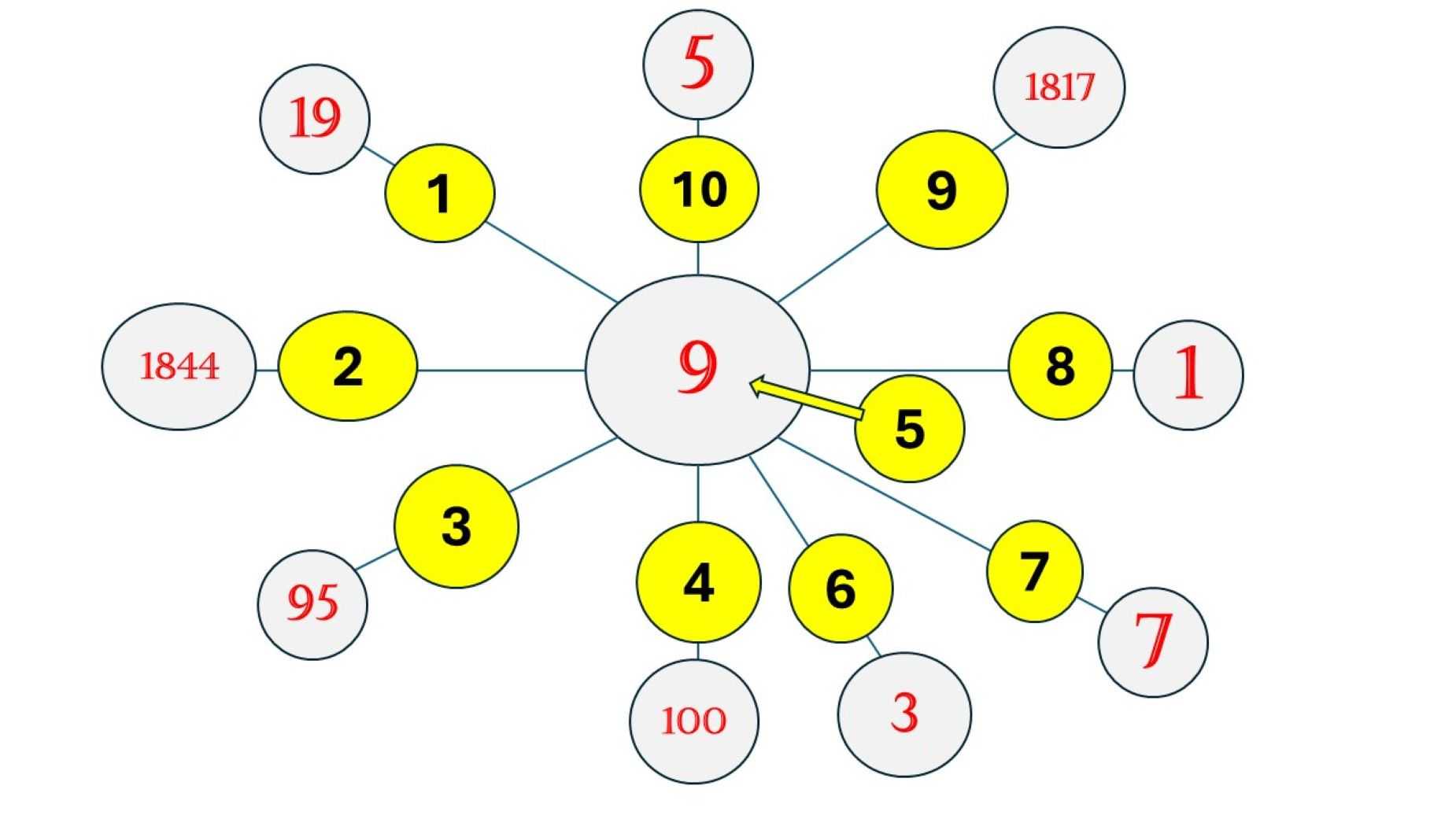
The numbers in yellow represent where the large red numbers sit. Identify the significance of the red number from the selection below the image and place it with its corresponding yellow number in the grid on the right.
Click on image to zoom
Valleys to cross to Unite with God Symbol of Perfection The Greatest Name of God Steps in the Spiritual Journey Declaration of the Báb The Haykal Birth of Bahaullah Invocations of "Allah-u-Abha" Months in the Baha'i calendar Number Gods in the Baha'i faith
* Drag / drop or click on the choices above to move them to the answer list.
View Image Attributions for This Quiz
1.   
2.   
3.   
4.   
5.   
6.   
7.   
8.   
9.   
10.   

Most Recent Scores
Today : Strike121: 2/10
Today : klotzplate: 10/10
Today : Dizart: 7/10
Today : kstyle53: 10/10
Today : MacaroniTree: 8/10
Today : lethisen250582: 10/10
Today : GoodwinPD: 10/10
Today : wellenbrecher: 10/10
Today : Guest 86: 0/10

Quiz Answer Key and Fun Facts
1. Months in the Baha'i calendar

The Baha'i calendar contains 19 months, each with 19 days (361 in total), however, intercalary days, known as Ayyám-i-Há, are inserted to align it with the solar year. Each of the 19 months was named, by the Báb, after an attribute of God. The calendar includes Holy Days and these are mainly centred around the twin founders - the Báb and Bahaullah - and includes events such as their birthdays and their passing.

The Baha'i New Year, known as Naw-Rúz, is astronomically fixed to match up with the vernal equinox. The Holy Days are then aligned with the solar calendar all bar the Twin Birthdays. These are observed on the first and second day after the eighth moon after the New Year.

Number nineteen is an important number within the faith, and it doesn't merely sit with the number of days and months within their calendar. Amongst others, there is the annual spiritual practice of the 19 day fast, the number of apostles of Bahaullah numbered 19 and the figure is also significant in their financial dealings relating to Huququllah (a form of giving known as "The Right of God)) and the payment of dowry.
2. Declaration of the Báb

Essentially, 1844 is the conceptional year of the Baha'i faith, it is the year that the Báb, one of the three central figures of the faith, announced that he was the messenger of God and that he was to pave the way for the Promised One, namely Bahaullah.

Siyyid 'Alí-Muhammad, a Persian merchant, would become known through history as The Báb, an Arabic word meaning "the Gate". In this year he announced that he was the bearer of a Divine Revelation that would transform humanity spiritually. His timing was perfect. The middle of the 19th century was a time of upheaval. Wars and revolutions were dominant, great changes were being experienced in areas of agriculture, economics and industry... the world sat on the cusp of great change, and this provided fertile ground for the arrival of the Promised One.
3. Invocations of "Allah-u-Abha"

Written in 1873, the "Kitáb-i-Aqdas", is the central religious text of the Baha'i faith and within the sacred document it is ordained that everyday believers must perform a meditation that involves washing their hands and, then their face, seat themselves, turn to God and then repeat the phrase "Allah-u-Abha" (God is most glorious) ninety-five times.

This practice ties in with one of the core principles of the faith in recognizing that the Manifestation of God and the obeying of all his laws are required to lead them down the right path. The constant repetition then aims to establish a spiritual connection, purify the soul and focus the mind.
4. The Greatest Name of God

In Islamic tradition there is a belief that there are 99 names for God. In Baha'i they believe that the 100th name for God is the "Greatest Name of God"... and that name is "Baha". In Arabic, the word translates to glory or splendour.

Consequently, Baha becomes a root word for the faith in respect to many names, symbols and phrases. For example, Baha'i means a follower of Baha. Two of the central figures of the faith are Bahaullah, which means "Glory of God" and, Abdul-Baha translates to "Servant of Glory".
5. Symbol of Perfection

Nine is the most revered number within the faith. This stems from two ideals. First, it is the highest single digit and, as a consequence, it represents completeness, fulfillment and... perfection. The other is that the numerical value of the name Baha (the "Greatest Name of God" in the faith), under the Abjad system (see below) is nine.

The number appears numerous times in Baha'i history and is used as an emblem within their teachings. For example, their places of worship are nine sided, they observe nine major Holy Days every year and one of their most important symbols is the nine point star.

(Note 1) The Abjad system is a decimal alphabetic numeral system that applies a numeric value to the 28 letters in the Arabic alphabet. To this end, the letter (a) is one, (b) is two and (h) is worth five. Hence, Baha is made up of 2+1+5+1 = 9
(Note 2) It seemed appropriate that the above image for this quiz should attempt to represent a nine point star with the number nine set in the centre.
6. Steps in the Spiritual Journey

The faith identifies each person as a wayfarer on a spiritual path, one of spiritual growth whose endpoint is "the immortal realm". Bahaullah expresses these ideals in his book of aphorisms "The Hidden Words" (1858) and patterns of three continually emerge in his dialogue. He encourages believers to take the three steps - to "give ear" to this teaching, to heed his words, and to take action on their meaning. Along the way they will experience three spiritual conditions or planes of existence - self, limitations and oneness.

In his book "Logos and Civilization" (2000), Dr. Nader Saiedi describes these stages as follows:
"In the beginning [the plane of self], the will is predominantly hedonistic and aggressive. The next stage [plane of limitation], some form of moral values is accepted but without serious transformation of the will. The result is inner conflict, guilt, and struggle against lower impulses. In the stages that follow [the plane of oneness], moral values become increasingly universalized and spiritualized, and the will becomes transformed, progressively reflecting the divine will."
7. Valleys to cross to Unite with God

"The Seven Valleys" is a book written by the Baha'i founder Bahaullah, around 1857-1858. It details the path to be taken by the soul on its spiritual journey. There are seven stages that combine to form the "Right Path" and they are to be taken in order, with the ultimate goal to be to "gaze on the Beloved".

The seven steps are as follows:
The Valley of Search: The sincere seeker cleanses their heart and strives for the truth.
The Valley of Love: The fire of love burns away the material self of the wayfarer.
The Valley of Knowledge: Where the seeker begins to understand the mysteries of God.
The Valley of Unity: The seeker sees the attributes of God in all creation.
The Valley of Contentment: The seeker becomes independent of all things and becomes inwardly happy.
The Valley of Wonderment: The wayfarer is struck dumb by the beauty of God and the vastness of his creation.
The Valley of True Poverty and Absolute Nothingness: The seeker becomes poor of all material things, but becomes rich in spiritual attributes.
8. Number Gods in the Baha'i faith

Baha'i is a monotheistic religion. Their concept of God is that of an "unknown essence", responsible for all that exists. They teach that God does not have a physical form and that God is panentheistic - he intersects every part of the universe and also extends beyond space and time.

God is also inaccessible but provides his knowledge through mediation via divine messengers, known as Manifestations of God. God is unknowable, which means his essence cannot be comprehended by humanity but his attributes, those of love, justice and mercy, can be emulated.
9. Birth of Bahaullah

Born Mirza Ḥusayn-Ali Nuri in Tehran on November 12, 1817, Bahaullah is one of three central figures in the faith and is seen as its founder. The name Bahaullah, in Arabic, translates to "Glory of God". Born into a wealthy family, as a young man he devoted himself to caring for the poor and the unfortunate, earning the sobriquet "Father of the Poor".

The Báb identified him as the Promised One, that had been prophesied in numerous major scriptures, and the one who would be the Manifestation of God, the one who guide humanity through its current age of maturity. Bahaullah accepted the calling, which led to him enduring a life of persecution, imprisonment and exile.

The birthday of Bahaullah is one of the nine major Holy Days celebrated by the faith.
10. The Haykal

Haykal is a five-pointed star that is one of the major symbols of the Baha'i faith. The word itself means temple or the body of something in Arabic. The top point of the star represents the head, the two points on either side are the hands and the two below are the feet. They can also represent "specific" people within the faith, and a great example of this appears in another of the faith's major symbols, the Ringstone.

The Ringstone is made up of three horizontal bars connected by a vertical line through the centre. The top bar represents God, the middle one, the Manifestations (prophets) of God and the bottom is humanity. The Holy Spirit is the vertical line that connects them all. On either side of this rests a Haykal, one of which represents the Báb, the herald of the faith and the other, Bahaullah, its founder.

As this number is significant to the Baha'i, it seems appropriate that, when Bahaullah declared himself the Manifestation of God for his age, he wrote to just five world leaders - Pope Pius IX, Napoleon III, Czar Alexander II, Queen Victoria, and Nasiri'd-Dín Shah - and the messages were in the form of a pentacle.
Source: Author pollucci19

This quiz was reviewed by FunTrivia editor looney_tunes before going online.
Any errors found in FunTrivia content are routinely corrected through our feedback system.
Related Quizzes
1. Bahá'í Holy Days and Festivals Average
2. Baha'i the Way Average
3. Baha'i Average
4. Holy Wood Tough
5. Candomblé Average
6. Mysterious Ways Average
7. ...According to the Gnostics Tough
8. Scientology Average
9. Don't Know Nothin' About Taoism Average
10. Religiously Easy Easier
11. Let it Rain Average
12. Beliefs Across The World Average

1/13/2026, Copyright 2026 FunTrivia, Inc. - Report an Error / Contact Us