Last 3 plays: lancer1972 (8/10), chrisatlas (10/10), Guest 165 (10/10).
Click on image to zoom
RastafariSikhismLutheranismShintoHinduismMormonismBaha'iJudaismTaoismIslam* Drag / drop or click on the choices above to move them to the answer list. View Image Attributions for This Quiz
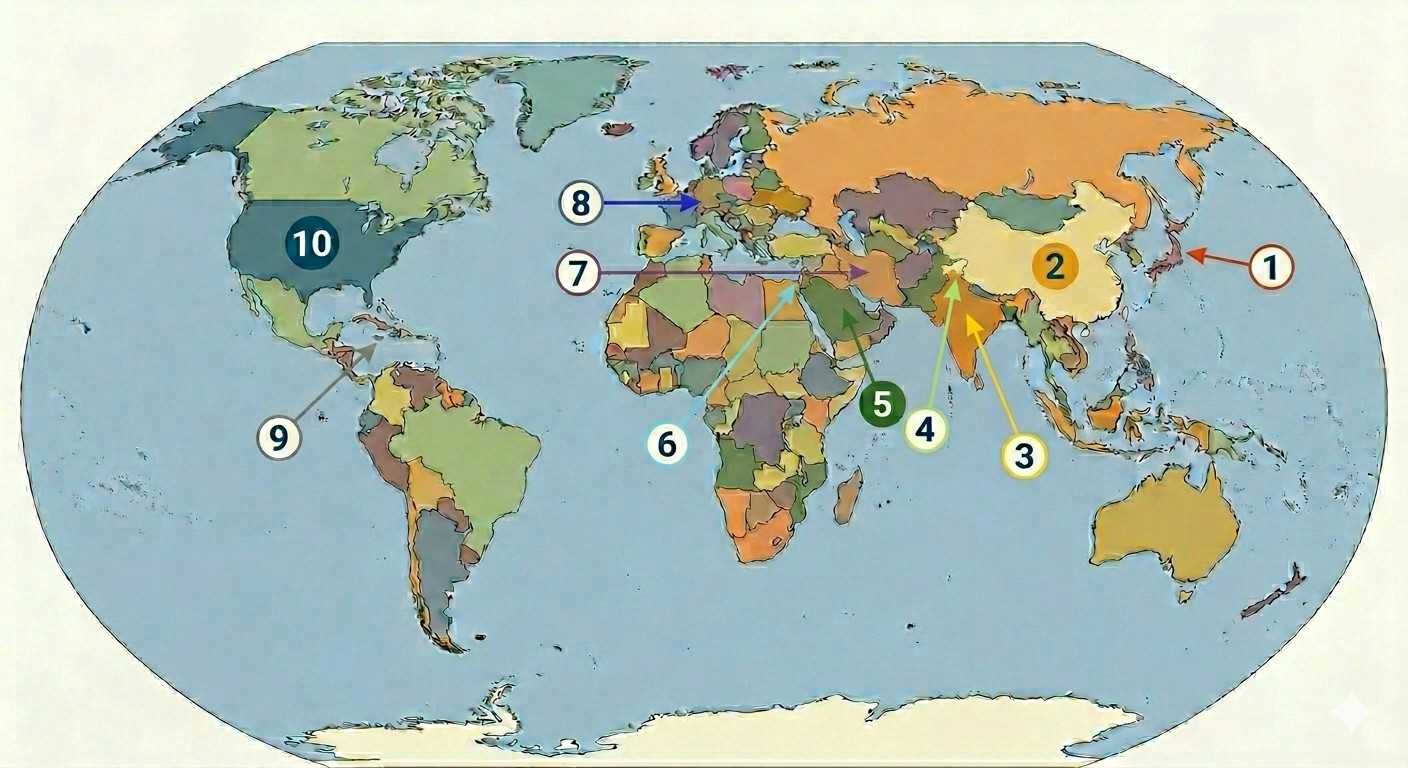
Shinto is an indigenous religion of Japan. It is classified as a polytheistic and animistic religion with no central authority. In Shinto, supernatural beings called 'kami' are worshipped and the houses of worship are called shrines. Torii gates are found at the entrance to the shrines and are considered a symbol of the religion.
2. Taoism
Taoism is indigenous to China. Followers of this spiritual tradition are encouraged to live harmoniously with each other and all elements of nature. The ancient text "Tao Te Ching" is considered fundamental to this way of life. It is believed to have been written in the 4th century BC. Practices that have developed from Tao include feng-shui - the placement of objects and structures to allow the flow of life energy, and internal alchemy - physical, mental, and spiritual practicies developed to strengthen the soul for life after death.
3. Hinduism
Hinduism is the main religion of India with around 70% of the country's population identifying as Hindu. In the 19th century, the term 'Sanatana Dharma' was coined by some Hindus to refer to the religion. It means that the religion has existed before time and is not a manmade creation. Hinduism is considered more a way of life than a formal religion.
There is no central authority figure and across the Indian subcontinent, there is significant diversity of practices and rituals.
4. Sikhism
Sikhism was founded in Punjab in the 15th century. Today this region is divided across the modern day countries of India and Pakistan. It was founded by Guru Nanak who is considered the first of the Sikh Gurus. There are ten gurus in all after which the holy book, the Guru Granth Sahib, was considered to be the eternal guru. Sikhs are distinguished by the Five K's that they are meant to carry at all times - kesh (unshorn hair), kangha (comb), kara (steel or iron bracelet), kacchera (undergarment), and kirpan (a small, curved dagger).
5. Islam
Islam is one of several major world religions classified as Abrahamic. This denotes that the religion is monotheistic and that Abraham is considered one of the key figures of the tradition. Other such religions are Judaism, Christianity, and the Baháʼí Faith, along with smaller ones with less number of followers.
Islam was founded in the 7th century AD in Mecca, now part of the modern day Kingdom of Saudi Arabia. The founder Muhammad received the holy book of the Quran from an angel which led to the formation of the new religion. Muslims consider Judeo-Christian figures like Noah, Abraham, and Moses to also be prophets with Muhammad being the final messenger from God. Today Islam is regarded as the second largest religion in the world after Christianity.
6. Judaism
Judaism is one of the earliest religions to preach monotheism - the concept of only one true God. Among the core texts is the Torah, the same five books that make up the first books of the Old Testament in the Christian Bible. Judaism developed in present day Israel and Palestine and parts of these areas continue to be referred to as the 'Holy Land'. Major Jewish festivals include Rosh Hashanah which is the Jewish New Year; Passover which commemorates the flight from Egypt in the time of Moses; and Hanukkah, the Jewish Festival of Lights.
7. Baha'i
The Baháʼí Faith is a relatively young religion compared to the others in this quiz. It originated in Iran in the 19th century. The Iranian religious leader Bab is considered one of the three central figures of this faith. The Bab taught that God was soon send a new prophet, similar to Jesus and Mohammed.
A few years later, Baháʼu'lláh, the second central figure of the Baháʼí Faith, declared himself to be the prophet announced by the Bab. As a result, he had to face serious persecution and was exiled from Iran.
Despite his exile, his followers continued to grow. The third key figure is ʻAbdu'l-Bahá, the son of Baháʼu'lláh, who spread the religion across Europe and North America.
8. Lutheranism
Lutheranism is a major denomination of Christianity. It developed from the teachings of the German priest, Martin Luther, after whom it is named. Luther is considered one of the key figures of the Reformation in the early 16th century. He raised issues with certain practices of the Roman Catholic Church which ultimately gave rise to a distinct denomination called Lutheranism.
By the mid 16th century, Lutheranism had been adopted as the state religion in many parts of northern Europe, including the influential German state of Prussia.
9. Rastafari
The Rastafari religion was established in Jamaica in the 1930s and is concentrated within the African diaspora. It is considered an Abrahamic religion like Judaism and Christianity since it is based on the Christian Bible. Rastafarians refer to God as Jah.
While the Ethiopian king, Haile Selassie, was considered a key figure by the followers of this religion, there is no central authority as such. Therefore there are many variations to how this religion is practiced.
10. Mormonism
Joseph Smith founded The Church of Jesus Christ of Latter-day Saints in New York in the early 19th century. It started with him publishing the "Book of Mormon" which later grew into the Latter-day Saints movement. According to Smith, the book was revealed to him by the Angel Moroni.
While Mormonism is considered within the broader umbrella of Christianity, there are many significant differences between the two, most notably the doctrine of eternal progression which states that some human beings could attain god-like status after death.
This quiz was reviewed by FunTrivia editor looney_tunes before going online.
Any errors found in FunTrivia content are routinely corrected through our feedback system.