FREE! Click here to Join FunTrivia. Thousands of games, quizzes, and lots more!
Visiting Bible Locations Trivia Quiz
Today we are traveling through the ancient Middle East, visiting sites that were important in both the Old and New Testaments. Come along with me, and let's see what we can uncover.
A label quiz
by ponycargirl.
Estimated time: 3 mins.
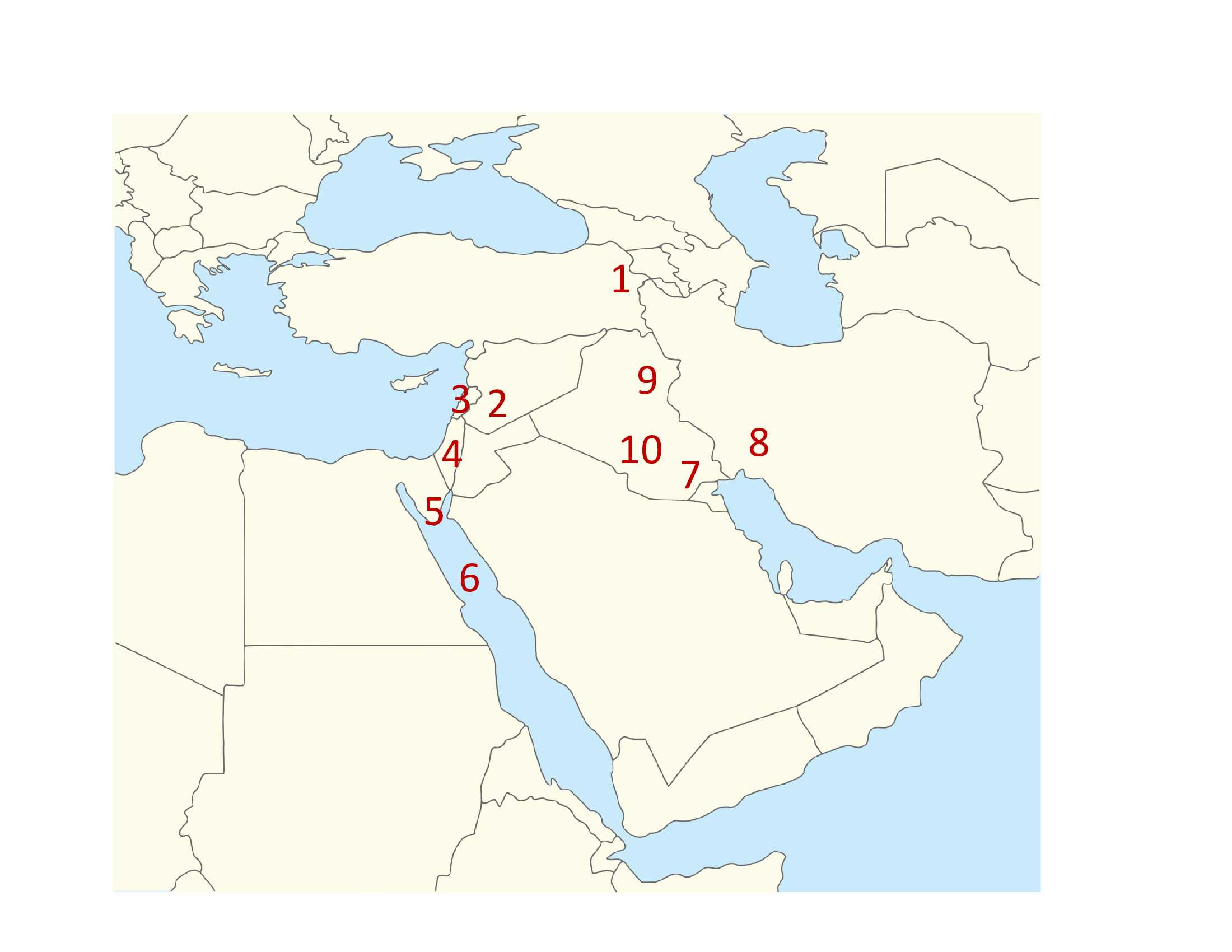
Match the number on the map with the location. All Bible quotations are from the King James Version.
Click on image to zoom
LebanonUrCanaanDamascusMt. SinaiNinevehMt. AraratBabylonRed SeaSusa* Drag / drop or click on the choices above to move them to the answer list. View Image Attributions for This Quiz
According to tradition, Noah's Ark is resting on top of Mt. Ararat. Genesis 8:4 says, "And the ark rested in the seventh month, on the seventeenth day of the month, upon the mountains of Ararat", after the biblical flood. Mt. Ararat is located in northeastern Turkey, which in biblical times was called Anatolia or Asia Minor. A dormant volcano, it is the highest mountain in Turkey, with two peaks called Big Ararat and Little Ararat. It is the national symbol of Armenia and is considered sacred grounds.
Since ancient times there have been many documented attempts to search for the Ark in Turkey, with many claiming to possess pieces of its wood. The first recorded modern venture was led by Friedrich Parrot in 1829, but he complained that Armenians wouldn't let anyone close to the top of the mountain. In 1876, James Bryce said he found a piece of wood about 4 feet long; upon examination it was found to have been cut off something with a tool. While there have been too many attempts to mention to find the Ark on Mt. Ararat, with many explorers claiming to have found its pieces, it must be stated that in the 21st century the area around the mountain has become a military restricted zone. Nevertheless, explorers have continued to try to locate the Ark using aerial photography.
2. Damascus
One of the oldest continuously-inhabited cities in the world, the founding of Damascus, Syria, is believed to date back to at least 11,000 years ago. It was established as an urban center in the 3rd millennium BC, with its location between civilizations in Mesopotamia and Egypt. In the Old Testament, the city is referred to as Damascus, Aram-Damascus, or Aram. It was the center of the Aramean kingdom, which was typically at odds with the people who lived in Canaan. The first mention of Aram is in Genesis 10:22; after the biblical flood Noah's son Shem migrated there and became the father of Adam. In Genesis 14:15, Abraham had to go there to rescue his nephew Lot, who had been kidnapped by Mesopotamian kings. There is also a mention of Eliezer, Abraham's servant, who was from Damascus, in Genesis 15:2.
According to 2 Samuel 8:5-6, King David conquered the Syrians of Damascus and placed garrisons there afterwards. The Kingdoms of Judah and Israel that came into existence after Solomon's death seem to have been involved in constant fighting with the people of Damascus, but the city suffered great destruction when it was attacked by the Assyrians. Isaiah 17:1 makes note of a prophecy that Damascus will "become a heap of ruins". While some believe this happened during an attack by the Assyrians c. 732 BC, others believe that it is a prophecy about the end times.
Of course, the most well known information in the Bible about Damascus is in the New Testament, and relates to the apostle Paul, then Saul. He had a life changing encounter with Christ while traveling there to persecute Christians in Acts 9:1-19. He was blinded by a bright light from heaven, but when his sight was restored, he became one of the most important missionaries of the early Church.
3. Lebanon
Of course, Lebanon was located to the north of the Promised Land, and is mentioned in the Bible as forming one of its borders. It was especially valued in biblical times for its vast forest of lumber, which the Israelites imported for use in their building projects. According to 1 Kings 5:1-14, Solomon made a deal with Hiram, the King of Tyre, to send thirty thousand Israelites to Lebanon to cut down the trees that were used both for the temple and Solomon's palace, which was called the Palace of the Forest of Lebanon.
Mention of the glorious trees in Lebanon is often made in comparison to strength and permanence in the Bible. Psalm 92:12 states, "The righteous will flourish like the palm tree: he shall grow like a cedar in Lebanon".
4. Canaan
In the Bible, Canaan is the promised land - the land that was promised to Abraham and his descendants throughout the book of Genesis (12:7, 13:15, 17:8, 26:3). It is described as being west of the Jordan River and east of the Mediterranean Sea. Historians believe that the Israelites arrived in Canaan in approximately 1500 BC.
Lean years of famine (Genesis 12:10) eventually precipitated a move to Egypt, where the Israelites reunited with Joseph, one of Jacob's sons, and first lived as pharaoh's guests before becoming slaves. They escaped from Egypt c. 1300 BC, but wandered for some years before returning to Canaan. There they found that land had been settled by other people, and it took some time and effort before the Israelites were able to re-establish their control over the region.
5. Mt. Sinai
Mt. Sinai, which is located in Egypt on the Sinai Peninsula, is sacred to Judaism, Christian, and Islam. It is also called Jabal Musa and Mount Horeb. St. Catherine's Monastery was built at the foot of the mountain where Moses saw the burning bush, as described in Exodus 3:1-10. It was at this time when God commanded that Moses deliver the people from slavery.
At the site there is a cave where it is believed Moses waited 40 days and 40 nights to receive the Ten Commandments from God. Moses was also given instructions regarding the covenant God made with Israel (Exodus 19:5-6) and was told how to built a Tabernacle - the Ark of the Covenant - to transport the stone tablets.
6. Red Sea
Biblical scholars believe that Moses led the Israelites out of Egypt around 1300 BC. Trapped on one side by Pharaoh's army and on the other by the sea, the Bible records that Moses raised his staff over his head, and a strong wind parted the water (Exodus 14). The Israelites were able to cross, while the Egyptians drowned in the sea.
Over the centuries scholars have debated whether such a feat was feasible. Some feel that the passage might have occurred in the Sea of Reeds instead. It is a shallow lake or marshy area, where the Egyptian chariots would not have been able to travel.
7. Ur
The ancient city of Ur was located at the confluence of the Tigris and Euphrates Rivers in ancient Mesopotamia, now Iraq. It became one of the most important Sumerian city-states, and was the site of one of the Cradles of Civilization around 5000 BC.
According to tradition, Abraham was born in the area around Ur, and he and his people were living a nomadic life herding animals when God spoke to him. Genesis 12:1-2 relates the story. "Get thee out of thy country, and from thy kindred, and from thy father's house, unto a land that I will shew thee: And I will make of thee a great nation, and I will bless thee, and make thy name great...." So when Abraham was 75 years old, he took his family and everything they had and went to the land of Canaan.
8. Susa
Susa was a very ancient city, believed to have been initially settled by the Elamites around 4000 BC. The Assyrians looted and burned the city c. 647 BC, but it was taken over by the Persian king, Darius the Great, c. 521; he chose the site as one of his capitals, and embarked on a massive building project during which time a royal residence was constructed. The biblical name for Susa was Shushan.
After his son, Xerxes, who the Bible calls Ahasuerus, was defeated by the Greeks during the Persian Wars, he went to Shushan to deal with local matters there. After rejecting Queen Vashti, he took a Jewish girl named Esther as a wife. On the advice of her cousin, Mordecai, Esther concealed her identity as it was dangerous to be a Jew in the Persian Empire at this time. Haman, the king's advisor, had convinced him to have all the Jews exterminated because he doubted their loyalty. Esther risked her life to save her people, revealing herself as a Jew and exposing Haman's plot. Her story is in the book of Esther, chapters 8 and 9.
9. Nineveh
The city of Nineveh was constructed on the Tigris River beginning about 6,000 BC, and became an important site for the worship of the goddess Ishtar, Mesopotamian goddess of love. After having been occupied by different groups of ancient people, it became the capital of the Assyrians about 705 BC. In spite of all its architectural splendor, the city was a wicked place. Enemies were skinned alive or publicly executed there, and their heads were stacked outside the city gate. The city was notorious for its use of cruelty.
When God chose Jonah to go to Nineveh (Jonah 1:1-2), he disobeyed and tried to go to Tarshish. Instead, there was a storm at sea, and Jonah was thrown off the ship and swallowed by a great fish (Jonah 1:17). After being expelled from the fish, Johan went to Nineveh as God commanded. After he warned the city that they would be destroyed if they didn't turn from their evil ways, the people repented (Jonah 3), and God spared the city.
10. Babylon
Babylon, located on the banks of the Euphrates River, was first settled by the Amorites c. 1894 BC. Soon the city grew to be so powerful that the people who lived there became Babylonians, and the land around it became known as Babylonia. The city was eventually overrun by various groups until it was taken by the Chaldeans (sometimes called the New Babylonians), who decided to make it their capital. King Nebuchadnezzar II oversaw numerous building projects and made his capital a showcase in approximately 626 BC.
By this time the Chaldean empire had grown to include the Kingdom of Judah in the southern part of Canaan. When their King Zedekiah rebelled against Chaldean rule, Nebuchadnezzar began a two year siege of Jerusalem, which resulted in the destruction of most of the city (c. 597 BC), including the First Temple of Solomon. The people were deported to Babylon (2 King 24-25 and 2 Chronicles 36).
This period in history is called the Babylonian Captivity. While in exile, the Jews worked in fishing, in agriculture, and on the king's building projects. They were expected to assimilate into New Babylonian culture, but were able to preserve their religious identity. When the city fell to the invading army of Cyrus the Great in 538 BC, he allowed the Jews to return to Canaan.
This quiz was reviewed by FunTrivia editor looney_tunes before going online.
Any errors found in FunTrivia content are routinely corrected through our feedback system.