FREE! Click here to Join FunTrivia. Thousands of games, quizzes, and lots more!
Quiz about Elements That Are Perfect Squares

Elements That Are Perfect (Squares) Quiz


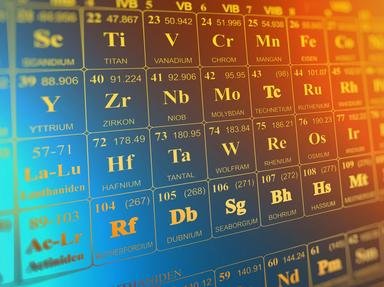
For some students, Math is their hardest subject. Others may choose Chemistry. This quiz puts those two together, oh no! Given seventeen elements, find ten that have a periodic table number equal to a perfect square, such as nine, three times three.

A collection quiz by GBfan. Estimated time: 3 mins.
  1. Home
  2. »
  3. Quizzes
  4. »
  5. Science Trivia
  6. »
  7. Chemistry
  8. »
  9. Periodic Table

Author
GBfan
Time
3 mins
Type
Quiz #
422,998
Updated
Feb 05 26
# Qns
10
Difficulty
Average
Avg Score
7 / 10
Plays
55
Last 3 plays: Guest 205 (2/10), kstyle53 (10/10), Guest 99 (0/10).
Select the elements whose periodic table number is a perfect square.
There are 10 correct entries. Get 3 incorrect and the game ends.
Krypton Indium Oxygen Manganese Beryllium Silver Hydrogen Plutonium Helium Argon Cobalt Fluorine Thallium Gadolinium Sulfur Fermium Radon

Left click to select the correct answers.
Right click if using a keyboard to cross out things you know are incorrect to help you narrow things down.

Most Recent Scores
Today : Guest 205: 2/10
Today : kstyle53: 10/10
Today : Guest 99: 0/10
Today : Guest 208: 5/10
Today : PurpleComet: 7/10
Today : Guest 113: 6/10
Today : thomas1975: 10/10
Today : Guest 174: 1/10
Today : cardsfan_027: 10/10

Quiz Answer Key and Fun Facts
Answer:

The first ten perfect square numbers are 1, 4, 9, 16, 25, 36, 49, 64, 81, and 100. Elements are listed in order and based on their atomic number. Elements are also grouped as they tend to have similar chemical properties. Let's look at each of these a few at a time. Hydrogen is number one on the periodic table. It's abbreviated H and deserves to be one since it is the most abundant element in the universe. Beryllium is number four on the table and abbreviated Be. It's actually a rare element in the universe and created by an impact with cosmic rays. There are trace elements of beryllium in the earth's crust. Number nine on the periodic table is fluorine, which is abbreviated as simply F. In its elemental form, this gas is toxic. It is the lightest halogen gas and, through an electrolysis process, scientists have been able to use fluorine to make steel and refine aluminum.

Number sixteen on the periodic table is sulfur with the symbol S. When listing elements found on Earth, sulfur ranks sixth and it's the tenth most abundant element by mass in the universe. Back in the day, sulfur was called brimstone. Today it's commonly used for fertilizer, water purification, and even car batteries. Manganese is number 25 and represented by the symbol Mg. It is a silvery metal and often combined with iron. It is an essential element for our health and can be found in our bones, liver, and kidneys. Krypton is number 36 on the table and represented by Kr. It is a chemically inert gas that has trace elements in our atmosphere. One common use for krypton is in the creation of lasers and in photography.

Coming in number 49 on the periodic table is Indium (In). In 1863, Ferdinand Reich and Hieronymus Theodor Richter discovered this white metal. Indium is toxic to humans when digested but it has been used for the creation of LED circuits, flat panel displays, and as a solder. Gadolinium is number 64 and described as Gd. It is a silvery white rare earth element. Pure gadolinium was first isolated in 1935 by a chemist named Felix Trombe. Thallium is number 81 on the periodic table and uses the symbol Ti. Thallium has been used in recent years for the nuclear agent in a cardiac stress test and the use of infrared detectors.

At number 100 on the periodic table is fermium, listed as Fm. Fermium was first discovered after the first hydrogen bomb explosion in 1952. In the debris, this new element was discovered. It was named after one of the first leading scientists studying nuclear physics, Enrico Fermi.

Of the elements not on the list, their periodic numbers respectively were helium (2), oxygen (8), cobalt (27), silver (47), radon (86), plutonium(94), and argon (18).
Source: Author GBfan

This quiz was reviewed by FunTrivia editor rossian before going online.
Any errors found in FunTrivia content are routinely corrected through our feedback system.
2/5/2026, Copyright 2026 FunTrivia, Inc. - Report an Error / Contact Us