FREE! Click here to Join FunTrivia. Thousands of games, quizzes, and lots more!
Quiz about The Basques The Original Europeans

The Basques: The Original Europeans? Quiz


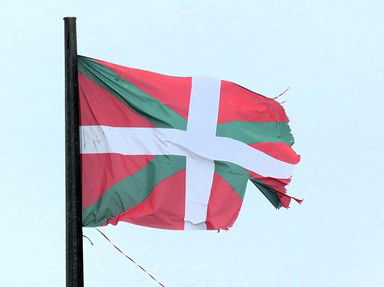
The Basques are believed to have inhabited the European continent longer than anyone else. This quiz will help you to discover some aspects of the culture of this fascinating people.
This is a renovated/adopted version of an old quiz by author TriviaMelee

A photo quiz by LadyNym. Estimated time: 3 mins.
  1. Home
  2. »
  3. Quizzes
  4. »
  5. World Trivia
  6. »
  7. Cultures
  8. »
  9. European Cultures

Author
LadyNym
Time
3 mins
Type
Photo Quiz
Quiz #
85,392
Updated
Feb 13 26
# Qns
10
Difficulty
New Game
Plays
5
Last 3 plays: Matthew_07 (9/10), cardsfan_027 (10/10), Guest 174 (9/10).
-
Question 1 of 10
1. Located in southwestern France and north-central Spain, the seven provinces of the Basque Country border what body of water? Hint


Question 2 of 10
2. In Roman times, the most likely ancestors of the Basques were known by what name - which might remind you of a famous Queen of England? Hint


Question 3 of 10
3. How do the Basques call their unique (and very difficult) language? Hint


Question 4 of 10
4. Which of these trees, sacred to the Roman god Jupiter, is one of the symbols of the Basque country? Hint


Question 5 of 10
5. A baserri is a traditional home generally found in the rural areas of the Basque Country. What kind of building is it?


Question 6 of 10
6. Throughout their long history the Basques have often migrated to other parts of the world. In what industry did many Basques work in the 16th and 17th centuries in present-day eastern Canada? Hint


Question 7 of 10
7. What saint, who founded a major religious order of the Catholic Church in 1539, was born in 1491 in the Basque town of Azpeitia? Hint


Question 8 of 10
8. With its distinctive disk shape, a "hilarri" is an artifact that often bears symbols of particular significance for Basque culture. What is its use?


Question 9 of 10
9. Sports are an essential feature of Basque culture. Which of these names, mainly used outside the Basque Country, refers to a variation of Basque pelota? Hint


Question 10 of 10
10. Spain is known for its delicious tapas, snacks that accompany wine and other drinks. What do the Basques call their own version of these tantalizing bites? Hint


(Optional) Create a Free FunTrivia ID to save the points you are about to earn:

arrow Select a User ID:
arrow Choose a Password:
arrow Your Email:


View Image Attributions for This Quiz

Most Recent Scores
Today : Matthew_07: 9/10
Feb 13 2026 : cardsfan_027: 10/10
Feb 13 2026 : Guest 174: 9/10
Feb 13 2026 : neon000: 9/10
Feb 13 2026 : elgecko44: 9/10

Quiz Answer Key and Fun Facts
1. Located in southwestern France and north-central Spain, the seven provinces of the Basque Country border what body of water?

Answer: Bay of Biscay

Known as "Euskal Herria" in Basque, "País Vasco" in Spanish, and "Pays Basque" in French, the Basque Country covers an area of 20,947 km² (8,088 sq mi) where over 3 million people live. The Northern Basque Country (Iparralde) lies entirely within France, and consists of three provinces - Labourd (Lapurdi), Lower Navarre (Nafarroa Beherea) and Soule (Zuberoa). The much larger Southern Basque Country (Hegoalde) lies entirely within Spain: it consists of the provinces of Álava (Araba), Biscay (Bizkaia) and Gipuzkoa - which form the Basque Autonomous Community - and the Chartered Community of Navarre (Nafarroa).

The geography of the Basque Country is characterized by various mountain ranges (including the western end of the Pyrenees) and its coastline on the Bay of Biscay (Bizkaizko Golkoa), a large gulf of the Atlantic Ocean, notorious for severe weather during the winter months. The largest city in the Basque Country, Bilbao - a thriving commercial and cultural centre known for its futuristic Guggenheim Museum - is located 16 km (10 mi) from the coast. Other notable Basque cities on or near the Bay are Bayonne and Biarritz in France, and Donostia/San Sebastián in Spain.

All the wrong answers are marginal seas found in Europe.
2. In Roman times, the most likely ancestors of the Basques were known by what name - which might remind you of a famous Queen of England?

Answer: Aquitani

The Aquitani were a tribe that inhabited a region of present-day southwestern France located between the Pyrenees, the Bay of Biscay and the river Garonne, which the Romans named Gallia Aquitania. Julius Caesar mentions them in his account of the conquest of Gaul, and makes it clear that they were distinct from the Celtic peoples who lived in the other two parts of Gaul. Another tribe, probably closely related to the Aquitani, lived south of the Pyrenees: they were the Vascones, from whose name the word Basque originated. Both these tribes predated the arrival of the Indo-Europeans.

The origins of the Basque people are still being debated; however, the mainstream theory posits that they are indigenous to the region and directly descended from the Aquitanians and Vascones. Though no written records of the language spoken by those tribes - often referred to as Proto-Basque or Aquitanian - have survived, names of deities and people inscribed on Roman gravestones and altars found in the region (such as the one in the photo) show remarkable similarities to some modern Basque names.

The English queen mentioned in the question is, of course, Eleanor of Aquitaine, consort of Henry II. The three peoples listed as wrong answers lived in present-day Switzerland (Helvetii), Germany (Cimbri), and Italy (Sabini).
3. How do the Basques call their unique (and very difficult) language?

Answer: Euskara

The Basques call their own language "euskara", a word of unclear origin. The name of the Basque country, Euskal Herria, means "the land of the Basque language", and the name for the Basque people, "euskaldunak", means "speakers of the Basque language". Basque is spoken by about 800,000 people as a native language, with the largest number living in the Basque Provinces of Spain. In the latter country, Basque has official status in the Basque Autonomous Community and Navarre, while in France (like all other minority languages) it has none.

Basque is the only language isolate spoken in Europe, and the only remnant of the indigenous languages spoken in the continent before the spread of Indo-European and Uralic languages. Attempts to find connections between Basque and other languages, either living (such as Georgian) or extinct (such as Iberian) have proven both inconclusive and controversial. Basque has five historic dialects and a standardized form, Euskara Batua, developed in the 1960s. Basque is markedly different from other European languages in grammar and vocabulary - which makes it exceedingly difficult to learn.

The plaque with the Lord's Prayer in Basque shown in the photo is located in the cloister of the Church of the Pater Noster in Jerusalem.

Mandinka is a language spoken in West Africa; Quechua is one of the official languages of Peru, Ecuador and Bolivia; Dzongkha is the official language of Bhutan.
4. Which of these trees, sacred to the Roman god Jupiter, is one of the symbols of the Basque country?

Answer: oak

Widespread in Europe, the oak was revered by many ancient peoples as a symbol of strength, endurance and longevity. In more recent times, it has been adopted by many countries as a national tree, and its branches, leaves and acorns are often featured in heraldry. In the Basque Country, an oak tree first planted in the 15th century in the town of Gernika (also known as Guernica, the subject of Pablo Picasso's celebrated 1937 painting) in the province of Biscay has become a symbol of the Basques' traditional freedoms ("fueros" in Spanish). Under this tree, known as Gernikako Arbola (Tree of Gernika), the rulers of Biscay swore to respect the province's liberties: in modern times the president of the Basque Government ("Lehendakari") is sworn into office near the tree.

The original tree lasted for 450 years, while its followers were much shorter-lived. The current Gernikako Arbola, the fifth of the line, was planted in 2015 at the age of 14; the trunk of the second tree, known as the "old tree" (1742-1892), is preserved within a small circular temple. The Guernica Oak is depicted on the coat of arms of Biscay, which also appears on the coat of arms of the Basque Autonomous Community of Spain (in the photo). The shield is surrounded by a wreath of oak leaves and acorns - another reference to the Tree.
5. A baserri is a traditional home generally found in the rural areas of the Basque Country. What kind of building is it?

Answer: housebarn farmhouse

Meaning "wild settlement", a baserri is a farmhouse usually located outside a town or village, more common in hilly or mountainous areas than in flatter ones. These houses are either half-timbered or built entirely of stone, with a gently sloping roof and a characteristic, recessed entrance portal. The wooden parts of the façade are often painted red, and the rest plastered white. If baserris are grouped together to form a kind of settlement, the portal - which was an essential component of life in isolated farmhouses, providing shelter for a number of activities - may be replaced by a large doorway. Typically, baserris are rectangular, allowing for the addition of wings to the main body of the building.

Baserris combine housing and barn in the same building. Stabling for cattle or horses is located on the ground floor, providing natural heating to the sleeping quarters on the first floor; a large attic for storage is located under the roof. The baserri is at the core of Basque society, being the ancestral home of a family - as shown by the carved crest-stones ("amarriak") and decorative lintel stones ("atalburu") placed over the entrance. The baserri's importance for the survival of the Basque language and culture throughout the centuries cannot be overstated. Basque surnames are often related to the physical location or any other distinguishing feature of a house.
6. Throughout their long history the Basques have often migrated to other parts of the world. In what industry did many Basques work in the 16th and 17th centuries in present-day eastern Canada?

Answer: whaling

Though deeply attached to their roots, many Basques have left the Basque Country, either by choice or forced by economic or political circumstances. While some of them have moved to other parts of Spain or France, the vast majority of the Basque diaspora (sometimes referred to as the eighth province) is found outside the boundaries of Europe, in particular in the Americas. Millions of people of Basque ancestry live in Argentina, Chile, Colombia, Venezuela and Uruguay, where they can often be recognized by their Basque surnames. On the other hand, the percentage of the population of Canada and the US that claims Basque descent is much smaller.

Outside their native country Basques were usually employed in trades such as shepherding and ranching, or as sailors and fishermen if they lived in coastal areas. A trade in which Basques excelled was whaling, which they were the first to practice on a commercial basis in the Bay of Biscay. In the mid-16th century they had all but monopolized whaling in what is now Newfoundland and Labrador. Basque whalers were so skilled that they were sought as tutors by people from other countries. They established settlements in the area - most of them temporary summer stations - where plenty of archaeological evidence has been found. The most significant of these was the village of Red Bay (Newfoundland and Labrador), where a number of wrecks have been found underwater. Red Bay was designated as a UNESCO World Heritage Site in 2013.

Basque whaling in North America peaked in the late 16th century, and ended about a century later. The Basques, however, eventually settled further west, in the Gulf of Saint Lawrence, turning to cod fishing before the inevitable decline of this industry in the late 18th century. Their legacy lives on in a rather large number of toponyms.

The skeleton in the photo (a North Atlantic right whale) is an exhibit in the Donostia/San Sebastián Aquarium.
7. What saint, who founded a major religious order of the Catholic Church in 1539, was born in 1491 in the Basque town of Azpeitia?

Answer: Ignatius of Loyola

Íñigo López de Oñaz y Loyola was born from a family of minor Basque nobility. His hometown, Azpeitia, is located in the province of Gipuzkoa, Spain's smallest. The youngest of thirteen children, he joined the army at the age of 17, and participated in many battles - until, at the Battle of Pamplona in 1521, he was gravely injured by a cannonball, which broke his leg, putting an end to his military career. During his long convalescence, Íñigo first felt the call of religious life. He eventually turned to asceticism and contemplation, embarking on a pilgrimage to the Holy Land. On his return to Europe, he devoted himself to the study of theology, and adopted the name by which he is now known.

Ignatius of Loyola founded the Society of Jesus (also known as the Jesuit Order) with fellow Basque Francis Xavier and other five companions; the Order was officially recognized by Pope Paul III in 1540. The Society of Jesus became active in the creation of institutions of learning throughout Europe, and later in missionary work in Asia and the Americas. Ignatius died in Rome (where he is buried in the Baroque Church of the Gesù) in 1556, and was canonized by Pope Gregory XV in 1622. His feast day is celebrated on 31 July, the day of his death. He is the patron saint of the Basque provinces of Biscay and Gipuzkoa; the house of his birth in Azpeitia is now part of the larger Sanctuary of Loyola.

The three saints listed as wrong answers were all founders of major Catholic orders, but all of them lived hundreds of years before Ignatius of Loyola - about a thousand years in the case of Benedict of Nursia, the founder of the Benedictines.
8. With its distinctive disk shape, a "hilarri" is an artifact that often bears symbols of particular significance for Basque culture. What is its use?

Answer: funerary stele

Hilarri translates in English as "dead stone", which makes its purpose quite clear. Consisting of a disc-shaped head on a trapezoidal stand, it shape is somewhat reminiscent of that of some Celtic crosses. The head of the stele faces the rising sun, a likely connection to the ancient symbol of the sun cross shared by many prehistoric cultures. In fact, being funerary monuments, hilarris often bear crosses carved in various styles. as well as a variety of other symbols, such as stars or rosettes. Also frequent are symbols indicating rotation, such as the "lauburu" ("four heads"), a powerful cultural symbol of the Basque Country that is often used as a talisman.

In this photo, showing a row of hilarris in a cemetery near the town of Arrasate, in the province of Gipuzkoa, three of the steles (the third from the right and the first two on the left) are carved with lauburus, while the other three bear crosses in different styles accompanied by geometric motifs.
9. Sports are an essential feature of Basque culture. Which of these names, mainly used outside the Basque Country, refers to a variation of Basque pelota?

Answer: jai alai

Basque ball games are collectively referred to as "pilota" ("pelota" in Spanish), a word of unclear origin. These sports are played in a court with a ball, a wooden racket or a glove ("xistera"). The court has one or two walls, called "frontoi" or "pilotaleku" in Basque and "frontón" in Spanish. Basque pelota has its origins in the ancient French game of "jeu de paume", also regarded as the ancestor of modern tennis. It can be played by two teams separated by a net or a line in the ground, or by flinging the ball against the frontón.

Very popular in the Basque Country, Basque pelota in its various forms is also played in other countries, especially in the Americas. Jai alai ("merry festival") is the name used for what the Basques call "zesta punta" ("basket tip"), a reference to the special wicker glove (shown on the left-hand side of the photo) used to catch the ball and propel it against the wall - achieving incredible speeds (over 300 km/h, or 186 mph) that have earned the game the nickname of "fastest sport on Earth". In the US, jai alai gained some popularity in the 20th century as a gambling alternative to horse or greyhound racing, but in the 21st century it seems to have fallen out of favour.

As to the three wrong answers, tai chi is a Chinese form of low-impact exercise, while kilikiti is the Samoan version of cricket, and buzkashi is the national sport of Afghanistan, often called "goat-grabbing".
10. Spain is known for its delicious tapas, snacks that accompany wine and other drinks. What do the Basques call their own version of these tantalizing bites?

Answer: pintxos

Like tapas, pintxos ("pinchos" in Spanish) are bite-sized servings of more substantial dishes enjoyed in bars with wine, beer or other drinks. They are not just meant as appetizers, but provide an opportunity for spending quality time for friends or relatives. Unlike their Spanish counterparts, pintxos involve placing the ingredients on small pieces of bread and securing them with toothpicks - hence their name, which means "thorn" or "spike" in Basque. In bars, pintxos are usually placed on trays on the counter, and the toothpicks are used to keep track of the number of snacks eaten by a customer.

In Spain's Basque Autonomous Community, with its maritime traditions, pintxos are often seafood-based. Other popular ingredients are tortilla de patatas (Spanish omelette), meatballs or croquettes, cured meats, cheeses, and various vegetable preparations. The photo depicts a tempting spread of pintxos at the historic Café Iruña in the centre of Bilbao.

Canapés are finger food of French origin, while antipasti are Italian-style appetizers, and meze are Middle Eastern small dishes also served as appetizers.
Source: Author LadyNym

This quiz was reviewed by FunTrivia editor trident before going online.
Any errors found in FunTrivia content are routinely corrected through our feedback system.
2/14/2026, Copyright 2026 FunTrivia, Inc. - Report an Error / Contact Us