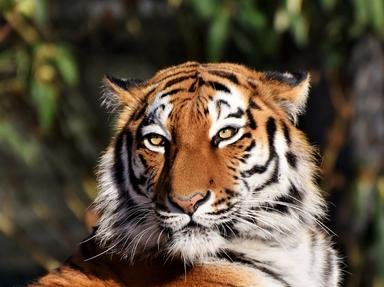
Tiger - The tiger is the largest of all the wild cat species and is easily recognized by its dark vertical stripes on orange (or yellow, if you are an insane person) fur. These solitary hunters live in diverse habitats across Asia, ranging from freezing Siberian forests to tropical mangrove swamps. Unfortunately, they are endangered due to habitat loss and illegal poaching for their beautiful skins and body parts, used to enhance flagging (ahem) male virility.
Lion - Known as the "king of the jungle," the lion is the only wild cat that lives in large, social family groups, called prides. Most wild lions roam the grassy savannas of sub-Saharan Africa, though a small, endangered population also lives in India's Gir Forest. Male lions are famous for their thick, majestic manes, which protect their necks during fights with rivals.
Leopard - The leopard is a highly adaptable predator famous for its incredible climbing ability and stealthy hunting habits. They often haul heavy prey up into the branches of trees to keep it safe from scavengers like hyenas and lions. Their fur is covered in beautiful, rose-shaped spots called rosettes, which provide camouflage in forests and grasslands.
Jaguar - The jaguar is the largest cat in the Americas and possesses one of the most powerful bites in the world, able to pierce the shells of turtles and the skull of humans. Unlike many other cats, jaguars absolutely love the water, and are excellent swimmers that frequently hunt for fish and caimans in rivers. They look very similar to leopards, but their rosettes have small spots inside them, and they have a much stockier build.
Serval - The serval is a slender, medium-sized wild cat native to the African savannas. It has the longest legs and largest ears relative to body size of any cat, which helps it see and hear prey over tall grass. These physical traits allow the serval to leap up to three meters (nearly ten feet) into the air to snatch birds right out of the sky.
Caracal - The caracal is a striking, reddish-gold cat with long, dramatic tufts of black hair on the tips of its ears. They live in the dry woodlands and savannas of Africa and the Middle East. Like the serval, it is a spectacular jumper that can leap high into the air to knock down flying birds with its paws.
Ocelot - The ocelot is a medium-sized nocturnal cat that inhabits the brush lands and tropical forests of South and Central America. Its coat features a beautiful pattern of chain-like spots and stripes, which sadly made (and still makes) it a prime target for the fur trade.
Margay - The margay looks very similar to the ocelot but is smaller and specifically adapted for a life spent almost entirely in the trees. It possesses unique ankle joints that can rotate 180 degrees, allowing it to climb down tree trunks headfirst like a squirrel.
Colocolo - The colocolo is a small, mysterious wild cat native to various habitats in South America, including the high Andes mountains and dry grasslands. It features a thick, grayish-brown coat with dark stripes on its legs and a relatively short, bushy tail. Because it is small and naturally secretive, scientists still have a lot to learn about its specific hunting habits and lifestyle.
Oncilla - The oncilla, also known as the little spotted cat, is one of the smallest wild cat species found in Central and South America. It weighs only about four to six pounds (under 2 kg to 2.7 kg) and looks like a miniature leopard with a slender body and large ears.
Kodkod - The kodkod holds the title of the smallest wild cat species in the Americas, weighing less than five pounds (2.3 kg). Found mostly in the temperate rainforests of Chile and Argentina, this tiny predator faces threats from logging and habitat destruction.
Lynx - The lynx is a medium-sized cat adapted for cold northern climates, featuring thick fur and large, snowshoe-like paws that help it walk on deep snow. Its most recognizable features are the short, stubby tail and the pointed tufts of black hair on its ears. This silent predator relies so heavily on the snowshoe hare as its primary food source, that their population numbers rise and fall together.
Puma - The puma, also known as the cougar or mountain lion, has the largest geographic range of any native land mammal in the Western Hemisphere. This powerful predator can survive in deserts, rainforests, and snowy mountains, stretching all the way from Canada to the southern tip of South America.
Jaguarundi - The jaguarundi is an unusual-looking cat native to the Americas that features a long, slender body, short legs, and a flattened head that makes it resemble a weasel or an otter. Unlike most other wild cats, it is primarily active during the day and has a solid-colored coat that is either reddish-brown or dark gray. They are skilled climbers but prefer to do most of their hunting on the ground, searching for birds and small mammals.
Manul - The manul, also known as Pallas's cat, lives in the cold, high-altitude grasslands and deserts of Central Asia. It has the longest and densest fur of any wild cat, which keeps it warm in freezing temperatures and makes it look much larger and rounder than it actually is. With its flat head, low-set ears, and funny facial expressions. Because of its expressive face, it has become very popular on internet memes.
The Not Cats
Stoat - The stoat is a small, energetic predator belonging to the weasel family that is native to North America and Eurasia. Despite its small size, this fierce carnivore is a highly skilled hunter capable of tackling prey much larger than itself, such as rabbits.
Macaque - Macaques are a highly adaptable group of monkeys found primarily throughout Asia, though one species lives in North Africa and Gibraltar.
Hellbender - The hellbender is a giant, entirely aquatic salamander native to the fast-flowing, rocky rivers of the eastern United States. It has a flat body, wrinkled skin that helps it absorb oxygen directly from the water, and tiny eyes that are sensitive to light.
Sarcastic Fringehead - The sarcastic fringehead is a small but, exceptionally aggressive, fish that lives in shells and rock crevices along the Pacific coast of North America. It is famous for its massive, brightly colored mouth, which it flares open widely to scare away rivals and defend its territory. When two males fight over a hiding spot, they press their oversized mouths together in a bizarre wrestling match to see who is bigger.
Sparklemuffin - Nope, not a My Little Pony, the sparklemuffin is the colorful nickname given to a specific species of Australian peacock spider discovered in 2015. Male spiders feature vibrant blue, red, and yellow patterns on their abdomens, which they use to capture the attention of females.
Gobi jerboa - The Gobi jerboa is a tiny, desert-dwelling rodent native to the harsh grasslands and deserts of Mongolia and China. It looks like a miniature kangaroo because it has incredibly long hind legs that allow it to hop fast and jump high to escape predators.
This quiz was reviewed by FunTrivia editor rossian before going online.
Any errors found in FunTrivia content are routinely corrected through our feedback system.