FREE! Click here to Join FunTrivia. Thousands of games, quizzes, and lots more!
Quiz about Live Like a Cat

Live Like a Cat Trivia Quiz


There are a wide variety of wild cats to be found around the globe. These amazing hunters are sleek and powerful... and beautiful! You should be able to size up your chances on whether you can figure out how to organize these felines into like groups.

by reedy. Estimated time: 3 mins.
  1. Home
  2. »
  3. Quizzes
  4. »
  5. Animal Trivia
  6. »
  7. Carnivores
  8. »
  9. Felidae-Cat Family

Author
reedy
Time
3 mins
Type
Quiz #
422,199
Updated
Dec 08 25
# Qns
12
Difficulty
Easy
Avg Score
10 / 12
Plays
43
Last 3 plays: Guest 70 (12/12), japh (12/12), Reamar42 (10/12).
???
???
???

Caracal Guiņa Flat-headed cat Lion Cougar Tiger Serval Rusty-spotted cat Jaguar Black-footed cat Ocelot Bobcat

* Drag / drop or click on the choices above to move them to the correct mystery boxes.


Most Recent Scores
Today : Guest 70: 12/12
Today : japh: 12/12
Today : Reamar42: 10/12
Today : Guest 76: 12/12
Today : Guest 66: 0/12
Today : Mookie325: 12/12
Today : Guest 108: 6/12
Today : absrchamps: 10/12
Today : MacaroniTree: 10/12

Quiz Answer Key and Fun Facts
1. Guiņa

Answer: Smallest Wild Cats

The guiņa, or kodkod (Leopardus guigna), is a small spotted cat found in temperate forests of Chile and parts of Argentina. It favours dense vegetation and fragmented landscapes, often near human activity. Despite its adaptability, deforestation and habitat fragmentation pose significant risks. Globally, it is considered least concern, but regional assessments often classify it as vulnerable.
2. Flat-headed cat

Answer: Smallest Wild Cats

The flat-headed cat (Prionailurus planiceps) is a small, elusive feline specialized for wetland habitats. It has a distinctive head shape and semi-webbed feet, which are adaptations for catching aquatic prey. Found in parts of Southeast Asia, including Sumatra and Borneo, this species depends on healthy riverine ecosystems. Ongoing deforestation and water pollution have severely impacted its numbers, making it an endangered species.
3. Black-footed cat

Answer: Smallest Wild Cats

One of the smallest wild cats, the black-footed cat (Felis nigripes) weighs only a few kilograms and has a compact body suited for life in arid regions. It is native to southern Africa, where it occupies grasslands and scrub deserts. Despite its size, this species is a formidable hunter, adapted to its harsh environment.

Its population is declining due to habitat degradation and disease, placing it in the vulnerable category.
4. Rusty-spotted cat

Answer: Smallest Wild Cats

Among the tiniest wild cats, the rusty-spotted cat (Prionailurus rubiginosus) is native to India and Sri Lanka, with a few populations in Nepal. It inhabits forests, scrublands, and grasslands, often near human settlements. Despite its small size, it is an agile and efficient predator. Habitat loss and fragmentation have led to its classification as near threatened, though it remains relatively widespread in some areas.
5. Bobcat

Answer: Mid-Sized Wild Cats

The bobcat (Lynx rufus) is a robust, medium-sized wild cat native to North America. It thrives in varied environments, including forests, deserts, and wetlands. Adaptable and widespread, it ranges from southern Canada through the United States into northern Mexico. Its population is stable overall, earning it a least concern status, though localized threats exist in some areas.
6. Caracal

Answer: Mid-Sized Wild Cats

The caracal (Caracal caracal) is a medium-sized cat recognized for its long, tufted ears and athletic build. It occupies diverse habitats, from African savannas to semi-deserts and woodlands in Asia. Known for its remarkable leaping ability, the caracal primarily hunts birds and small mammals.

While globally listed as least concern, regional populations face pressure from habitat loss and persecution.
7. Ocelot

Answer: Mid-Sized Wild Cats

The ocelot (Leopardus pardalis) is a medium-sized cat with striking markings, native to tropical and subtropical regions of the Americas. It inhabits forests, savannas, and mangroves, ranging from South America to parts of Mexico and southern Texas. Although generally stable, habitat loss and illegal hunting have reduced numbers in some areas, making conservation efforts important.
8. Serval

Answer: Mid-Sized Wild Cats

The serval (Leptailurus serval) is a slender, long-legged cat adapted to hunting in tall grasses of African savannas and wetlands. Its exceptional jumping ability allows it to catch birds and rodents with precision. Widespread across sub-Saharan Africa, the serval is classified as least concern, though local populations may decline due to habitat conversion and hunting.
9. Cougar

Answer: Largest Wild Cats

Also known as the mountain lion, the cougar (Puma concolor) is a versatile predator found across the Americas. It occupies forests, mountains, deserts, and grasslands, demonstrating remarkable adaptability. While globally listed as least concern, certain isolated populations, such as the Florida panther, are critically endangered due to habitat fragmentation and human conflict.
10. Jaguar

Answer: Largest Wild Cats

The jaguar (Panthera onca) is the largest cat in the Americas, with a powerful build and a preference for dense forests and wetlands. Its range extends from Mexico through Central America into South America, with the Amazon basin hosting the largest populations. Jaguars are apex predators but face threats from habitat loss and poaching, leading to their near threatened status.
11. Lion

Answer: Largest Wild Cats

Lions (Panthera leo) are among the most iconic big cats, known for their muscular build and social behavior. Males are significantly larger than females, and both thrive in open habitats such as savannas and grasslands. Historically widespread, lions now primarily occur in sub-Saharan Africa, with a small population surviving in India's Gir Forest.

They face threats from human conflict and habitat encroachment, earning them a global status of vulnerable, with Asiatic lions considered endangered.
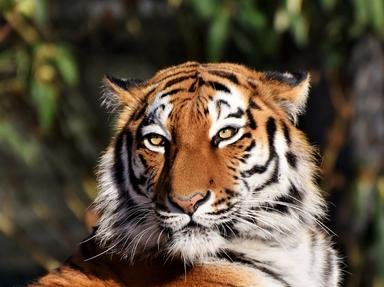
12. Tiger

Answer: Largest Wild Cats

The tiger (Panthera tigris) is the largest of all wild cats, with males often weighing several hundred kilograms and reaching lengths of up to three meters. These powerful predators inhabit a variety of environments, including tropical forests, mangroves, and grasslands across Asia.

Their range is fragmented, stretching from India and Nepal to parts of Southeast Asia and the Russian Far East. Tigers are currently classified as endangered due to habitat loss, poaching, and declining prey populations.
Source: Author reedy

This quiz was reviewed by FunTrivia editor rossian before going online.
Any errors found in FunTrivia content are routinely corrected through our feedback system.
12/8/2025, Copyright 2025 FunTrivia, Inc. - Report an Error / Contact Us