FREE! Click here to Join FunTrivia. Thousands of games, quizzes, and lots more!
What Am I? Trivia Quiz
Here is a compilation of 15 animals, with ten of them classified as either apes or monkeys. Your objective is to determine the group to which each of these animals belongs. Good luck and have fun. Digby
A classification quiz
by Lord_Digby.
Estimated time: 3 mins.
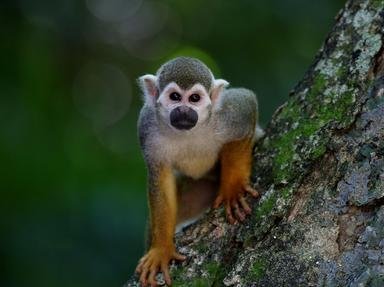
You'll find the capuchin monkeys in Central and South America, particularly in Honduras, Nicaragua, Costa Rica, Brazil, Argentina, and Paraguay. Their name originates from the capuchin friars, as the fur on their heads resembles the hoods that these monks wear. This species spends most of its life among the trees. Sometimes they will leave the canopy and go to ground level to find water or hunt for insects.
Capuchin monkeys are very intelligent and are known to use tools like sticks and stones to help with finding food and breaking open nuts.
2. Mandrill
Answer: Monkey
Mandrills are the largest species of monkey on earth. The face of a mandrill is a beautiful colour, with the face having blue and red skin with a yellow beard. The body is a brownish olive with a red/pink rear end. They spend most of the time on the ground, but at nighttime they sleep in the trees. They live in groups known as troops, which usually comprise one male and up to 20 females, along with their young. Sometimes troops join forces with other troops; these are known as 'hordes' and can grow up to several hundred and possibly run into thousands.
The primary diet of mandrills consists of fruits, roots, insects, and small reptiles and amphibians.
3. Marmoset
Answer: Monkey
The marmoset is a small monkey that can be found in South American rainforests. Marmosets are arboreal animals, which means they spend just about all their lives high up in the trees. The primary diet of the marmoset, which consists of tree sap, gum, and insects, is found along the trunks and branches high above the forest floor.
The tails of the marmoset are not prehensile, unlike some of the New World monkeys, like the capuchins and squirrel monkeys. This basically means the marmoset is unable to use their tails for gripping objects. It does have a long tail compared to its body; this helps with their balance while they run along tree branches.
4. Baboon
Answer: Monkey
The baboon comes from Africa and Arabia and can be found in the savanna and tropical forests. As they are omnivores their diet includes fruits, grass, seeds, roots, birds, rodents, antelopes, and smaller monkeys.
In contrast to other monkeys, they predominantly spend most of the day on the ground. However, they do climb trees to forage for food, and at night, they can rest in trees or on elevated rocks and cliffs to avoid predators. Unlike other Old World monkeys, baboons lack prehensile tails that would allow them to grasp branches.
They have strong jaws with sharp canine teeth, which can be two inches (50mm) long; they also have the same number of teeth as us humans, 32 to be precise. Their eyes are quite close together. Another distinctive feature of the baboon is the rear end, which is red.
5. Muriqui
Answer: Monkey
Muriquis also known as woolly spider monkeys. There are two types of muriqui: the Southern muriqui and the Northern. Both of these animals can only be found in Brazil. Sadly, the Northern muriqui is in danger of becoming extinct due to its habitat being destroyed, although there are some measures to help keep this species alive.
Their main diet consists of leaves from several types of trees and fruit. They are also known to eat a few flowers, buds and bark. All muriquis possess a prehensile tail, which is a specialised tail utilised for movement under the branches rather than on top, a feature found in only a limited number of New World monkey species. The small, or absent thumb, along with the prehensile tail observed in muriquis, is associated with the movement patterns that define the species, with suspensory climbing and rapid swinging from branch to branch
6. Gorilla
Answer: Ape
The gorilla can be found in several places in Central Africa, including Cameroon, Gabon, and the Republic of the Congo. There are two subspecies: the Eastern Gorilla (Mountain Gorilla) and Western Gorilla (Lowland Gorilla). These subspecies live in different regions of Africa.
Generally, the gorillas are herbivores, as they mainly eat a mixture of leaves, stems, and shoots; however, the lowland gorillas do eat fruit when available. Out of all the apes, the gorilla is the largest and can weigh over 200 kg (440 lb) and stand six feet tall (1.8 m).
Gorillas have hair and not fur, they have fingernails and not claws, and they also have an opposable thumb, so it can move toward and touch the other fingers on the same hand.
7. Chimpanzee
Answer: Ape
Chimpanzees can be found in equatorial Africa. They live in the tropical rainforests and woodlands in several African countries, including Republic of the Congo, Somalia, Kenya and Uganda.
Chimpanzees are very similar to us humans. They use tools and use their hands just like us to remove dirt, insects, and dead skin from their fur. They are known to groom other animals in their communities, as it helps to bond with other chimps.
Members of the group have to keep to established rules within their communities. The boss is an alpha male, and each member understands their rank within the hierarchy. While these rules are generally very strict, they can occasionally be tested, especially when a male seeks to take over the group. It is noteworthy that the leader is not necessarily the strongest or largest chimp; instead, it is often the one who has cultivated strong alliances with fellow chimps and has the political skills required to maintain leadership.
Chimpanzees are omnivores, so they can eat many types of food. Figs are a big part of a chimpanzee's diet, with a large variety of fruits on the menu. When fruits are in short supply, they will also eat leaves, flowers, seeds, and honey and are even known to eat a small amount of meat.
8. Orangutan
Answer: Ape
The only places you'll find the orangutan are Borneo and Sumatra. To keep themselves safe, they spend most of their lives high up in the tree canopy. They eat, sleep, and breed in the trees. Most of the food can be found in the canopy. 60% of the orangutan's diet consists of fruits, and the rest of the diet is made up of leaves, figs, flowers, and young shoots directly from branches.
Orangutans are, in general, solitary animals, especially the males who prefer to be on their own. The female will look after her young between six and eight years, maybe because they only give birth every eight years. The males are bigger than the females and can weigh between 50 and 130 kg (110 to 285 lb). In comparison, the female weighs around 30 to 54 kg (66 to 120 lb)
9. Bonobo
Answer: Ape
The bonobo's habitat is exclusively found in regions south of the Congo River, within the Democratic Republic of the Congo, Central Africa. Their diet primarily consists of fruit, along with various plants and small animals. Bonobos inhabit both mature and younger forests, including wetlands. Previously, the bonobo was referred to as the "pygmy chimpanzee," a term introduced in 1929 by the German zoologist Ernst Schwarz.
Unlike some of the apes, the bonobo group is run by an alpha female leader. Although male bonobos are individually larger than females, the females assert their dominance by creating strong coalitions. They spend their time on the ground slightly more than being in the trees but will make nests in the trees at nighttime for sleeping and very occasionally will make a nest on the ground.
10. Gibbon
Answer: Ape
Gibbons can be found in several places in East, South, and Southeast Asia. China, Myanmar, Cambodia, and the islands of Sumatra, Borneo, and Java are all home for these apes. Gibbons spend most of the time in the trees but will go to ground level when required. With their very long arms, they can move around the trees with ease. Being omnivores, they have a wide range of food they can eat. Generally speaking, the diet of the gibbon would be 60% fruit and 20% leaves and shoots. The rest of the diet can be a mixture of flowers, nectar, insects, and bird eggs.
Males and females are more or less the same size, but the fur can be of various colours. Black, gray, brown, sandy buff, and cream are all typical of the variations. A fascinating aspect of the gibbon is its wrist, which allows for biaxial movement because it features a ball-and-socket joint. This capability aids in alleviating stress on the shoulder joint.
11. Lemurs
Answer: Neither
Lemurs can only be found on the island of Madagascar. They are neither monkeys nor apes but are primates. According to scientists, there are over 100 species and subspecies of lemur. The smallest lemur is called the Madame Berthe's mouse lemur, which is also the smallest primate in the world. It will fit in your hand, as it's only around 3.5 inches long (9 cm).
Many people will have heard of the ring-tailed lemur, as it's easy to identify with its black and white fur and its black and white hooped tail. Females are the boss of the group or troop and will stay with the same troop for their whole life. Males, on the other hand, will sometimes switch to other groups. Groups can vary from five or six up to around forty members.
The diet of the lemur is mainly fruit, with plants and flowers on the menu.
12. Lorises
Answer: Neither
The lorises are classified as primates. They are cute and small and live alone, spending most of their lives in the trees. Being nocturnal, these animals are primarily active during the night. They are part of the genus Nycticebus. Their habitats are found in the warm, humid tropical rainforests of South-east Asia, including India, Indonesia and Sri Lanka.
There are several species of lorises and subspecies. Bengal, Javan, and pygmy slow lorises, but they are all of the same genus, Nycticebus. Lorises are classified as omnivores, so in general they eat lots of fruit, insects, small animals, and fresh young plants.
13. Tarsier
Answer: Neither
The tarsiers are small primates about the size of a squirrel. Tarsiers are found only on the forested islands of maritime Southeast Asia, such as Brunei, Indonesia, Malaysia, and the Philippines. They are the only primates that are completely carnivorous, primarily feeding on insects. They are famous for their large eyes, with each eyeball sometimes being larger and heavier than their brain.
To navigate through the trees, they mainly jump from branch to branch. To grab on to trees, they have a hairless tail and adapted fingers that have rounded pads to help their grip. To complement their eyes, the tarsier can also turn their heads 180 degrees to either side while searching for food
14. Sloth
Answer: Neither
Sloths are incredibly slow, arboreal mammals found in the tropical rainforests of Central and South America. There are two distinct species of sloths: the two-toed sloth and the three-toed sloth. They live their lives in these tropical rainforests. The sloths benefit from areas with regular rainfall and a thick tree population.
The sloth belongs in the class of Mammalia, the order Pilosa. While they may look like monkeys, they are in fact related to the armadillos and anteaters. They leave the tree canopy once a week to get rid of their waste. The diet of a sloth depends on if it's a two- or three-toed sloth. The two-toed sloth is an omnivore, while the three-toed sloth is an herbivore. The later will eat leaves, insects, and fruit, while the two-toed will only eat leaves 99% of the time.
15. Slow loris
Answer: Neither
The slow loris is a distinct type of primate belonging to the suborder Strepsirrhini. They can be found in the tropical and subtropical forests of India, China, Bangladesh, Cambodia and Thailand to name a few. For safety reasons the loris prefers to live in the forest where the trees are very high and have very thick foliage. Being nocturnal they sleep in the daytime and go and search for food at night time.
Lorises are omnivorous animals that consume a variety of foods, including insects such as slugs and bugs, as well as fruit, leaves, and eggs taken from bird nests. Sometimes they satisfy their thirst by licking water droplets from leaves.
A notable feature of the loris is its large, round eyes. The eyes of a loris can make images look bigger and closer, providing them with outstanding vision. Their sizable eyes also help them to accurately gauge distances, which makes navigation through the rainforest easier. Another interesting fact about their eyes is they have a special reflective layer on the outside, which enables the loris to see in dim light.
This quiz was reviewed by FunTrivia editor rossian before going online.
Any errors found in FunTrivia content are routinely corrected through our feedback system.