FREE! Click here to Join FunTrivia. Thousands of games, quizzes, and lots more!
Quiz about Brazils Natural Wonders

Brazil's Natural Wonders Trivia Quiz


Brazil is home to many of the world's incredible natural wonders. Here are ten such beauties in this interesting and informative photo quiz.

A photo quiz by trident. Estimated time: 3 mins.
  1. Home
  2. »
  3. Quizzes
  4. »
  5. Geography Trivia
  6. »
  7. South America
  8. »
  9. Brazil

Author
trident
Time
3 mins
Type
Photo Quiz
Quiz #
413,657
Updated
Apr 27 26
# Qns
10
Difficulty
Easy
Avg Score
9 / 10
Plays
338
Awards
Top 5% quiz!
Last 3 plays: Midget40 (10/10), Guest 89 (9/10), Guest 76 (5/10).
-
Question 1 of 10
1. Iguazu Falls is easily one of the most beautiful locations on the planet, with its series of waterfalls (the largest system in the world) following a horseshoe-like row. The falls line the border between Brazil and what other large South American country? Hint


Question 2 of 10
2. Nearly 80% of this region's floodplains are underwater during rainy seasons, and it is home to countless plant and animal species. What is the name of this massive Brazilian wetland? Hint


Question 3 of 10
3. The Meeting of Waters in Manaus, Brazil, is a fascinating look at the confluence between the Solimões River (part of the Amazon) and the Rio Negro. Due to differences in the content of each body of water, a striking contrast is created. What is the cause of the brown-colored water?


Question 4 of 10
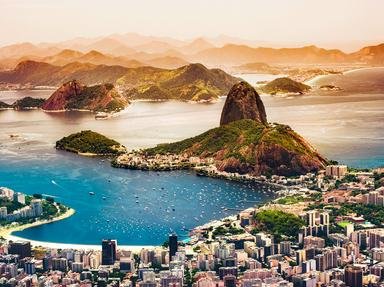
4. Sugarloaf Mountain, at the mouth of Guanabara Bay, is a popular location on which you can take a cable car. In which Brazilian city is it located? Hint


Question 5 of 10
5. The region of Jalapão, with its orange sand dunes, comprises the second largest hot desert on Earth after the Sahara.


Question 6 of 10
6. A popular locale for tourists, performers, and even athletes, which beach in Rio de Janeiro is flanked by two forts, one at each end? Hint


Question 7 of 10
7. With an elevation of 2,995 meters (9,827 ft) above sea level, Pico de Neblina is taller than Mount Aconcagua in Argentina.


Question 8 of 10
8. Due to the impermeable rock layer covering its base, Lençóis Maranhenses National Park is home to a large number of what natural features? Hint


Question 9 of 10
9. Known as "Diamond Plateau" in English, which region was once the world's largest diamond producer?


Question 10 of 10
10. The most common accounting of how the Amazon rainforest got its name is from which of the following, who encountered a tribe of female warriors? Hint


(Optional) Create a Free FunTrivia ID to save the points you are about to earn:

arrow Select a User ID:
arrow Choose a Password:
arrow Your Email:


View Image Attributions for This Quiz

Most Recent Scores
May 04 2026 : Midget40: 10/10
Apr 19 2026 : Guest 89: 9/10
Apr 03 2026 : Guest 76: 5/10
Apr 01 2026 : ozzz2002: 10/10
Mar 25 2026 : Guest 62: 8/10
Mar 23 2026 : Guest 143: 7/10

Quiz Answer Key and Fun Facts
1. Iguazu Falls is easily one of the most beautiful locations on the planet, with its series of waterfalls (the largest system in the world) following a horseshoe-like row. The falls line the border between Brazil and what other large South American country?

Answer: Argentina

Iguazu Falls stretches across the border between Brazil and Argentina and is often considered one of the most impressive natural sites in the world. The falls form a wide, horseshoe-like system that extends for about 1.7 miles (2.7 kilometers). Located within Iguazu National Park, a UNESCO World Heritage Site, they are fed by the Iguazu River as it flows through dense rainforest. Their formation goes back millions of years and is tied to volcanic activity and shifting tectonic plates.

There are roughly 275 individual cascades, with the most famous being the Devil's Throat, a massive U-shaped drop that plunges dramatically downward. While Iguazu is not the tallest waterfall in the world, its combination of width, height, and surrounding jungle makes it especially memorable, drawing in around 1.5 to 2 million visitors each year.
2. Nearly 80% of this region's floodplains are underwater during rainy seasons, and it is home to countless plant and animal species. What is the name of this massive Brazilian wetland?

Answer: Pantanal

Pantanal ranks among the largest tropical wetlands on Earth, covering more than 75,000 square miles. It formed over time as the Paraguay River shifted course and created an enormous floodplain. The region moves through clear wet and dry seasons, and those changes shape everything about the landscape.

From November to March, heavy rains cause much of the area to flood, while the dry season from May to October brings lower water levels. This cycle supports an incredible range of life. The Pantanal is home to over 1,000 bird species and 300 kinds of fish, along with animals such as jaguars, capybaras, and giant otters. Plants like water hyacinths and Victoria amazonica thrive in the wetlands, while palms and hardwood trees dot the surrounding savannah.
3. The Meeting of Waters in Manaus, Brazil, is a fascinating look at the confluence between the Solimões River (part of the Amazon) and the Rio Negro. Due to differences in the content of each body of water, a striking contrast is created. What is the cause of the brown-colored water?

Answer: sediment from the Andes Mountains

At Manaus, the Meeting of Waters shows two major rivers flowing side by side without mixing right away. The Solimoes River and the Rio Negro meet there, creating a sharp contrast between muddy brown and dark water. This effect comes from differences in temperature, speed, and composition.

The Rio Negro begins in Colombia and carries tannins and organic material, which give it a dark color. The Solimoes, part of the Amazon system, originates in the Andes and carries sediment, which makes its water appear brown. When they meet, the cooler Rio Negro and the warmer Amazon flow alongside each other for several miles. The difference in temperature and speed keeps them from blending immediately.
4. Sugarloaf Mountain, at the mouth of Guanabara Bay, is a popular location on which you can take a cable car. In which Brazilian city is it located?

Answer: Rio de Janeiro

At the entrance to Guanabara Bay, Sugarloaf Mountain rises above the surrounding landscape in Rio de Janeiro. The name dates back to the 16th century, when its shape reminded Portuguese settlers of the sugar loaves used in Europe. The mountain itself formed millions of years ago and is made mainly of granite and quartz.

Standing about 396 meters (1,299 feet) tall, it offers wide views of the city and coastline. One of the most popular ways to reach the top is by cable car, a system first introduced in 1912. The ride happens in two stages and gives visitors a clear view of Rio, including Copacabana Beach and the Christ the Redeemer statue.
5. The region of Jalapão, with its orange sand dunes, comprises the second largest hot desert on Earth after the Sahara.

Answer: False

Jalapao, located in the state of Tocantins, is known for its incredible landscapes, especially its orange sand dunes. Even so, it is nowhere near the size of the world's largest deserts. Covering about 34,000 square kilometers, it is much smaller than the Sahara or the Arabian Desert. The region has a semi-arid climate, with hot days and cooler nights.

The area supports plants adapted to dry conditions, including golden grass, which local artisans use to make jewelry and decorative items. The cerrado biome in Jalapao also includes palms, tall grasses, flowering plants, and shrubs. Wildlife such as jaguars, giant anteaters, maned wolves, and armadillos live there, along with many bird species like toucans, parrots, and macaws.
6. A popular locale for tourists, performers, and even athletes, which beach in Rio de Janeiro is flanked by two forts, one at each end?

Answer: Copacabana

Copacabana Beach stretches along Rio de Janeiro's coastline for about 4.5 kilometers and is easy to recognize from its curved shape. It sits between the ocean and the surrounding hills, with Sugarloaf Mountain nearby. At each end of the beach, there is a fort. Fort Copacabana stands on the southern side and now serves as a military museum, while the Forte Duque de Caxias marks the northern end.

The beach draws a wide mix of visitors, from tourists to athletes. People often gather there for volleyball and soccer, and the atmosphere frequently includes music and dancing, especially samba.
7. With an elevation of 2,995 meters (9,827 ft) above sea level, Pico de Neblina is taller than Mount Aconcagua in Argentina.

Answer: False

Pico da Neblina rises in the Amazon Rainforest near the border with Venezuela and stands as the highest peak in Brazil. It reaches about 2,995 meters (9,827 feet), though it is much shorter than Aconcagua in Argentina, which is the tallest mountain in South America. The first recorded climb to the summit took place in 1965 during a Brazilian military expedition.

The surrounding environment supports a wide range of plant life, including orchids and bromeliads, along with other rainforest species. Its remote location provides a habitat for animals such as jaguars, tapirs, and many types of birds.
8. Due to the impermeable rock layer covering its base, Lençóis Maranhenses National Park is home to a large number of what natural features?

Answer: freshwater lagoons

Lençois Maranhenses National Park stands out because of its unusual landscape. Although it looks like a desert, it fills with water during the rainy season. From January to June, rain from the nearby Amazon Basin collects between the dunes, forming thousands of clear freshwater lagoons.

The dunes themselves can reach heights of about 40 meters and are shaped by constant winds. Even in this harsh setting, life persists. The lagoons support fish and amphibians, while the surrounding area includes grasses, cacti, and succulents. Birds such as herons and seagulls appear there, along with migratory species at certain times of the year.
9. Known as "Diamond Plateau" in English, which region was once the world's largest diamond producer?

Answer: Chapada Diamantina

Chapada Diamantina, located in Bahia, formed through geological changes that took place over millions of years. These include the uplift of ancient seabeds and volcanic activity, which created its rough terrain. The region contains a wide variety of minerals, including quartz, amethyst, and agate.

During the 19th century, it became one of the world's leading sources of diamonds. The town of Lencois developed as a center for this trade and still reflects that period through its preserved colonial architecture.
10. The most common accounting of how the Amazon rainforest got its name is from which of the following, who encountered a tribe of female warriors?

Answer: a Spanish conquistador

The Amazon rainforest, the largest tropical rainforest on Earth, developed over millions of years through a combination of geological and climate changes. It spans nine South American countries and supports an enormous range of life. Scientists estimate there are around 390 billion trees across about 16,000 species.

The region includes canopy trees, medicinal plants like the Cinchona tree, and many types of orchids. Wildlife is just as diverse, with animals such as jaguars, sloths, and capybaras, along with birds like toucans and parrots. One well-known story connected to the Amazon involves Francisco de Orellana, a Spanish conquistador. During a 1541 expedition, his group encountered female warriors, which inspired the name "Amazonas."
Source: Author trident

This quiz was reviewed by FunTrivia editor agony before going online.
Any errors found in FunTrivia content are routinely corrected through our feedback system.
5/6/2026, Copyright 2026 FunTrivia, Inc. - Report an Error / Contact Us