FREE! Click here to Join FunTrivia. Thousands of games, quizzes, and lots more!
Quiz about How Long Ha Long

How Long, Ha Long? Trivia Quiz

A Sampling of Vietnam's Geography

Here are ten questions about the geography of Vietnam. From fantasy formations and terraced terrains to mighty metropolises and the occasionally noisy northern neighbor, here you'll get taste of Vietnam (spoiler: tastes a lot like chicken). Enjoy!

A photo quiz by JJHorner. Estimated time: 3 mins.
  1. Home
  2. »
  3. Quizzes
  4. »
  5. Geography Trivia
  6. »
  7. Asia
  8. »
  9. Vietnam

Author
JJHorner
Time
3 mins
Type
Photo Quiz
Quiz #
423,270
Updated
Mar 02 26
# Qns
10
Difficulty
Easy
Avg Score
8 / 10
Plays
28
Last 3 plays: Guest 113 (9/10), Guest 170 (3/10), cardsfan_027 (10/10).
-
Question 1 of 10
1. Which of the following Vietnamese cities, located near the country's geographic midpoint along the coast, was once known as Tourane? Hint


Question 2 of 10
2. What mountain range runs along much of Vietnam's western border with Laos? Hint


Question 3 of 10
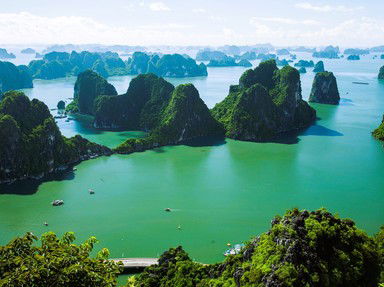
3. Which famous bay in northeastern Vietnam is known for its limestone karsts and is a UNESCO World Heritage Site? Hint


Question 4 of 10
4. Which Vietnamese city is home to the War Remnants Museum and the Notre-Dame Cathedral Basilica of Saigon? Hint


Question 5 of 10
5. Which river delta in southern Vietnam is one of the most agriculturally productive regions in all of Southeast Asia? Hint


Question 6 of 10
6. Which national park in central Vietnam contains some of the world's largest caves, including Son Doong Cave? Hint


Question 7 of 10
7. What mountainous town in northern Vietnam is known for terraced rice fields and ethnic minority cultures? Hint


Question 8 of 10
8. Which ancient city in central Vietnam is known for its well-preserved Old Town and historic trading port? Hint


Question 9 of 10
9. Which neighboring country lies directly north of Vietnam? Hint


Question 10 of 10
10. What former imperial capital of Vietnam is famous for its citadel and royal tombs along the Perfume River? Hint


(Optional) Create a Free FunTrivia ID to save the points you are about to earn:

arrow Select a User ID:
arrow Choose a Password:
arrow Your Email:


View Image Attributions for This Quiz

Most Recent Scores
Today : Guest 113: 9/10
Mar 02 2026 : Guest 170: 3/10
Mar 02 2026 : cardsfan_027: 10/10
Mar 02 2026 : sally0malley: 9/10
Mar 02 2026 : Jooga1: 3/10
Mar 02 2026 : goldwolf007: 7/10
Mar 02 2026 : maryhouse: 3/10
Mar 02 2026 : FlicksBuff: 6/10
Mar 02 2026 : winston1: 10/10

Quiz Answer Key and Fun Facts
1. Which of the following Vietnamese cities, located near the country's geographic midpoint along the coast, was once known as Tourane?

Answer: Da Nang

Da Nang sits close to the midpoint of Vietnam's skinny waistline, that curvaceous S-shaped stretch of land that looks like it's in mid-twirl on a map if you really use your imagination. It hugs the South China Sea and practically splits the distance between Hanoi in the north and Ho Chi Minh City in the south. I'm sure geography teachers love it. So do travelers who realize they can bounce from beaches to mountains to ancient towns, all before they can finish a cup of that crazy-strong Vietnamese coffee.

The city has had more than one identity over the centuries. It was a major port during the Champa Kingdom, then later was known to the French colonials as Tourane during the Vietnam War. Today it's a rapidly growing coastal city with attractive bridges like the Dragon Bridge, which actually breathes fire on weekend nights... if subtlety is not your thing. A short drive away is Hoi An, and over the Hai Van Pass you get views that make you forgive the unforgiving humidity.
2. What mountain range runs along much of Vietnam's western border with Laos?

Answer: The Annamite Range

The Annamite Range is also known as the Truong Son Mountains, and it's the rugged spine stretching along much of Vietnam's western border with Laos. It is not a very tidy border either. It's wild, forested, and in places still very much untamed. The range runs roughly north to south and has impacted everything from weather patterns to wartime strategy.

During the Vietnam War, parts of the Ho Chi Minh Trail wound through this terrain, threading supply routes through dense jungle and steep ridges. In the here and now, the region is better known for its biodiversity than its battle lines. New species have been discovered there in recent decades, including the saola, sometimes called the Asian unicorn... which sounds really cool until you see a photograph, realize it's actually rocking two very normal horns, and then sadly sit and ponder the meaning of everything you thought you knew.
3. Which famous bay in northeastern Vietnam is known for its limestone karsts and is a UNESCO World Heritage Site?

Answer: Ha Long Bay

Ha Long Bay is what you get when a fantasy artist drinks too much of that crazy-strong Vietnamese coffee. Seriously, Gandalf would fit in just fine among the thousands of limestone karsts and islets that poke up out of the blue-green water in the Gulf of Tonkin, each one with a scruffy toupee of greenery slapped on the top. If you're wondering, the name means "Descending Dragon," but unlike the bridge in Da Nang, it won't breathe fire unless you chant the proper magic spells (ask the locals). The whole area is made for junk cruises, with very sappy descriptions like "...to help you find your own love in this highly evocative sea..." (Vietnam Escape tours).

It was designated a UNESCO World Heritage Site in 1994 for its natural beauty and geological value, but Ha Long Bay is more than just eye candy for travelers. Many of the karsts are covered in caves, some massive and cathedral-like, others snugger than I would ever care to experience. Archaeological evidence shows that humans have lived in the area for thousands of years. (No credible research is available for amiable old wizards.)
4. Which Vietnamese city is home to the War Remnants Museum and the Notre-Dame Cathedral Basilica of Saigon?

Answer: Ho Chi Minh City

Ho Chi Minh City doesn't exactly dance around the country's past. The War Remnants Museum lays it out very bluntly, with photographs and exhibits that confront the Vietnam War head on. And if you think the place holds a grudge about American intervention, well that's a big you-betcha. It is sobering, intense, and not really the kind of place to enjoy an ice cream cone with the kids.

When you step outside, you're in a big mix of motorbikes and street vendors, and the city roars on, unapologetically and very much alive.

Just a short ride away you'll find a stark contrast to the museum's accusing finger directed at western colonizers. That's the Notre-Dame Cathedral Basilica of Saigon, built by French colonists in the late 19th century, before the French decided Vietnam wasn't such a fun place. Its red bricks were imported from Toulouse. That's brand loyalty, I guess. The twin bell towers rise above downtown, in an ironic reminder that this city once officially answered to the name Saigon. Today it is Vietnam's largest city and an economic juggernaut, where skyscrapers and colonial facades compete for elbow room in the crowded skyline.
5. Which river delta in southern Vietnam is one of the most agriculturally productive regions in all of Southeast Asia?

Answer: The Mekong Delta

The Mekong Delta is called Vietnam's "Rice Bowl", but it's so much more. It's also a fruit basket and a seafood counter all rolled into one giant squishy landscape. Down where the Mekong River finally spits out into the South China Sea, it splinters into a maze of distributaries, canals, and floating markets. There you'll see boats piled high with dragon fruit, coconuts, and big old sacks of rice drifting past like grocery carts without the one wheel that won't quite align with the others. It is humid. It is fertile. And it's where the money is.

Covered with nutrient-rich sediment that was deposited over thousands of years, the delta produces more than 50% of Vietnam's rice and a huge share of its aquaculture, especially shrimp and catfish.

The region is where the frontiers of numerous cultures overlap, being home to ethnic Vietnamese, Khmer, and Chinese communities. Life here revolves around the waterways. When the river rises, fields flood. When it falls, planting starts anew.
6. Which national park in central Vietnam contains some of the world's largest caves, including Son Doong Cave?

Answer: Phong Nha-Ke Bang National Park

With a name like Phong Nha-Ke Bang National Park, it's got to be good. Points to our planet for totally strutting her stuff. Another UNESCO World Heritage Site, it's located near the Laos border. If you hear "National Park" and think wide open spaces, that's not this. Well, not exactly this. The park is essentially a labyrinth of caves carved in ancient limestone over hundreds of millions of years.

And then there is Son Doong Cave, which was discovered in 1991, and only fully explored in 2009. It's considered the largest cave passage in the world by sheer volume. It has its own jungle. Its own weather. It may declare independence any day. Just huge.

The park contains more than 300 caves and cavelets, including the photogenic Phong Nha Cave and Paradise Cave. Underground rivers sneak through chambers the size of cathedrals, collapsed ceilings provide spotlights for the scene and energy for plants that have no business growing that deep in a cave. I won't pretend to have been there, but I have been very disappointed at Crystal Cave in Pennsylvania. However, that should not really be mentioned in the same

paragraph as Phong Nha-Ke Bang.

But back to the national park. The photos online are stunning. The surrounding forest is certainly no slouch, albeit not the main attraction. Here you'll encounter lots of rare species and a vast array of biodiversity. But let's be honest. You want to go to the cave that would fit a skyscraper in it. Right?

RIGHT?

Of course you do.
7. What mountainous town in northern Vietnam is known for terraced rice fields and ethnic minority cultures?

Answer: Sa Pa

Sa Pa, pronounced kind of like "sah pah", which is easier than you'd think, perches up high in the Hoang Lien Son mountains near the Chinese border, where like much of Vietnam, it's often covered in mist. The terraced rice fields cascade down the tiered hillsides in brilliant green ripples during growing season, before donning their aureate coat of senescence at harvest.

And if that's too poetic for you, the fields look like big-honkin' green staircases built for giants, then they turn brown and die.

The town is also home to several ethnic minority groups, including the Hmong, Dao, Tay, Giay, and other peoples I won't try to pronounce. Their traditional clothing, markets, and village life are a central part of Sa Pa's identity, although I still vote for the giant steps.

French colonists first developed it as a hill station in the late 19th and early 20th centuries, drawn by the cool mountain air. Today, hikers rub elbows there as they trek through Muong Hoa Valley or attempt Fansipan, the highest peak in the country.
8. Which ancient city in central Vietnam is known for its well-preserved Old Town and historic trading port?

Answer: Hoi An

Hoi An is just a pretty place. Lanterns glow at dusk, wooden shop houses lean drunkenly with age, and the Thu Bon River meanders by as if it's just out for a little walk. From the 15th to the 19th century, Hoi An was a bustling hub of international trade, attracting merchants from Japan, China, Portugal, and beyond. The ghosts of the past are still very much visible here.

Its Old Town is a beautifully preserved blend of Vietnamese, Chinese, and Japanese architecture. You can check out assembly halls built by Chinese merchant communities. There are also old tube houses that disappointingly look nothing like tubes and the famous Japanese Covered Bridge, which has been standing since the late 1500s and does in fact look like a covered bridge. UNESCO gave Hoi An World Heritage status in 1999, and honestly, it clearly earned it. The place looks like something out of a museum or history book.

And those tube houses that don't look like tubes at all? Yeah, they're basically ultra-narrow row homes or terraced houses, depending on where you learned to speak English.
9. Which neighboring country lies directly north of Vietnam?

Answer: China

Yeah, it's China, which is one of the more pronounceable answers in this quiz. It stretches along Vietnam's entire northern border, a frontier that runs for roughly 1,400 kilometers (about 870 miles) from the mountains near Laos all the way to the Gulf of Tonkin. It's a boundary full of steep hills, winding rivers, and hectic border crossings where trucks rumble through with everything from electronics to dragon fruit.

Over the centuries, their relationship has been... well, it's complicated. Vietnam was under Chinese rule for more than a millennium before gaining independence in the 10th century. There have been periods of cultural exchange and cooperation punctuated with periods of open conflict, including a brief but very intense border war in 1979. But over a few thousand years, what relationship won't have its ups and downs?
10. What former imperial capital of Vietnam is famous for its citadel and royal tombs along the Perfume River?

Answer: Hue

The imperial capital we're looking for is Hue, which straddles the Perfume River in Thua Thien-Hue and is pronounced exactly as it doesn't look: "hway". From 1802 to 1945, it served as the imperial capital under the Nguyen dynasty, and the city still carries that certain whiff of regality. This massive Imperial City, encircled by thick stone walls and a moat (no alligators), forms the heart of the old citadel. Step through its gates and you're wandering through courtyards, temples, and palaces, while back in the city proper await markets, restaurants, and the usual nightlife.

Here and there along the Perfume River are the elaborate tombs of Nguyen emperors, each seemingly designed to show up the previous. Some of these are peaceful garden complexes. Others are big and grand and theatrical, combining traditional Vietnamese styles with colonial French influences. Hue received UNESCO World Heritage status in 1993 for its complex of monuments, and even after heavy damage during the 1968 Tet Offensive, restoration efforts have helped it reclaim its former glory.
Source: Author JJHorner

This quiz was reviewed by FunTrivia editor agony before going online.
Any errors found in FunTrivia content are routinely corrected through our feedback system.
3/3/2026, Copyright 2026 FunTrivia, Inc. - Report an Error / Contact Us