FREE! Click here to Join FunTrivia. Thousands of games, quizzes, and lots more!
Quiz about A Century of Unrest

A Century of Unrest Trivia Quiz

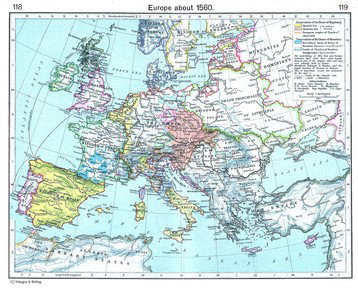
Europe in the 16th Century

The European continent underwent great changes during the 16th century, leading to constant strife, but also to major discoveries and innovations. This quiz will touch upon a few of these pivotal events.
This is a renovated/adopted version of an old quiz by author naylor182

A photo quiz by LadyNym. Estimated time: 3 mins.
  1. Home
  2. »
  3. Quizzes
  4. »
  5. History Trivia
  6. »
  7. European

Author
LadyNym
Time
3 mins
Type
Photo Quiz
Quiz #
223,466
Updated
Jun 26 26
# Qns
10
Difficulty
New Game
Avg Score
9 / 10
Plays
24
Last 3 plays: Waldkaeuzchen (4/10), gme24 (10/10), LukerOaks (7/10).
-
Question 1 of 10
1. The treatise "The Prince", written by Niccolò Machiavelli in 1513, is widely regarded as one of the founding works of modern political philosophy. What notorious military leader and pope's illegitimate son was the main inspiration for this work? Hint


Question 2 of 10
2. The round-the-world expedition led by Ferdinand Magellan, which departed Spain in 1519, made stops in a number of present-day countries. Which of these was NOT one of them? Hint


Question 3 of 10
3. In 1527, the mutinous troops of Holy Roman Emperor Charles V sacked what famous city? Hint


Question 4 of 10
4. In the autumn of 1529, the city of Vienna was besieged for two weeks by the army of what powerful ruler?


Question 5 of 10
5. What influential religious order, specialized in education, was founded in 1540 as part of the Catholic Church's response to the Protestant Reformation? Hint


Question 6 of 10
6. Ivan IV Vasilyevich, known as the Terrible, became the first Tsar of All Russia in 1547. He was succeeded by his youngest son, Feodor, in 1584. What happened to Ivan Ivanovich, Feodor's older brother and their father's heir?


Question 7 of 10
7. Who were the belligerents in the Eighty Years' War, which began in 1566 and ended in 1648 with the Peace of Münster? Hint


Question 8 of 10
8. Which of these major 16th-century battles was fought against the Ottoman Empire in 1571? Hint


Question 9 of 10
9. What was the name of the English castle, dismantled in the 1630s, where Mary Queen of Scots was imprisoned until her execution in 1587? Hint


Question 10 of 10
10. Henry III of Navarre became Henry IV of France in 1589. He was the first French king belonging to what dynasty? Hint


Most Recent Scores
Today : Waldkaeuzchen: 4/10
Today : gme24: 10/10
Today : LukerOaks: 7/10
Today : Julia103: 8/10
Today : Guest 38: 9/10
Today : CountFosco: 8/10
Today : gwendylyn14: 5/10
Today : Guest 99: 7/10
Today : Guest 64: 4/10

Quiz Answer Key and Fun Facts
1. The treatise "The Prince", written by Niccolò Machiavelli in 1513, is widely regarded as one of the founding works of modern political philosophy. What notorious military leader and pope's illegitimate son was the main inspiration for this work?

Answer: Cesare Borgia

Born in 1475, Cesare Borgia was the oldest of the children of Cardinal Rodrigo Borgia (later Pope Alexander VI) by his mistress, Vannozza Cattanei; like his siblings, he was fully recognized by his father. Initially meant for the Church, Cesare became a cardinal in his early twenties, but left the religious life in 1498 after the mysterious death of his younger brother, Giovanni.

He then embarked in a military career, becoming a "condottiero" (mercenary commander) for King Louis XII of France, leading his armies during the Second Italian War (1499-1501). Despite his undeniable military and political talent, his father's influence was essential to Cesare's success in securing a state for himself in Central Italy. Following Alexander VI's death in 1503, Cesare had trouble retaining power when Julius II (Giuliano della Rovere), his family's sworn enemy, was elected Pope. After a few tumultuous years, Cesare was ambushed and killed in 1507 during the siege of Viana in the Kingdom of Navarre in northern Spain.

Niccolò Machiavelli, in his capacity as Secretary of the Republic of Florence, spent a few months (October 1502-January 1503) at Cesare's court in Romagna and was greatly impressed by him. However, he also recognized the dangers inherent to the acquisition of a principality thanks to outside help (in Cesare's case, his father's papal authority). The condottiero's brutal, underhanded methods in dealing with opposition to his rule in Romagna are detailed in Chapter VII of Machiavelli's seminal work, "The Prince" (written in 1513, but published in 1532, after the author's death) as well as one of his minor works. The betrayal and murder of Cesare's political rivals was regarded with admiration by Machiavelli and other contemporaries as an example of political realism rather than a crime. Machiavelli's acceptance of the use of immoral means to preserve the state has often been summed up as "the ends justify the means".

The three wrong answers are all famous 15th-century Italian condottieri. Erasmo da Narni, nicknamed Gattamelata, was the subject of a famous equestrian bronze statue by Donatello.
2. The round-the-world expedition led by Ferdinand Magellan, which departed Spain in 1519, made stops in a number of present-day countries. Which of these was NOT one of them?

Answer: Japan

The expedition, led by Portuguese explorer Ferdinand Magellan and financed by the Spanish Crown, departed from Seville on 20 September 1519. The five-ship fleet had about 270 men on board: the Victoria (depicted in the photo) was the only one to complete this historic first circumnavigation of the world. The ships sailed down the Atlantic coast of Africa, then crossed the ocean to reach Brazil. The fleet entered the strait that now bears Magellan's name on 1 November 1520, finally reaching the Pacific Ocean - so named by Magellan because of its calm and peaceful appearance if compared with the notoriously choppy waters of the strait - on November 28.

Magellan's primary goal was finding a new trade route to the Spice Islands (Moluccas, now part of Indonesia). However, he had no idea of how vast the Pacific Ocean was: the crossing of the ocean took the fleet nearly four months, during which the ships ran dangerously low on food and water. The first land they reached was Guam, in the Mariana Islands; from there they reached the Philippines, where Magellan lost his life. Spanish navigator Juan Sebastian Elcano took over from Magellan, leading the remaining ships to the Moluccas. From there, Elcano decided to head towards the Cape of Good Hope (in present-day South Africa) in their return journey. The Victoria eventually reached Seville after a harrowing voyage: of those who had set sail three years earlier, many had died, and only 21 people disembarked in Seville on 6 September 1522.

Though the Magellan expedition never reached Japan, the first European landing in the archipelago occurred about two decades later, in 1543, when a Portuguese trading ship was blown off course and landed on an island south of Kyushu.
3. In 1527, the mutinous troops of Holy Roman Emperor Charles V sacked what famous city?

Answer: Rome

In the early 16th century, the Italian peninsula became a battlefield for the armies of major European powers - in particular the Holy Roman Empire and the kingdom of France. In 1519, Charles I of Spain had become Holy Roman Emperor with the name of Charles V. His growing power, boosted by the acquisition of vast and wealthy territories in the New World, was perceived as a threat by other European rulers, including the Pope, who was also dealing with the consequences of the Protestant Reformation. Elected in 1523, Clement VII found himself at odds with Charles V, and in an attempt to curb his power formed an alliance with Francis I of France, the Emperor's arch-rival, named the League of Cognac.

During the war fought between the League and the Holy Roman Empire, the latter ran out of money to pay its troops - causing the 34,000 soldiers, nearly half of whom were German mercenaries known as Landsknechte ("servants of the land"), to mutiny and force their commander to head towards Rome. On 6 May 1527, the Imperial Army captured the city, whose defenses were not strong enough to hold their attackers at bay. The Swiss Guards protecting the Pope were all killed: while Clement VII sought refuge within Castel Sant'Angelo, the Imperial troops unleashed a storm of violence on the inhabitants of the city. The German Landsknechte (known in Italian as "lanzichenecchi"), who were in large part Protestant, robbed and desecrated holy sites, and targeted members of the clergy for unspeakable acts of violence.

Rome remained under Imperial occupation until February 1528, when a plague finally drove the invader's away. Having lost over two-thirds of its population, it took the city nearly three decades to recover from this traumatic event - which marked the end of the golden age of the High Renaissance, as well as a shift of power from the Papacy to the Emperor.
4. In the autumn of 1529, the city of Vienna was besieged for two weeks by the army of what powerful ruler?

Answer: Suleiman I the Magnificent

The siege of Vienna, which took place in the autumn of 1529, was the first attempt by the Ottoman Empire to capture the city, the capital of the Archduchy of Austria, a state of the Holy Roman Empire. The Ottoman Empire, at that time headed by sultan Suleiman I the Magnificent, had become involved in the civil war that had erupted in Hungary after the death of King Louis II in the battle of Mohács (1526). The Ottomans were interested in establishing a presence in Hungary, which they intended to use as a base to launch an invasion of Europe. In the spring of 1529, Suleiman gathered an army of about 100,000 men in Bulgaria, from where - despite adverse weather conditions - he headed northwest to Hungary, capturing the royal city of Buda on 8 September.

The citizens of Vienna, aware that the Ottoman army was advancing towards the city, had time to organize their resistance, helped by professional soldiers sent by Charles V and other rulers. A 70-year-old German mercenary, Nicholas, Count of Salm, was appointed as the commander of the defensive forces: once he arrived in Vienna, he fortified the city walls and blocked the four city gates. The Ottomans intended to use mines to break the walls, but the explosive devices were detected before they could do any real damage to the fortifications. The siege lasted from 27 September to 15 October. Weakened by casualties, food and water shortages, sickness and desertion (as well as the constant rainfall), the Ottoman army launched a final attack on 14 October, but was repulsed, and the sultan called off the siege, retreating to Constantinople.

The first siege of Vienna marked the beginning of 150 years of military tensions between the Holy Roman Empire and the Ottoman Empire, which culminated in the second siege of the city in 1683. In the following decades, Suleiman the Magnificent tried to advance towards Vienna again, but he died in his tent during one such attempt in 1566.

Mehmet II the Conqueror was the sultan responsible for the fall of Constantinople in 1453.
5. What influential religious order, specialized in education, was founded in 1540 as part of the Catholic Church's response to the Protestant Reformation?

Answer: Society of Jesus

The beginnings of the Society of Jesus lie in the meeting of seven students at the University of Paris on 15 August 1534. The seven companions met in a crypt beneath the chapel of Saint-Denis in Montmartre to pronounce vows of poverty, chastity, and obedience. Among the seven there were Ignatius of Loyola and Francis Xavier, both scions of noble families from northeastern Spain. The group chose the name "Compañía de Jesús" (Society of Jesus) for themselves, which initially proved controversial because it mentioned the name of Jesus, but was eventually accepted.

In 1537, the seven traveled to Rome to seek the Pope's approval for their order. Paul III gave them a commendation and permission to be ordained as priests. The formal confirmation of the order's constitution occurred on 27 September 1540 through a papal bull. As Ignatius had been a soldier before he turned to the religious life, the opening words of the order's charter mention serving as "a soldier of God under the banner of the Cross". After their official foundation, the members of the order - who became known as Jesuits - concentrated their efforts in a few key areas, namely education and evangelism, founding schools throughout Europe, and sending missionaries to various parts of the world, including India (where Francis Xavier is buried), Japan, China, and the Americas. The Jesuits were also active in contrasting the spread of Protestantism in Europe.

Classified as an order of clerics regular, the Jesuits are headed by a Superior General, nicknamed "the black Pope". Their mother church is the Baroque Church of the Gesù in Rome, where Ignatius of Loyola is buried. In 2013, the first Jesuit Pope - Argentine cardinal Jorge Bergoglio, who took the name of Francis - was elected.
6. Ivan IV Vasilyevich, known as the Terrible, became the first Tsar of All Russia in 1547. He was succeeded by his youngest son, Feodor, in 1584. What happened to Ivan Ivanovich, Feodor's older brother and their father's heir?

Answer: he was killed by the Tsar in a fit of rage

Born in 1530, Ivan IV Vasilyevich belonged to the Rurikid dynasty, founded in the 9th century AD by the Viking prince Rurik. He became Grand Prince of Moscow at the age of three after his father's death, and at 16 was crowned Tsar of All Russia in the Cathedral of the Dormition in the Kremlin. The title he assumed - the Russian version of Caesar, meaning emperor - was a statement of intent, proclaiming the sovereign's absolute power and its divine origin.

At the beginning of his reign, Ivan implemented various important reforms and embarked on a series of military campaigns that considerably expanded his domain. However, Ivan's tendency towards paranoia and uncontrollable anger eventually overwhelmed him, coupled with difficulties caused by external factors (such as droughts, famine and overpopulation) as well as the effects of prolonged wars. His personal police, the infamous "oprichniki", ravaged large parts of the country, their campaigns of violence culminating in the sack of Novgorod (1570), in which thousands of citizens perished. Ivan became prone to frequent fits of rage, which did not spare even his closest family members. In fact, he is believed to have killed his son and heir, Ivan Ivanovich, by striking him in the head with his pointed sceptre: the tragic event was depicted in realist painter Ilya Repin's most famous work, created in 1885. Ivan died three years later, in 1584, and was succeeded by his weak, ineffectual youngest son, Fyodor I, who died childless in 1598 - his death marking the end of the Rurik dynasty and the beginning of the Time of Troubles.

The epithet "terrible" applied to Ivan IV is a somewhat inaccurate translation of the Russian "grozny", which is much closer in meaning to "formidable" or "awe-inspiring".
7. Who were the belligerents in the Eighty Years' War, which began in 1566 and ended in 1648 with the Peace of Münster?

Answer: Spain and Netherlands

Also known as the Dutch Revolt, the Eighty Years' War was one of the many European conflicts that stemmed from the Protestant Reformation. It pitted the staunchly Catholic Spanish Empire against various groups of rebels - mostly Protestant - from the Habsburg Netherlands, which included much of present-day Netherlands, Belgium and Luxembourg.

Following a period of simmering tensions, violent protests against Spain's pro-Catholic policies broke out in the summer of 1566, consisting in the organized destruction of religious images (depicted in the 17th-century painting in the photo) by Calvinists known as Beeldenstorm, or Iconoclastic Fury. The early stages of the rebellion were brutally repressed by the Spanish Army. However, the single episode that finally led the provinces to unite against Spain was the sack of Antwerp in November 1576, when mutinying Spanish troops laid waste to the prosperous city, causing thousands of deaths and widespread destruction.

In 1579, the seven provinces - who had found a leader in William of Orange, known as the Silent - formed the Union of Utrecht. Two years later, in 1581, they declared their independence from Spain - which, however, proved hard to defeat, especially when Philip II appointed his nephew Alexander Farnese, Duke of Parma, as commander of the Spanish Army. The Spanish managed to regain most of the territories they had lost, and William of Orange was assassinated in 1584. However, Spain's advance was brought to an end in 1588 by the Duke of Parma's departure in the wake of the failure of the Spanish Armada to invade England. In the same year, the Dutch Republic was officially formed. In the final 12 years of the 16th century, a successful campaign led by Maurice of Orange, son of William the Silent, conquered most of the territories previously lost to Spain.

The conflict between the Dutch Republic and the Spanish Empire lasted - albeit with relatively long breaks - until 1648, when the two exhausted parties finally decided to hold peace talks, culminating in the Peace of Münster. Recognized by Spain as an independent country, the Dutch Republic became one of the great European powers - a status it held for over a century.
8. Which of these major 16th-century battles was fought against the Ottoman Empire in 1571?

Answer: Lepanto

On 7 October 1571 the Battle of Lepanto pitted the fleet of the Ottoman Empire against a coalition of Catholic states known as the Holy League - arranged by Pope Pius V as a response to the Ottomans' bloody conquest of Cyprus in September 1570. The most significant powers in the League were the Spanish Empire and the Republic of Venice; among the League's other members there were the Papal States, the Republic of Genoa, the Grand Duchy of Tuscany, and the Knights of Malta. John of Austria, illegitimate son of Charles V and half-brother to Philip II of Spain, was appointed supreme commander of the fleet, which consisted of 212 rowing warships (206 galleys and six galleasses), manned by 40,000 sailors and oarsmen and carrying about 30,000 troops.

The engagement took place in the Gulf of Patras in western Greece: Lepanto is the Venetian name of Naupaktos, an Ottoman naval station on the Gulf of Corinth. The largest naval battle in the West since classical antiquity, the battle of Lepanto involved over 450 warships. Though the two fleets were almost evenly matched in numbers, with the Ottomans deploying 222 war galleys, the Christian fleet had superior firepower and eventually won the day. The Grand Admiral of the Turkish fleet, Ali Pasha, was killed in action, and the Ottoman fleet was almost completely destroyed: their losses have been estimated to have been as high as 40,000 people, while the Holy League suffered between 7,500 and 10,000 casualties. Great Spanish writer Miguel de Cervantes participated in the action and was seriously wounded, losing the use of his left arm.

While the Ottomans quickly rebuilt their fleet and held on to their territories in the eastern Mediterranean, the victory of Lepanto gave a much-needed boost to the morale of the Christian forces, particularly the Spanish Empire, whose status of defender of Christendom was reinforced.

The Battle of Pavia was fought in 1525 by France against the Holy Roman Empire. Flodden was a 1513 battle between England and Scotland, while the capture of Calais by the French occurred in early January 1158, ending over 200 years of English rule.
9. What was the name of the English castle, dismantled in the 1630s, where Mary Queen of Scots was imprisoned until her execution in 1587?

Answer: Fotheringhay

The only surviving child of King James V of Scotland and his second wife, French noblewoman Mary of Guise, Mary Stuart (born in 1542), was six days old when she became Queen of Scotland. Her father had died after receiving news of the Scottish defeat in the battle of Solway Moss. She spent most of her childhood in France on account of her betrothal to the Dauphin Francis, who she married in 1558, becoming queen consort of France in 1559. After her husband's untimely death, Mary returned to Scotland in 1561. The six years of her rule of her native country were plagued not only by tensions with the Protestants led by John Knox, but also by a series of scandals linked to her second and third marriage. Forced to abdicate in favour of her infant son James, in 1567 Mary fled to England, seeking the protection of her cousin, Queen Elizabeth I.

Unfortunately, Elizabeth saw Mary (regarded by many Catholics as the legitimate heir to the English throne) as a threat and kept her prisoner in various castles for nearly 19 years. Desperate to regain her freedom and status, Mary began to plot against Elizabeth. Things came to a head in 1586, when she was implicated in a plot to assassinate the English queen and replace her with Mary, known as the Babington Plot. Fotheringhay Castle in Northamptonshire was Mary's final place of imprisonment, where she was tried, found guilty, and sentenced to death. However, her execution was delayed several months because Elizabeth was reluctant to give the order, worried about the consequences of such a decision. The English queen eventually signed the death warrant on 1 February 1587, and on 7 February Mary was beheaded in the castle's Great Hall. She was 44 years old at the time of her death.

After Mary's execution, Fotheringhay Castle fell into disrepair and was demolished about 50 years later; now only the earthworks remain. The three castles listed as wrong answers are all associated with the Tudors: Pembroke is the only one located in Wales rather than England.
10. Henry III of Navarre became Henry IV of France in 1589. He was the first French king belonging to what dynasty?

Answer: Bourbon

Born in 1553, Henry of Navarre was the son of Jeanne III of Navarre (Jeanne d'Albret) and her husband and co-ruler, Antoine de Bourbon. Henry II of France and his consort, Catherine de' Medici, were his godparents. Though baptized in the Roman Catholic faith, Henry was raised as a Protestant by his mother, who was a staunch Calvinist. In 1572 he became King of Navarre - a kingdom located on both sides of the Pyrenees - and soon afterwards married Marguerite of Valois, the daughter of his royal French godparents. A few days after the wedding, on 24 August 1572. Henry barely escaped being killed in the notorious St Bartholomew Day's Massacre, in which many Huguenots (French Calvinist Protestants) who had attended the wedding were murdered, probably by order of Catherine de' Medici herself.

Henry became heir presumptive to the throne of France in 1584, as the House of Bourbon to which his father belonged was a cadet branch of the Capetian dynasty. After a short but fierce war of succession, known as the War of the Three Henrys (the other two being Henry III of France and Henry I of Lorraine, Duke of Guise), Henry of Navarre became King of France when Henry III was assassinated, ending the male line of the House of Valois. The transition, however, was not smooth, as Catholics refused to accept a Protestant as their sovereign. Unable to seize control of Paris by force of arms, in 1593 Henry renounced Protestantism, allegedly declaring that Paris was well worth a Mass.

Once crowned, Henri put an end to the civil wars, and in 1598 signed the Edict of Nantes, which granted substantial rights to French Huguenots. Henry IV reigned until 1610, when he was also assassinated by a fanatic; he was succeeded by his son, Louis XIII - the father of Louis XIV, the Sun King.
Source: Author LadyNym

This quiz was reviewed by FunTrivia editor ponycargirl before going online.
Any errors found in FunTrivia content are routinely corrected through our feedback system.
6/26/2026, Copyright 2026 FunTrivia, Inc. - Report an Error / Contact Us