FREE! Click here to Join FunTrivia. Thousands of games, quizzes, and lots more!
The Oldest Five Trivia Quiz
Going back to the dawn of civilization there were five. They each built monumental structures, had an organized government, grew enough food to sustain their population, and devised a way to keep records.
Your task is to determine which clues go together and sort them into the correct categories.
???
???
???
???
???
IndusUrban Grid Pattern at Mohenjo-daroSewer SystemStep Pyramid of ZoserHuang HeFortaleza, Pativilca, SupeTigris and EuphratesHammurabi CodeAceramicQuipuCaralAnyangUndeciphered ScriptCuneiformHieroglyphicsNileMandate of HeavenFirst Wheel365 Day Calendar Oracle Bones
* Drag / drop or click on the choices above to move them to the correct mystery boxes.
Egypt is called the Gift of the Nile, and rightfully so. Not only did the river create a ribbon of green in the middle of a vast desert, its annual flood left behind rich deposits of silt and water that could be saved and used for irrigation. Early hunter-gatherers were attracted to the river; over time they began to form larger groups, working together to better contain the annual flood waters. Eventually they made ditches, canals, and even basins to avert the flow of water.
In approximately 4000 BC, the groups of people consolidated into two separate kingdoms - Upper and Lower Egypt. By 3100 BC the Upper and Lower were united by Pharaoh Narmer into one kingdom. Dynastic history had begun!
2. Hieroglyphics
Answer: Egypt
The ancient Egyptians developed hieroglyphic writing sometime around 3300 BC; the symbols were carved into stone or drawn on papyrus scrolls. Hieroglyphic writing was not the simple picture writing that it appears to be. Instead, the pictures were symbols that stood for ideas, sounds, and even entire words! The symbols were arranged by scribes according to the way they looked best with no punctuation. The reading direction was determined by the way the animal or human figures faced.
Hieroglyphics were mostly used for official government decrees or religious texts. Other forms of writing were also developed; these included hieratic, a cursive script used for record keeping, which was developed c. 3200-3000 BC, and demotic, developed c. 650-600 BC, that was used for business and writing letters.
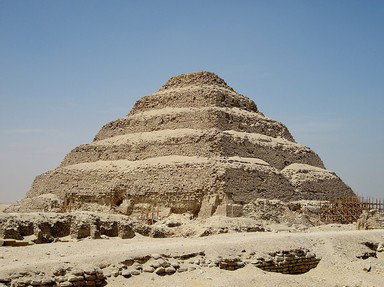
3. Step Pyramid of Zoser
Answer: Egypt
Zoser was a pharaoh of the Third Dynasty (c. 2667-2648), and is credited with building not only the first monumental building made entirely out of stone, but also the first ever pyramid structure. The step pyramid was part of his burial complex, which was designed by Imhotep, his vizier, who served as the main architect and engineer during its construction at Saqqara. Made of limestone, the step pyramid had six progressively smaller tiers that served to cover pharaoh's grave. Beneath the structure was a network that reached for 3.5 miles (5.6 km) which featured tunnels, chambers, and a central burial shaft.
4. 365 Day Calendar
Answer: Egypt
The ancient Egyptians used a 365 day solar calendar that was based on the appearance of Sirius, the dog star right before the annual flooding of the Nile. It was divided into 12 months, each with 30 days. Each 30 day month consisted of three 10-day periods known as decans. Five extra days were added to the end of the year, and were known as the Heriu Renpet.
These days were sacred, and each one celebrated the birthday of their major deities, Osiris, Horus, Set, Isis, and Nephthys. There was no leap year as the calendars just drifted backward a day every four years.
When Pharaoh Ptolemy III attempted to rectify this issue, the priests and people alike resisted the reform, and he dropped it.
5. Tigris and Euphrates
Answer: Mesopotamia
By the Neolithic Revolution (c. 10,000 BC), plants had been domesticated and crops grown in Mesopotamia, which is part of the Fertile Crescent, an area of rich farmland that includes Mesopotamia, the Levant, and parts of modern day Iran and Turkey. Considered to be a Cradle of Civilization along with ancient Egypt, Mesopotamia was located in the Land Between the Rivers - the Tigris and Euphrates - in what is modern day Iraq. Also like the ancient Egyptians, the early people worked together to contain the annual flood waters.
After the flood, the silt and water were used to rejuvenate and irrigate the once barren land. Mesopotamia was the site of many ancient battles and empires. And why did so many people want the land? It was all about the fertile soil!
6. Cuneiform
Answer: Mesopotamia
Cuneiform is the oldest known written language in the world. Developed c. 3100 BC by the ancient Sumerians who created the first civilization in Mesopotamia, it was a cursive writing, made by using a stylus to press symbols into wet clay. Once the clay tablet was baked in a kiln, or simply dried in the sun, it became a permanent record.
The development of written language is the beginning of history, of course, and cuneiform was such a valuable invention that many other people who eventually conquered areas in Mesopotamia adopted it. Libraries of cuneiform tablets have been found in places like Ninevah (Assyrians), Nippur (Sumerians/Akkadians), and Persepolis (Iran), and with historians being able to read the language since the early 1800s, more history has been brought to light.
7. First Wheel
Answer: Mesopotamia
The ancient Sumerians who lived in Mesopotamia invented the wheel, but this fact may surprise you! A potter's wheel was the first wheel invented c. 3500 BC. This was used to shape clay better for making vessels and containers. It took about 300 more years for them to apply the principal behind the potter's wheel to wheels for carts and wagons.
These wheels did not have spokes; they were made of heavy wooden discs that had planks of wood that were clamped together. Depictions of sledges and carts with wheels have been found on cuneiform tablets and the famous Royal Standard of Ur. Dating to approximately 2600 BC, the Royal Standard shows a depiction of wheels on a war chariot.
8. Hammurabi Code
Answer: Mesopotamia
Although Hammurabi's Code is not the oldest written code in the world, it is the most comprehensive. In very precise language, the 282 entries that were made on the over seven feet (2.13 m) tall slab stated which actions were against the law and what the penalty would be for noncompliance. The laws covered every aspect of life imaginable, including family, trade, divorce, and even building homes.
Although the law did not treat everyone equally - upper class people could get away with a simple fine for some offenses, it is famous for its "eye for an eye" concept. For example, if a noble put out the eye of a slave, he would be levied a fine that was paid to the slave's owner. If a noble put out the eye of another noble, his eye would be destroyed. Unfortunately there haven't been a lot of court records discovered that tell us how well the code was administered.
9. Indus
Answer: Indus
The civilization that began in modern Pakistan c. 2500 BC was centered around the Indus River. Here the river flood was precipitated by monsoons, seasonal winds that brought rain in June. Farmers learned to plant their crops both before and after the flood, but they could not always save their cities.
There is a lot of archaeological evidence that shows that buildings were constantly being rebuilt after the flood season, and historians believe today that some sort of catastrophic flood is probably what ended the Indus Valley Civilization.
10. Undeciphered Script
Answer: Indus
Historians believe that the Indus Valley Civilization, commonly called the Harappan Civilization after the first major city of the culture was discovered, may have adopted a form of picture writing from people in Mesopotamia. Harappan script consisted of 400 different symbols; while some were pictographs, others were more abstract.
Inscriptions have mostly been found on small objects, such as pottery, amulets, and stamp seals. To this very day, however, the seals they created have been undecipherable.
This, unfortunately, limits what is known about the Indus Valley Civilization.
11. Urban Grid Pattern at Mohenjo-daro
Answer: Indus
Harappa and Mohenjo-daro appear to have been the two most important urban centers in the Indus Valley. Planners laid out the cities in a grid pattern. The most important streets ran north-south and secondary streets ran east-west. Using bricks that were baked in kilns, they built houses that were several stories tall; over time the bricks even became a standard, uniform size.
Historians believe that at their height of power the cities may have covered six or seven square miles and contained as many as 35,000 people.
12. Sewer System
Answer: Indus
Most houses in Indus Valley urban centers had wells that provided for water and drainage systems. They had bathrooms that were connected to a sewer system that ran underneath the city streets, which appear to have been way ahead of their time. Cities also had large public bath houses, however, it is not known whether they were built solely for hygienic purposes or perhaps had important religious significance as well.
The civilization, with its peak of development occurring at approximately 2500 BC, collapsed around 1500 BC.
13. Huang He
Answer: China
The Huang He River in China flows over 2900 miles (4640 km). It is also called the Yellow River due to the loess, the yellow soil that is seen on the river bank and is carried downstream. Annual floods could become quite violent and unpredictable; that explains why The Great Sorrow is another name for the Huang He River.
As in other locations, the annual flood brought rich nutrients to the soil and water that was necessary for irrigation. The first Chinese legends date the civilization to about 3,000 BC with the Hsia Dynasty, however, the first true evidence of civilization in China dates to approximately 1766 BC with the Shang Dynasty.
14. Oracle Bones
Answer: China
Oracle bones were carved with pictograms and used by Shang Dynasty priests to ask questions about the future which were posed to either the gods or ancestors. After completing the carving, the oracle bones were heated and priests would interpret cracks that appeared on the bones in order to answer questions. Over time the characters that were used for the pictograms - there were about 200 of them - became the basis for written language in China.
15. Anyang
Answer: China
Anyang, which is also known as Yin Yinxu, is considered to be the oldest known Chinese city and was the capital of the Shang Dynasty. Dating back to c. 1300 BC, it is considered to be the first stable capital in China, and symbolizes that the people had moved from a semi-nomadic way of life to an urban one. Excavations which began in 1928 have revealed artifacts that show that wheeled chariots were in use, the people knew how to cast bronze, and had domesticated plants and animals - including elephants!
16. Mandate of Heaven
Answer: China
Although other cultures eventually developed concepts that were similar to the Mandate of Heaven, it is considered to be a strictly Chinese political doctrine, and was used as the moral justification for overthrowing a dynasty. For example, when the Zhou Dynasty overthrew the Shang Dynasty (c. 1046 BC) it was said that they had the right to do so because the Shang no longer had Heaven's favor.
They believed that natural disasters like floods and famine or peasant uprisings were proof that a dynasty had lost its blessing and a new, better leader should take the place of the old one. Specifically, the last Shang ruler had become corrupt and ignored his duties. When his army deserted him at the Battle of Muye, he was overthrown, and it was said that the new ruler had received the Mandate of Heaven.
17. Fortaleza, Pativilca, Supe
Answer: Norte Chico
Also called the Caral-Supe Civilization, the Norte Chico is the oldest known civilization in the Americas. Flourishing from 3000-1800 BC, it was located in Peru in an area approximately 100 miles (161 km) from the modern city of Lima. Although the coastal strip was an extremely dry desert, glacial meltwater and season runoff from the Andes Mountains flowed down to the Fortaleza, Pativilca, and Supe Rivers.
The river valley was home to an urban center called Huaricanga, which many historians believe to be the oldest urban settlement in the area. Crops like cotton, squash, and beans were grown on the irrigated land, which the inland settlements traded with fishing communities on the coast that used the cotton to make fishing nets.
18. Aceramic
Answer: Norte Chico
The Norte Chico people were aceramic, which means they did not manufacture any type of ceramic vessel. How did they manage that? Apparently they used gourds for cooking and storing their food. It is very unusual to find such an advanced civilization that did not create art of any kind. Some historians believe that perhaps the art was created on perishable materials.
19. Quipu
Answer: Norte Chico
The Norte Chico did not develop a written language, which is why there is still a lot to learn about their culture. Instead, they used the quipu, which was a system of knotted strings for record keeping and accounting purposes. Their quipu is very similar to the same device and system eventually used by the Incas.
20. Caral
Answer: Norte Chico
Approximately 124 miles (200 km) north of modern day Lima, the urban center of Caral, which was a thriving community from about 3000 BC-1800 BC, is considered to be the oldest in the Americas. It contains features such as seven large pyramids, sunken plazas, an amphitheater, and residential houses.
Historians believe the alignment of the city demonstrates the knowledge of astronomy and the presence of religion. It is believed that priests performed rituals to worship what has been called the staff god, the earliest representation of a deity in the Americas. Strangely, there is no evidence that city walls were built for protection or weapons were ever made. For reasons unknown to us today, Caral was abandoned in c. 1800 BC.
This quiz was reviewed by FunTrivia editor gtho4 before going online.
Any errors found in FunTrivia content are routinely corrected through our feedback system.