FREE! Click here to Join FunTrivia. Thousands of games, quizzes, and lots more!
Which Hobby Today? Trivia Quiz
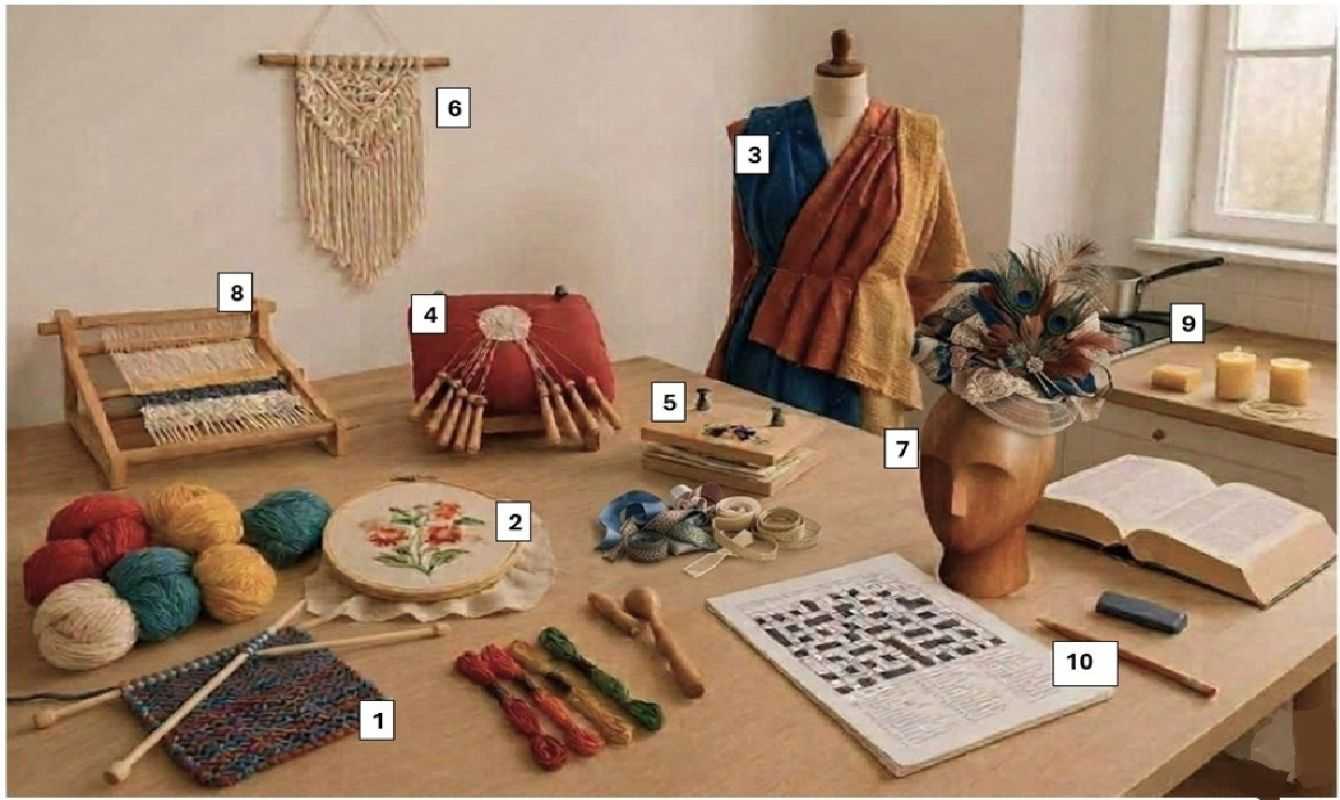
I have so many crafting interests! Let's go to my hobby room and see if you can help me pick out the various options there! Hmmm, what shall I choose today?
A label quiz
by VegemiteKid.
Estimated time: 3 mins.
Last 3 plays: xchasbox (10/10), Dorsetmaid (10/10), Guest 174 (10/10).
Click on image to zoom
DressmakingFlower pressBobbin laceworkingKnittingMillineryMacrameCandlemakingWeavingEmbroideryCrossword making* Drag / drop or click on the choices above to move them to the answer list. View Image Attributions for This Quiz
Knitting emerged as a practical craft in the early medieval period, producing flexible, warm garments. Early knitted artifacts have been found in Egypt, while Europe later developed strong knitting traditions supported by guilds. In Norway, examples of knitting date back as far as the late 1400s, where Selbu patterns gained immense popularity which endures to today.
Other iconic examples of early knitting patterns include Aran jumpers and Fair Isle (one of the Shetland Islands) both of whose textured patterns carry regional identity; and finely knitted silk stockings once worn by European nobility. Famous knitting figures include British-born Elizabeth Zimmermann, who transformed modern knitting education, and Kaffe Fassett, known for his vivid colorwork and influence on contemporary textile arts.
2. Embroidery
An ancient decorative art that uses needle and thread to embellish fabric, archaeological evidence traces embroidery back to early civilisations in Egypt, China, and the Middle East. Historically, it served both symbolic and practical purposes, from storytelling textiles to garments that conferred status, to religious iconography.
One of the most famous embroidered works is the Bayeux Tapestry (a piece that is nearly 70m (230ft) long and 50cm (20in) tall), which visually narrates the Norman Conquest of England, and was the work of William the Conqueror's wife, Matilda.
More modern renowned practitioners include Mary Linwood, celebrated for her needlework pictures in the 18th century, and Constance Howard, who helped establish embroidery as a modern art form in the 20th century.
3. Dressmaking
Dressmaking developed alongside the evolution of tailored clothing, becoming especially refined from the Renaissance onward as garments shifted from draped to fitted forms. Historically, skilled dressmakers produced everything from everyday wear to elaborate court attire, often working closely with clients.
Famous dressmaking achievements include the hand-constructed gowns of the Victorian era and haute couture garments created before industrial sewing. Notable artisans include Rose Bertin, dressmaker to Marie Antoinette; Madeleine Vionnet, whose mastery of draping transformed modern fashion design; and 8-time Oscar winner Edith Head who was nominated a record 35 times for the Academy Award for Best Costume Design.
4. Bobbin laceworking
Originating in Europe during the 16th century as a highly intricate method of creating lace, bobbin lacework uses threads wound on bobbins, then pinned into patterns. It was prized for trimming garments, veils, and altar cloths, particularly in regions such as Flanders, Italy, and England. It was traditionally made with threads of linen, silk, wool, cotton or even with precious metals.
Celebrated examples include Belgian and Chantilly lace, admired for their delicacy and complexity. Historical centres of lace making and artisanship, such as those working under Catherine de' Medici's patronage, elevated bobbin lace to a luxury art prized by royalty.
5. Flower press
Flower pressing combines art and science and developed from early botanical study traditions in the 16th and 17th centuries, when plants were preserved for documentation and teaching. Over time, it evolved into a decorative craft used to create albums, framed artworks, and educational displays. It is essential to get the pressure applied and the temperature at which they are maintained correct, so the specimens don't deteriorate during the process.
Pressed-flower collections were greatly enhanced by the use of Wardian cases, which allowed scholars and explorers to bring plants from newly discovered places back for the purposes of examination and propagation. Influential figures include Sir Joseph Banks, an English naturalist and botanist; Carl Linnaeus, whose systematic plant classification relied on preserved specimens; and Mary Delany, known for her remarkably detailed floral paper compositions.
6. Macrame
Macrame, whose name is derived from the Arabic word mikrama, is a knot-based textile art with roots in ancient knotting traditions, later flourishing among Arab weavers and spreading via the medium of maritime trade. Historically, it was used for decorative fringes, wall hangings, and functional items like belts and hammocks.
A distinctive revival occurred in the 1970s, making macrame a symbol of handmade, bohemian style and counter-culture craft. Modern artisans such as Fanny Zeneidius helped popularise contemporary macrame through instructional work and exhibitions.
7. Millinery
From ancient times, head coverings have had a history tied to fashion, military and social rank, etiquette, and protection from harsh weather. In around the 1600s, the art of hat making became somewhat formalised, and in the late 17th century, the term millinery (the art of designing and making hats) became widely used. The Italian city of Milan was at the time the hub of the world's textile and fashion trade and became the place to purchase feathers, lace, ribbons and other notions related to the production of hats, giving the craft its name.
Iconic millinery occasions include hats worn by royalty such as Queen Elizabeth II, and by film stars, such as those from Hollywood's Golden Age. Renowned milliners include Caroline Reboux, a leading Parisian hat designer, and Irish-born Philip Treacy, whose avant-garde creations have redefined modern millinery.
8. Weaving
Weaving is one of humanity's oldest crafts, dating back to prehistoric times when plant fibers were interlaced to create cloth. Across cultures, weaving developed unique techniques and symbolic patterns, from Andean textiles to West African kente cloth. Famous woven works include Persian carpets and Navajo blankets, valued for both craftsmanship and cultural significance. Well-known weaving innovators include Anni Albers, who bridged traditional weaving and modern textile design, and William Morris, whose woven textiles shaped the Arts and Crafts movement.
9. Candlemaking
Candle making began in ancient civilisations, where early candles were made from tallow or beeswax for religious rituals and illumination. Chandlers were sought after tradesmen, especially for churches where candles had decorative, symbolic and ceremonial uses, and in wealthy households where dozens of candles were used in chandeliers to illuminate a ballroom or library.
Historic examples include elaborate beeswax candles used in cathedrals and royal ceremonies. In 1934, Joseph Morgan patented a candle-making machine which transformed production, while modern artisanal candlemakers focus on hand-poured designs and natural materials.
10. Crossword making
Crossword creation is a modern intellectual craft that emerged in the early 20th century with the publication of the first known crossword puzzle in 1913 by Arthur Wynne. An ancient variation known as Magic Squares was played in China about 200 years B.C. Another ancient version was played in Pompeii, in which a player was required to arrange on a grid a given group of words so the result meant that the words would read the same way across and down.
In more modern times, Benjamin Franklin created one of the first Magic Squares for publication in 1767; other influential crossword constructors include Margaret Farrar, who set early standards of quality, and Will Shortz, who shaped contemporary crossword culture through editing and promotion.
If you love crosswords, you should try some of those on this site that have been written by my Phoenix Rising teammates: pollucci19, psnz, leith90, and 1nn1!
This quiz was reviewed by FunTrivia editor Bruyere before going online.
Any errors found in FunTrivia content are routinely corrected through our feedback system.