FREE! Click here to Join FunTrivia. Thousands of games, quizzes, and lots more!
Quiz about Renaissance Europe

Renaissance Europe Trivia Quiz

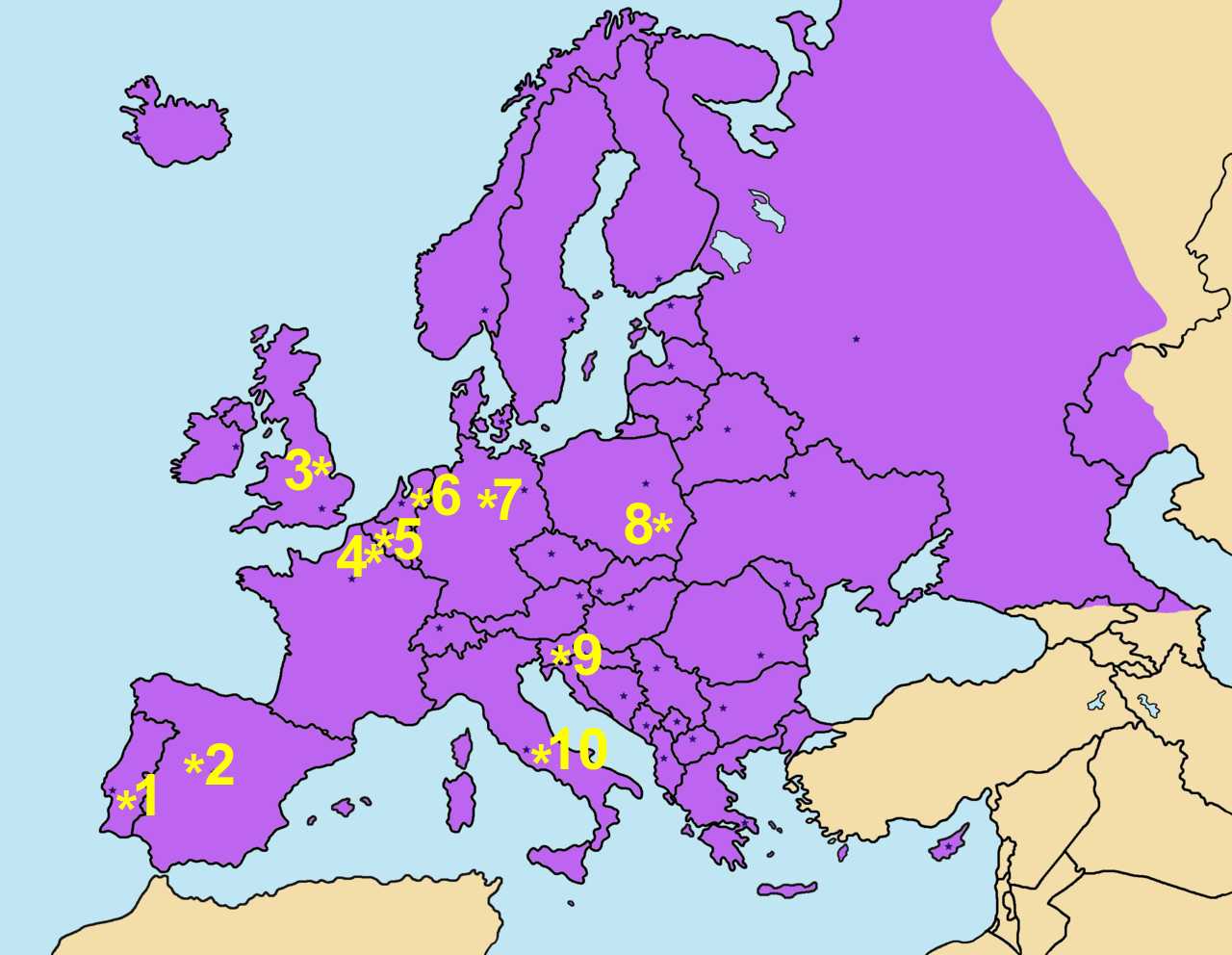
Birthplaces of Renaissance Composers

From the churches of Rome to the courts of Flanders and from England to Poland, these Renaissance composers helped shape a musical style characterized by balanced polyphony, vocal richness, and an increasing sensitivity to the meaning of the text.

A label quiz by reedy. Estimated time: 3 mins.
  1. Home
  2. »
  3. Quizzes
  4. »
  5. Music Trivia
  6. »
  7. Classical Music
  8. »
  9. Composers Mixture

Author
reedy
Time
3 mins
Type
Label Quiz
Quiz #
425,201
Updated
Aug 08 26
# Qns
10
Difficulty
New Game
Plays
7
Last 3 plays: Guest 76 (3/10), jonnowales (6/10), lethisen250582 (10/10).
Click on image to zoom
Jacobus Gallus Orlande de Lassus John Taverner Duarte Lobo Jan Pieterszoon Sweelinck Tomás Luis de Victoria Mikołaj Gomółka Heinrich Isaac Giovanni Pierluigi da Palestrina Josquin des Prez
* Drag / drop or click on the choices above to move them to the answer list.
View Image Attributions for This Quiz
1.   
2.   
3.   
4.   
5.   
6.   
7.   
8.   
9.   
10.   

Most Recent Scores
Today : Guest 76: 3/10
Today : jonnowales: 6/10
Today : lethisen250582: 10/10
Today : Reamar42: 6/10
Today : bernie73: 4/10
Today : runaway_drive: 10/10
Today : kstyle53: 10/10

Quiz Answer Key and Fun Facts
1. Duarte Lobo

Born in the Alentejo town of Alcáçovas, Portugal, Duarte Lobo (c.1565-1646) emerged during the golden age of Portuguese sacred polyphony. He later built his career in Lisbon, where he held important musical posts connected with the capital's religious institutions. Lobo's masses and motets are distinguished by their sonorous textures, careful craftsmanship, and expressive dignity. Published at the beginning of the seventeenth century, his works helped preserve the great Iberian polyphonic tradition even as newer Baroque styles were beginning to take hold elsewhere in Europe.
2. Tomás Luis de Victoria

Tomás Luis de Victoria (1548-1611) was born in Ávila, Spain, a city closely associated with the Catholic Reformation. He later studied and worked in Rome, where he absorbed the influence of Italian sacred music while maintaining a distinctly Spanish expressive voice. Often regarded as the greatest composer of Renaissance Spain, Victoria devoted almost his entire output to sacred music. Works such as the "Officium Defunctorum" (1605) display an intensity of emotion and spiritual depth that set him apart from many contemporaries.

His music remains one of the highest achievements of Renaissance religious composition.
3. John Taverner

John Taverner (c.1490-1545) was born in Lincolnshire, England, during the final decades before the English Reformation transformed religious life and church music. He achieved prominence as the first organist and master of the choristers at Cardinal College, Oxford, now Christ Church. Taverner's masses and motets represent the height of pre-Reformation English polyphony, characterized by expansive vocal lines and intricate textures.

His "Missa Gloria tibi Trinitas" became particularly influential, giving rise to the instrumental form known as the In Nomine, which remained popular among English composers for more than a century.
4. Josquin des Prez

Josquin des Prez (c.1450/1455-1521) was born in the region of Hainaut, an area that today lies on the border between Belgium and France. He spent his career serving courts and churches in some of Europe's most influential cultural centres, including Milan, Rome, and Ferrara. Widely regarded as the leading composer of the High Renaissance, Josquin transformed the art of polyphony by giving greater attention to the meaning and expression of the text.

His masses, motets, and chansons circulated throughout Europe and were studied as models of compositional craftsmanship long after his death.
5. Orlande de Lassus

Orlande de Lassus (1532-1594) was born in Mons, in present-day Belgium, and became one of the most internationally celebrated composers of the Renaissance. After spending time in Italy during his youth, he settled in Munich, where he served the Bavarian court for much of his life. Lassus possessed an extraordinary ability to adapt to different musical styles and languages, producing sacred and secular works in Latin, French, Italian, and German.

His enormous output and expressive approach to text setting made him one of the most admired musicians of sixteenth-century Europe.
6. Jan Pieterszoon Sweelinck

Although born in Deventer in 1562, Jan Pieterszoon Sweelinck spent almost his entire professional life in Amsterdam, where he served as organist of the Oude Kerk for more than forty years. Celebrated throughout northern Europe as a performer, teacher, and composer, he attracted students from Germany and beyond who carried his ideas back to their own regions.

His keyboard works, particularly his fantasias and variation sets, combined Renaissance contrapuntal techniques with a growing emphasis on instrumental virtuosity. Through both his compositions and his pupils, Sweelinck exerted a lasting influence on the development of the northern European organ tradition.
7. Heinrich Isaac

A native of Flanders, Heinrich Isaac (c.1450-1517) enjoyed one of the most international careers of any Renaissance composer. He worked for the Medici court in Florence before entering the service of Holy Roman Emperor Maximilian I, moving between some of the leading cultural centres of his day. Isaac's music successfully blended the contrapuntal sophistication of the Franco-Flemish school with the melodic character of Italian traditions.

His monumental "Choralis Constantinus," a vast collection of liturgical music compiled for the church year, remains among the most ambitious sacred projects of the Renaissance.
8. Mikołaj Gomółka

Mikołaj Gomółka (c.1535-c.1591) was born in Sandomierz, Poland, and spent part of his career at the royal court in Kraków. Although only a portion of his music survives, he occupies a significant place in the history of Polish Renaissance culture.

He is best known for "Melodie na Psałterz Polski" (1580), a complete musical setting of Jan Kochanowski's Polish translation of the Psalms. By composing sophisticated vocal music in the vernacular, Gomółka helped foster a distinctly Polish musical identity while remaining connected to broader European Renaissance traditions.
9. Jacobus Gallus

Jacobus Gallus, also known as Jacob Handl (1550-1591), was born in Carniola, a historical region that forms part of modern Slovenia. He spent much of his professional life in Austria and Bohemia, where he became one of Central Europe's leading composers of sacred music. Gallus excelled in the motet, producing works that combined intricate Renaissance polyphony with a growing concern for dramatic textual expression.

His monumental collection "Opus Musicum" contains hundreds of liturgical pieces and stands as one of the major achievements of late Renaissance church music.
10. Giovanni Pierluigi da Palestrina

Few composers are more closely associated with Renaissance church music than Giovanni Pierluigi da Palestrina (c.1525-1594), who was born in the town from which he took his name near Rome, Italy. Active at several of Rome's most important churches, he became a central figure in the musical life of the Counter-Reformation. Palestrina's music is admired for its clarity, balance, and graceful handling of polyphonic lines, qualities that later generations treated as exemplary.

His "Missa Papae Marcelli" became one of the best-known sacred works of the period, and his style continued to serve as a model for the teaching of counterpoint long after the Renaissance had ended.
Source: Author reedy

This quiz was reviewed by FunTrivia editor agony before going online.
Any errors found in FunTrivia content are routinely corrected through our feedback system.
8/8/2026, Copyright 2026 FunTrivia, Inc. - Report an Error / Contact Us