FREE! Click here to Join FunTrivia. Thousands of games, quizzes, and lots more!
Baroque Europe Trivia Quiz
Birthplaces of Baroque Composers
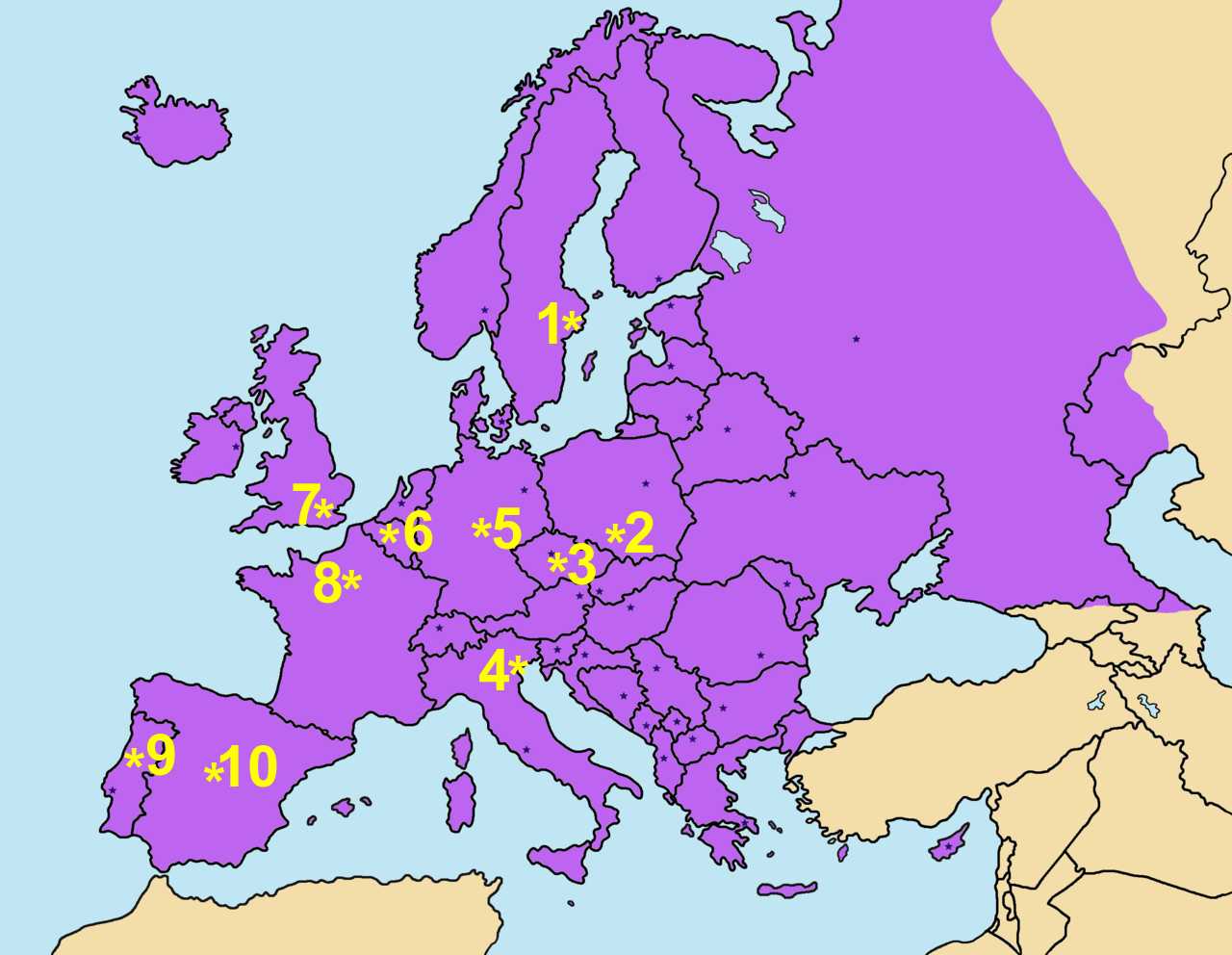
From Portugal to Poland and from Sweden to Italy, these Baroque composers helped shape a musical style characterized by elaborate ornamentation, dramatic contrasts, and expressive melody. Can you match them to their birthplaces on the map?
Last 3 plays: Guest 216 (8/10), vlk56pa (10/10), DeepHistory (10/10).
Click on image to zoom
Antonio VivaldiJan Dismas ZelenkaJuan Hidalgo de PolancoHenry PurcellGrzegorz Gerwazy GorczyckiFrançois CouperinJohann Sebastian BachJoseph-Hector FioccoCarlos SeixasJohan Helmich Roman* Drag / drop or click on the choices above to move them to the answer list. View Image Attributions for This Quiz
Johan Helmich Roman (1694-1758), often called the "Father of Swedish Music," was born in Stockholm, Sweden. As a young musician he traveled to England, where he encountered the music of Handel and other prominent Baroque composers. Upon returning home, Roman introduced many of the latest musical fashions to Swedish audiences and helped establish a national tradition of art music.
His "Drottningholm Music" (1744) remains one of the best-known works in Sweden's musical heritage.
2. Grzegorz Gerwazy Gorczycki
Born in Rozbark, now part of the Polish city of Bytom, Grzegorz Gerwazy Gorczycki (c.1665-1734) became one of the most respected composers of the Polish Baroque. He spent much of his career in Kraków, where he combined traditional contrapuntal writing with newer influences arriving from Italy.
His motets, masses, and other sacred compositions show how international Baroque trends found a distinctive expression within Polish church music. Today he is often regarded as one of the leading figures of Poland's early musical history.
3. Jan Dismas Zelenka
The Bohemian composer Jan Dismas Zelenka (1679-1745) was born in Louňovice pod Blaníkem, in what is now the Czech Republic. Much of his professional life was spent in Dresden, one of central Europe's great cultural centres. Zelenka's music is notable for its originality, rhythmic energy, and adventurous harmonic language. Sacred works such as the "Missa Votiva" (1739) reveal a composer whose imagination rivalled that of many better-known contemporaries, making him one of the most distinctive voices of the Bohemian Baroque.
4. Antonio Vivaldi
Born in Venice, Italy, Antonio Vivaldi (1678-1741) became one of the defining figures of the Italian Baroque. Venice was among Europe's leading musical centres, and Vivaldi helped popularize the solo concerto, a genre that highlighted the contrast between an individual performer and the orchestra.
His collection "The Four Seasons" (1725) remains one of the most famous examples of programmatic Baroque music, vividly portraying scenes from nature. Through his energetic rhythms and inventive orchestration, Vivaldi's influence spread throughout Europe.
5. Johann Sebastian Bach
Johann Sebastian Bach (1685-1750) entered the world in Eisenach, in what is now Germany. Although respected during his lifetime, his influence expanded dramatically after the nineteenth-century revival of his music. Bach brought the German Baroque tradition to extraordinary heights through his mastery of counterpoint, harmony, and musical structure. Works such as the "Brandenburg Concertos" (1721), "The Well-Tempered Clavier" (1722/1742), and the "Mass in B Minor" demonstrate how intricate musical lines could be combined into works of remarkable depth and coherence.
6. Joseph-Hector Fiocco
Joseph-Hector Fiocco (1703-1741) was born in Brussels, Belgium. Living in the Southern Netherlands, a region situated between major European cultural centres, he absorbed influences from both French and Italian music. His sacred vocal works, chamber pieces, and keyboard compositions blend French elegance with the melodic style then spreading from Italy. Though less famous today than Bach or Vivaldi, Fiocco served as an important conduit for the major musical currents of Baroque Europe in the Low Countries.
7. Henry Purcell
Henry Purcell (c.1659-1695) was born in Westminster, now part of London in the United Kingdom. Despite a career cut short by his early death, he became the most important English composer of the Baroque era. Purcell combined influences from Italy and France with native English traditions to create a distinctive national style.
His opera "Dido and Aeneas" (c.1689) remains a landmark of English musical drama, while his anthems and ceremonial works demonstrate the expressive possibilities of Baroque harmony.
8. François Couperin
Paris was the birthplace of François Couperin (1668-1733), one of the leading figures of the French Baroque. Known as "Couperin le Grand," he came from a distinguished musical family and became closely associated with the refined style of the French court.
His harpsichord music is filled with elegance, ornamentation, and subtle character pieces. Couperin also championed the idea that French and Italian traditions could enrich one another, helping to bridge two of Europe's most influential musical cultures.
9. Carlos Seixas
The Portuguese composer Carlos Seixas (1704-1742) was born in Coimbra. A gifted keyboard virtuoso, he became one of the foremost musicians of eighteenth-century Portugal. His many keyboard sonatas combined the expressive qualities of the Baroque with features that foreshadowed the Classical style.
Although his reputation never reached the international heights of some contemporaries, Seixas played a key role in developing Portugal's keyboard tradition and strengthening the country's place within European musical life.
10. Juan Hidalgo de Polanco
Juan Hidalgo de Polanco (1614-1685) was born in Madrid, Spain, and spent much of his career at the Spanish royal court. He is frequently regarded as one of the founders of Spanish opera and zarzuela, a form of musical theatre that combines spoken dialogue with song.
At a time when Italian music dominated much of Europe, Hidalgo helped establish a distinctly Spanish voice in vocal drama. His work contributed to the rich artistic culture of Spain's Golden Age and demonstrated the flexibility of the Baroque style across different languages and traditions.
This quiz was reviewed by FunTrivia editor agony before going online.
Any errors found in FunTrivia content are routinely corrected through our feedback system.