FREE! Click here to Join FunTrivia. Thousands of games, quizzes, and lots more!
Romantic Europe Trivia Quiz
Birthplaces of Romantic Composers
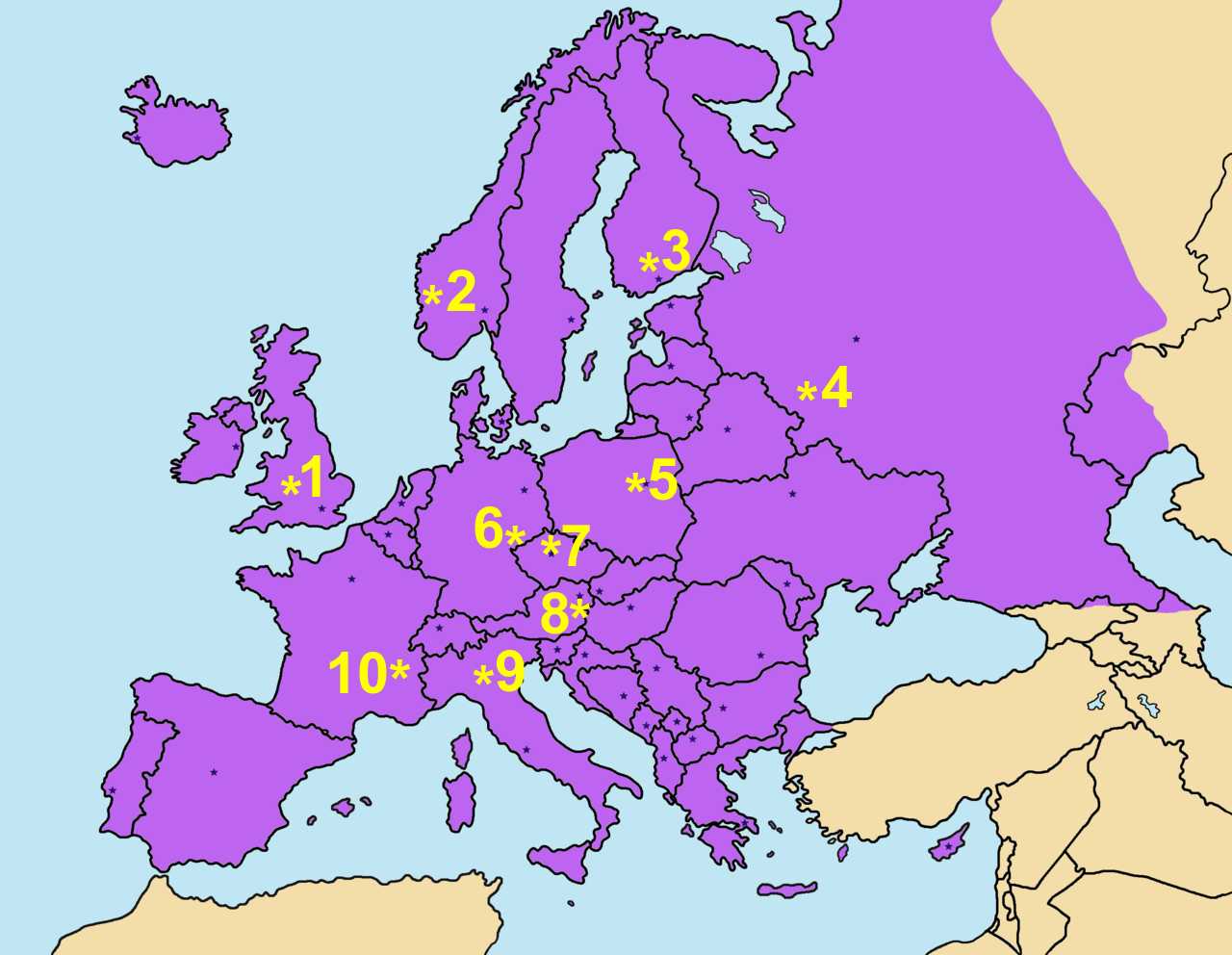
From Norway to Italy and from France to Russia, these Romantic composers left their mark on music history. Can you match them to their birthplaces on the map?
Last 3 plays: Reamar42 (10/10), elgecko44 (10/10), gwendylyn14 (3/10).
Click on image to zoom
Hector BerliozFrédéric ChopinEdvard GriegMikhail GlinkaAntonín DvořákEdward ElgarRobert SchumannFranz LisztGiuseppe VerdiJean Sibelius* Drag / drop or click on the choices above to move them to the answer list. View Image Attributions for This Quiz
Although Edward Elgar (1857-1934) was born in Lower Broadheath, Worcestershire, his music reached far beyond rural England. A leading figure of Late Romanticism, Elgar favored broad melodies, rich orchestral colours, and powerful emotional contrasts. At a time when most of Europe's celebrated composers came from Germany, Austria, France, Italy, or Russia, Elgar showed that Britain could compete on the same stage. Works such as "Enigma Variations" (1899) and "Pomp and Circumstance March No. 1" (1901) remain among the best-known examples of English Romanticism.
2. Edvard Grieg
The city of Bergen, where Edvard Grieg (1843-1907) was born, belonged to the union of Norway and Sweden at the time but is now part of independent Norway. Grieg believed that a nation's music should reflect its own culture, and he frequently drew inspiration from Norwegian folk songs and dances.
His gift for memorable melodies and colourful orchestral writing made works such as "Piano Concerto in A minor" (1868) and "Peer Gynt Suite No. 1" (1888) enduring favourites of the Romantic repertoire.
3. Jean Sibelius
When Jean Sibelius (1865-1957) entered the world in Hämeenlinna, Finland was still the Grand Duchy of Finland, an autonomous territory within the Russian Empire. By the end of the nineteenth century, his music had become closely associated with the Finnish struggle for a distinct national identity. Combining Romantic orchestral writing with inspiration drawn from Finnish myths and landscapes, Sibelius produced works such as "Finlandia" (1899), which became an unofficial symbol of Finnish pride.
4. Mikhail Glinka
The composer often credited with launching a Russian school of classical music, Mikhail Glinka (1804-1857) came from Novospasskoye in the Russian Empire, a village that today lies in Russia. At a time when many Russian composers looked to Western Europe for models, Glinka incorporated Russian history, legends, and musical traditions into his work.
His operas "A Life for the Tsar" (1836) and "Ruslan and Lyudmila" (1842) showed that Romantic music could express a distinctly national identity.
5. Frédéric Chopin
Few composers are as closely associated with the piano as Frédéric Chopin (1810-1849). He was born in Żelazowa Wola, then part of the Duchy of Warsaw and now in Poland. Chopin rarely wrote for large orchestras, instead exploring the piano's ability to convey poetry, intimacy, and profound emotion. Works such as the "Études" (1837), the "Polonaise in A-flat Major, Op. 53" (1842), and his many nocturnes show how Romantic composers prized personal expression, whether in moments of quiet reflection or dazzling virtuosity.
6. Robert Schumann
Robert Schumann (1810-1856) grew up in Zwickau, a town in the Kingdom of Saxony that is now part of Germany. Equally influential as a composer and music critic, he believed that music could express thoughts, moods, and emotions just as powerfully as words. Whether in the character pieces of "Carnaval" (1835) or the childhood scenes portrayed in "Kinderszenen" (1838), Schumann excelled at transforming literary ideas and personal emotions into sound.
7. Antonín Dvořák
Few composers did more to introduce Central European folk traditions to international audiences than Antonín Dvořák (1841-1904). The village of Nelahozeves, where he was born, lay within the Kingdom of Bohemia of the Austrian Empire and is now part of the Czech Republic. Dvořák wove Czech rhythms and melodies into symphonies and concertos without losing their broad appeal.
His "Symphony No. 9 'From the New World'" (1893) and "Cello Concerto in B minor" (1895) proved that music rooted in local traditions could still win audiences around the world.
8. Franz Liszt
Born in Raiding (Doborján), then part of the Kingdom of Hungary within the Austrian Empire and today located in Austria, Franz Liszt (1811-1886) became one of the nineteenth century's greatest musical celebrities. His astonishing piano technique dazzled audiences, but his influence extended far beyond performance. Romantic composers sought new ways to tell stories through music, and Liszt's orchestral "Les Préludes" (1854) helped popularize the symphonic poem, a genre that allowed composers to depict stories, places, and dramatic events without using words.
9. Giuseppe Verdi
Opera reached new dramatic heights through the music of Giuseppe Verdi (1813-1901). Born in Le Roncole, then in the Duchy of Parma and now in Italy, Verdi created operas filled with memorable melodies, larger-than-life characters, and intense emotional conflict. Works such as "Rigoletto" (1851), "La Traviata" (1853), and "Aida" (1871) are filled with jealous lovers, flawed heroes, and life-or-death decisions - the sort of intense drama Romantic audiences loved.
10. Hector Berlioz
The eldest composer in this group, Hector Berlioz (1803-1869), was born in La Côte-Saint-André, France. Few musicians better embodied the Romantic spirit of imagination and innovation. In "Symphonie fantastique" (1830), Berlioz used a massive orchestra, vivid instrumental colours, and a dramatic narrative to depict obsession, dreams, and hallucinations, showing that an orchestra could paint scenes and tell stories as vividly as a novel or stage play.
This quiz was reviewed by FunTrivia editor agony before going online.
Any errors found in FunTrivia content are routinely corrected through our feedback system.