FREE! Click here to Join FunTrivia. Thousands of games, quizzes, and lots more!
Quiz about Dont Exorcise Me

Don't Exorcise Me Trivia Quiz


Possession by supernatural entities and the banishment of evil forces are not just popular plot devices for horror movies, but are part of the core beliefs of many world religions. This quiz touches on some aspects of this fascinating topic.

A multiple-choice quiz by LadyNym. Estimated time: 3 mins.
  1. Home
  2. »
  3. Quizzes
  4. »
  5. Religion Trivia
  6. »
  7. Religion Mixture
  8. »
  9. Thematic Religious Mixture

Author
LadyNym
Time
3 mins
Type
Multiple Choice
Quiz #
422,760
Updated
Jan 31 26
# Qns
10
Difficulty
New Game
Avg Score
9 / 10
Plays
15
Awards
Editor's Choice
Last 3 plays: Guest 81 (9/10), Twotallgnome (8/10), purelyqing (10/10).
- -
Question 1 of 10
1. The belief in possession by supernatural beings was widespread in the ancient world. What Ancient Greek god was associated with a mystery cult that involved being possessed by the deity, as well as the use of alcohol and other psychoactive substances? Hint


Question 2 of 10
2. The Synoptic Gospels relate various instances of exorcisms performed by Jesus Christ. By what military-sounding collective name is the demon in the miracle of the Gadarene swine identified? Hint


Question 3 of 10
3. Some of the most powerful prayers of the Catholic Church against demonic possession are addressed to what warrior saint - Satan's traditional adversary? Hint


Question 4 of 10
4. Followers of Islam practice exorcism against possession by various spirits. What name is given in Arabic to the main category of supernatural beings (often associated with bottles) that can possess people? Hint


Question 5 of 10
5. What is the name of the small rolls of parchment, inscribed with verses from the Torah, affixed on the doorposts of Jewish homes as protection from evil spirits? Hint


Question 6 of 10
6. In Shinto, the indigenous religion of Japan, some animal spirits are believed to be able to possess humans. One of these creatures is the "kitsune", which in Japanese denotes what clever and crafty animal?

Answer: (3 letters)
Question 7 of 10
7. In what religious tradition - also known for its use of prayer wheels and flags - would you find a ceremony known as Gütor, or Exorcising-Ghost Day? Hint


Question 8 of 10
8. The fourth avatar of Lord Vishnu is often invoked in Hindu exorcism rituals as a destroyer of evil. What is his name, meaning "man-lion" in Sanskrit? Hint


Question 9 of 10
9. Possession by spirits known as "loa" features prominently in African diasporic religions such as Haitian Vodou. In Haitian Creole, the person possessed by one of these spirits is referred to as "chwal" - meaning what domestic animal? Hint


Question 10 of 10
10. An integral component of many religious traditions, the practice of shamanism involves interaction with the spirit world. What musical instrument is used by Siberian and Sámi shamans to induce a state of trance? Hint


(Optional) Create a Free FunTrivia ID to save the points you are about to earn:

arrow Select a User ID:
arrow Choose a Password:
arrow Your Email:


Most Recent Scores
Today : Guest 81: 9/10
Today : Twotallgnome: 8/10
Today : purelyqing: 10/10
Today : Guest 174: 9/10
Today : Reamar42: 8/10
Today : xchasbox: 10/10
Today : AmandaM: 10/10
Today : GoodwinPD: 10/10
Today : rossian: 10/10

Quiz Answer Key and Fun Facts
1. The belief in possession by supernatural beings was widespread in the ancient world. What Ancient Greek god was associated with a mystery cult that involved being possessed by the deity, as well as the use of alcohol and other psychoactive substances?

Answer: Dionysus

In Ancient Greece and Rome, mystery cults flourished alongside the official religion. As their name implies, these religious movements required their followers to undergo initiation, and the nature of their practices was kept secret from outsiders. Unlike mainstream religion, which was mainly based on public rituals and ceremonies, these cults focused on deeper spiritual experiences, often attracting members of marginalized social groups such as slaves or foreigners, as well as women.

Known from inscriptions, artistic depictions and literary references, the Dionysian Mysteries are believed to be older in origin than Greek civilization itself. Probably originating in Asia Minor (present-day Turkey), the cult was closely associated with wine and its use as an entheogen - a psychoactive substance ingested during religious rituals to facilitate mystical experiences. The rites performed during the Dionysian Mysteries involved being possessed by the god Dionysus: this possession was comparable to unleashing the animal instincts present within his followers, breaking the rules and constraints of civilized society and acquiring divine powers. This state of ecstatic trance - achieved through dancing and the use of an instrument called a bullroarer, which produced a vibrating, roaring sound - was described in Greek as "enthousiasmos" (inspiration or possession by a god), the origin of the English word enthusiasm.

In Ancient Rome, the Dionysian Mysteries developed into private festivals known as Bacchanalia, dedicated to the worship of Bacchus, the Roman equivalent of Dionysus. They were known for such unbridled revelry that they caused a scandal in 186 BC and were drastically reformed by the Senate.
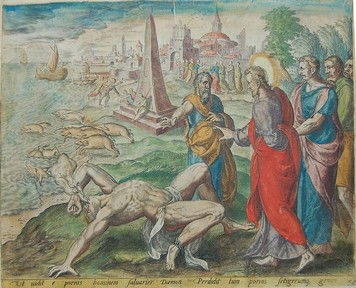
2. The Synoptic Gospels relate various instances of exorcisms performed by Jesus Christ. By what military-sounding collective name is the demon in the miracle of the Gadarene swine identified?

Answer: Legion

While there are no mentions of exorcisms performed by Jesus in the Gospel of John, the Gospels of Matthew, Mark and Luke contain accounts of seven major events in which Jesus banished demons that were possessing people. The best known of these incidents, related in all three Synoptic Gospels, and often depicted in art, is the exorcism of the Gerasene demoniac, also known as the miracle of the Gadarene swine. However, the version in the Gospel of Matthew differs substantially from those in the Gospels of Mark and Luke, as it is shorter and involves two men instead of one.

The story narrates Jesus' encounter with a man possessed by an "unclean spirit" who had lived in for years the tombs near the eastern shore of the Sea of Galilee. He is described as naked, and so strong that he was able to break the chains with which people tried to bind him. Jesus commands the spirit to leave the man, and asks for his name - an essential component of an exorcism according to the Jewish tradition (this detail is absent in Matthew's version). The demon replies his name is Legion, "for we are many". The demons then beg Jesus not to send them away, but to allow them to enter a large herd of swine that are feeding nearby. When the demons enter the pigs, the poor animals run down the slope into the lake and drown.

This episode was interpreted by two of the foremost Catholic theologians - St Augustine of Hippo and St Thomas Aquinas - as proof that Christians had no duties towards animals, and that believing otherwise was nothing more than superstition.
3. Some of the most powerful prayers of the Catholic Church against demonic possession are addressed to what warrior saint - Satan's traditional adversary?

Answer: St Michael the Archangel

The specifics for the formal rite of exorcism in the Roman Catholic Church - which must be performed by an ordained priest - are laid out in the liturgical book known as "Rituale Romanum" (Roman Ritual). Before proceeding, the priest must make sure that a person is actually possessed and not suffering from any mental or physical illness. In 1898, during the papacy of Leo XIII (1873-1903), a long prayer to St Michael the Archangel was added to the exorcism formula; shortened in the 1902 edition of the Roman Ritual, the prayer was made optional in the revised version of the Rite of Exorcism issued in 1999.

In the book of Revelation (12:7-12), St Michael the Archangel is described as the leader of the heavenly host, who will defend God's people in the final battle against Satan and the forces of evil. In art he is often depicted as a warrior wielding a sword or a spear, trampling Satan (often in the guise of a serpent or a dragon) beneath his feet. The other saints listed as wrong answers are all among the military saints venerated by the Roman Catholic and Orthodox churches.
4. Followers of Islam practice exorcism against possession by various spirits. What name is given in Arabic to the main category of supernatural beings (often associated with bottles) that can possess people?

Answer: jinn

Belief in supernatural entities such as ghosts and demons, as well as their ability to possess people, things or places, is deeply ingrained in the Islamic faith. Indeed, the influence of these creatures is often used as an explanation for both positive and negative events - so it should not come as a surprise that exorcism ("ruqya", meaning spell or incantation) is widely practiced.

While a person can be possessed by a vengeful ghost ("afarit"), most possessing spirits in Islam do not have human origins. These demons can be roughly divided into two main types, the devils ("shayatin"), who are always evil, and the jinn, who are instead morally ambivalent. Jinn (whose singular form, jinni, is the root of the English word genie) originated in the polytheistic religion practiced in the Arabian Peninsula before the spread of Islam. They are mentioned 29 times in the Quran, where they are described as rational, anthropomorphic beings who, like humans, have free will and are capable of good and evil deeds. Possession by a jinn (whose bodies are composed of fire and air) can happen for a variety of reasons, and can be beneficial to a person. On the other hand, shayatin lead humans into sin by whispering to their hearts rather than possessing their bodies.

Seraphim are angelic beings described in the Bible, while daevas are demons in the Zoroastrian religion, and asuras are the opponents of the gods in Hinduism.
5. What is the name of the small rolls of parchment, inscribed with verses from the Torah, affixed on the doorposts of Jewish homes as protection from evil spirits?

Answer: mezuzah

A mezuzah (meaning "doorpost" in Hebrew; plural is mezuzot) is a piece of parchment ("klaf") on which verses from the book of Deuteronomy (6:4-9 and 11:13-21) are inscribed by a trained scribe ("sofer") using a special quill pen and indelible black ink. This piece of parchment is then rolled up and placed in a small, oblong case, which is then affixed to the doorpost at the entrance of a home - taking care not to damage the scroll.

While in the Biblical verses inscribed on the mezuzah it is stated that its purpose is to remind the faithful of God's commandments, the scroll gradually came to be seen as a means of protecting one's home from the forces of evil - in particular the widely feared dybbuk, the disembodied soul of a dead person that is constantly looking for a host body. If a mezuzah is not properly affixed or maintained, this may make a home and its inhabitants vulnerable to these feared beings.

A kippah is a kind of skullcap also known as yarmulke; a menorah is a seven-branched candelabrum (traditionally lit for Hanukkah), while challah is a special bread eaten on Jewish holidays.
6. In Shinto, the indigenous religion of Japan, some animal spirits are believed to be able to possess humans. One of these creatures is the "kitsune", which in Japanese denotes what clever and crafty animal?

Answer: fox

An animistic religion, Shinto is based on the belief in nature-related spirits known as kami. In addition to those beings, often referred to as gods, followers of Shinto believe in a wide variety of supernatural entities known as "yōkai", a category that includes ghosts, demons and other malevolent spirits as well as benevolent or mischievous ones. Among these entities there are creatures called "bakemono", which can take the shape of various animals such as the raccoon dog ("tanuki") or the fox ("kitsune"). Possession by a fox is known as "kitsunetsuki", whose symptoms may resemble classic Western demonic possession, or also some kind of mental illness. The victims are said to be mainly young women. In order to free someone from fox possession, an exorcism is performed by a miko (shrine maiden) or a yamabushi (ascetic hermit).

On the other hand, in Shinto spirit possession is often voluntary, taking the form of a kind of mediumship in which a person acts as a bridge between the physical and the spiritual realm. People who act the role of a "yorishiro" (an object capable of attracting kami) are referred to as "yorimashi", which means possessed person. In the past, miko often performed the role of spiritual mediums.
7. In what religious tradition - also known for its use of prayer wheels and flags - would you find a ceremony known as Gütor, or Exorcising-Ghost Day?

Answer: Tibetan Buddhism

Tibetan Buddhism retains a number of features of the region's indigenous Bön religion - including the belief in spirits and ghosts. Among these supernatural beings there are the so-called "hungry ghosts" (a translation of the Sanskrit name "preta"), who also play a role in Chinese and Japanese Buddhism, as well as Taoism and Chinese folk religion. These entities are not regular ghosts, but rather souls that have been unable to achieve reincarnation, and in their intermediate state between death and rebirth are tormented by intense suffering - in particular extreme hunger and thirst. These beings can be released from their unhappy state by being stabbed with a ritual dagger called "phurba".

The ritual of Gütor - literally "offering of the 29th" - is held on the 29th day of the twelfth lunar month, just before the festival of Losar, the Tibetan New Year. The ceremony focuses on purification from negative influences, including evil spirits, so that the new year can begin in an untroubled and auspicious way. While elaborate ceremonies with music and dance are held in temples and monasteries, people thoroughly clean their homes, decorate them with flowers and symbols of good luck, and gather fragrant wood for burning. A special soup called "guthuk", made with nine different ingredients, is eaten, and later in the evening people go out with lit torches, shouting words of exorcism.
8. The fourth avatar of Lord Vishnu is often invoked in Hindu exorcism rituals as a destroyer of evil. What is his name, meaning "man-lion" in Sanskrit?

Answer: Narasimha

Malevolent supernatural beings abound in Hinduism, and most of them are believed to be able to possess people. Among these entities there are the restless ghosts of deceased persons ("bhootas"), spirits tormented by insatiable hunger or thirst ("pretas"), and flesh-eating demons ("pishachas"). The Vedas, the oldest Hindu holy scriptures, deal with the subject of exorcism, which is usually performed by chanting mantras (sacred verses) and conducting a fire-based ritual called "yajna".

Adherents of the various different sects within Hinduism may also call upon the deity they revere as a supreme being or one of their manifestations. This is the case of the Vaishnavites, the followers of one of the major Hindu denominations, who regard Vishnu as their chief deity. In Vaishnavism, exorcisms are performed by reciting the name of Narasimha, a fierce, lion-headed avatar of Vishnu who is revered as a powerful demon-slayer and protector against evil. Chanting the Ugra Narasimha mantra or the Narasimha Kavachan prayer is believed to destroy negative supernatural influences and cure illnesses caused by demonic possession.

Brahma is the Hindu creator god, the first member of the Trimurti, while Rama and Krishna are also avatars of Vishnu. The monkey god Hanuman, also invoked in exorcism rituals, was the most devoted follower of Rama.
9. Possession by spirits known as "loa" features prominently in African diasporic religions such as Haitian Vodou. In Haitian Creole, the person possessed by one of these spirits is referred to as "chwal" - meaning what domestic animal?

Answer: horse

Haitian Vodou is probably the earliest of the African diasporic religions that developed in the Americas as a consequence of the Atlantic slave trade. A syncretic religion that blends elements of Catholicism with the traditional religions of West and Central Africa, it is based on the belief in a host of spirits, the loa (also spelled "lwa"), subjected to the creator god Bondye. These supernatural beings, often referred to as gods and goddesses, are mainly derived from African deities, in particular those of the Yoruba people of present-day Nigeria, Togo and Benin. However, in Vodou as in other African diasporic religions they are usually identified with Catholic saints or angels.

Many Haitian Vodou rituals hinge on possession by the loa - which, unlike demonic possession in Christianity, is regarded as positive, though potentially dangerous. The possessed person is referred to as "chwal", which means horse (from the French "cheval"), as he or she is "mounted" by the spirit. The chwal goes into a state of trance, aided by the use of songs and drums, trembling and convulsing as the loa enters their head and displaces the two halves of their soul. The possession may last from a few hours to several days: it will leave the chwal exhausted, but without any memory of the event. Loa possession is believed to have the function of providing healing or offering advice, warnings or insights into the future.

In the African diasporic religions of Brazil, such as Candomblé, the person possessed by the loa is called "cavalo", which means horse in Portuguese.
10. An integral component of many religious traditions, the practice of shamanism involves interaction with the spirit world. What musical instrument is used by Siberian and Sámi shamans to induce a state of trance?

Answer: drum

Many of the world's religions feature a component of shamanism, in which a practitioner known as a shaman (a word of unclear origin) acts as a bridge between the world of spirits and the physical world through various types of mind alteration - most notably by falling into a trance. These practices, frequently having the purpose of divination or healing, are a key feature of animistic religions, which believe that spirits dwell in all things. Though practiced globally, shamanism is mainly associated with peoples who inhabit the northern regions of the Northern Hemisphere.

In order to produce the trance that will allow them to enter the spirit world, shamans employ a variety of methods, ranging from autohypnosis to the ingestion of entheogens (mind-altering substances) to the use of chanting, music and rhythm. In particular, the shamans of Lapland (Sápmi) and Siberia are known for their use of special drums, whose drumheads are made of reindeer hide inscribed with symbolic patterns. In Siberia and parts of Central Asia, small bells may be hung from the shaman's cloak or inside the drum to call or send back spirits. In traditional healing rituals, a shaman often plays a role similar to that of an exorcist by treating illnesses that are believed to be caused by evil spirits.
Source: Author LadyNym

This quiz was reviewed by FunTrivia editor looney_tunes before going online.
Any errors found in FunTrivia content are routinely corrected through our feedback system.
1/31/2026, Copyright 2026 FunTrivia, Inc. - Report an Error / Contact Us