FREE! Click here to Join FunTrivia. Thousands of games, quizzes, and lots more!
Quiz about A Crime Scene From A Forensic View

A Crime Scene From A Forensic View Quiz


My daughter-in-law studied forensic science in college. So for this quiz we are going to pretend we are investigating a crime scene. Pick out those clues that are forensically important and leave the few that will not help.

A collection quiz by stephgm67. Estimated time: 3 mins.
  1. Home
  2. »
  3. Quizzes
  4. »
  5. Science Trivia
  6. »
  7. Forensic Science

Author
stephgm67
Time
3 mins
Type
Quiz #
424,372
Updated
Jun 06 26
# Qns
10
Difficulty
Easy
Avg Score
8 / 10
Plays
45
Last 3 plays: Retired2006 (8/10), teachdpo (9/10), Guest 73 (9/10).
Select the clues in the imagined crime scene that are most important for a forensic scientist. Leave out those that will not aid in this manner.
There are 10 correct entries. Get 3 incorrect and the game ends.
Hand written note Stopped watch Fingerprints Muddy bootprint Broken glass window Lingering smell of bleach Bloodstain pattern Hair with roots Wool fiber on victim Shell casing Electronic tablet Pile of pills Melted ice Victim's car keys Hair without roots

Left click to select the correct answers.
Right click if using a keyboard to cross out things you know are incorrect to help you narrow things down.

Most Recent Scores
Today : Retired2006: 8/10
Today : teachdpo: 9/10
Today : Guest 73: 9/10
Today : OswaldEllie: 9/10
Today : HBSpud: 10/10
Today : Guest 159: 9/10
Today : Peachie13: 8/10
Today : Reamar42: 10/10
Today : martin_cube: 9/10

Quiz Answer Key and Fun Facts
Answer:

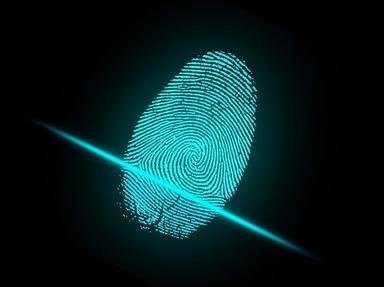
Fingerprints: Every person has unique ridges on their fingertips that leave behind oils and sweat. Finding a visible print can directly link a specific suspect to a weapon, handle, or surface at the scene, providing undeniable proof of contact. If a print is suspected but not easily seen, scientists use specialized powders, fumes (think superglue), or lasers. The prints are then run through automated fingerprint identification systems to find a match quickly.

Bloodstain pattern: As you probably figured out, it is possible to get DNA or blood type information from the bloodstain at the crime scene. But the shape, size, and distribution of blood droplets also tell a story. Forensic scientists analyze these patterns to determine the direction of a blow, the type of weapon used, the minimum number of strikes, and where the victim and attacker were standing. They can help to recreate the positions during the attack.

Hair with roots: DNA is a like a biological barcode that helps determine a particular individual. It can be found in skin cells left from "touch DNA" on a doorknob, saliva on a drinking glass, or (in this example) a hair with a root attached. Modern technology requires only a microscopic amount, sometimes just a few cells, to build a profile. That DNA is then run through databases like CODIS to identify an unknown suspect or conclusively place a known person at the scene.

Muddy bootprint: Things like shoes and tires leave unique impressions behind. First the print is photographed. Then, if it's actually in the mud or snow, a casting is made (like a dentist would do in their office). If it's on the floor (like this hypothetical case) gelatin lifters or specialized adhesive tapes are used to transfer the mud residue directly to a film backing. Forensic scientists can match the brand, size, and (hopefully) the specific wear patterns (like a unique scuff or a rock stuck in the tread) to a suspect's shoe or vehicle.

Shell casing: Guns have unique identifiers just like humans have fingerprints. When a gun is fired, the firing pin, ejector, and barrel leave microscopic, unique scratches and grooves on the bullet and cartridge casing. Matching these "toolmarks" to a specific firearm can prove a suspect's gun was the one used in the crime. Even if the weapon itself isn't recovered, the casings can link multiple different shootings across the country to the same gun.

Wool fiber: Many crimes across the country have been solved with the help of something as simple as a fiber. Fibers from clothing, blankets, or car carpets easily transfer during a physical struggle. Finding a wool fiber on a victim that later matches a suspect's sweater creates a powerful circumstantial link showing close physical contact. Scientists use high-powered microscopes and chemical analysis to ensure the fiber dyes and materials are an identical match.

Electronic tablet: Most of us have heard it, but modern technology is incredibly telling and "erased" data never really goes away. Location data, time stamps, text messages, search histories, and even smart-home logs (like my smart fridge and wine cooler) can establish a timeline and expose a suspect's motive or alibi. Even if someone deletes their messages or throws their phone in water, forensic computer specialists can often recover the hidden data from the flash memory.

Broken glass window: The way glass breaks reveals a lot about how a crime occurred. By looking at the different fracture lines, scientists can determine whether a window was broken from the inside or outside, and sometimes even the order in which multiple bullets passed through it. Because the first break alters the stress lines in the glass, later hits will stop when their cracks hit an existing line. This simple physical rule allows scientists to accurately sequence a chaotic timeline of events. (See, physics in school will play a part later in life!)

Pile of pills: Finding chemical substances, such as this pile of pills, can establish a motive, explain a victim's sudden incapacitation, or point toward an accidental overdose. Field tests and laboratory analysis identify the exact composition, purity, and, frankly, whether it's even legal. Using advanced laboratory instruments like gas chromatography, scientists can separate complex mixtures to identify even trace amounts of poisons or synthetic drugs. This can transform a mysterious death inquiry into a clear homicide or accidental poisoning case.

Handwritten note: Things like suicide notes, forged checks, or threatening letters carry unique individual characteristics. Forensic document examiners look at handwriting slants, pen pressure, ink chemistry, and even printer watermarks to verify authenticity or identify the author. They can also use infrared lighting to reveal "hidden writing," which is the invisible impression left on the blank pages beneath the sheet that was written on. This technique often uncovers deleted drafts or hidden messages that the writer thought were gone.

- Finding a loose strand of hair on a rug looks like a classic clue. However, if the hair fell out naturally, it lacks the root bulb containing nuclear DNA. While it can sometimes be used for mitochondrial DNA testing, it cannot pinpoint a specific individual with 100% accuracy the way rooted hair can.

- Unfortunately, once water melts or evaporates, it loses all structural shape, destroys any underlying water-soluble evidence, and yields zero actionable data for the lab.

- A forensic scientist cannot package a lingering smell into an evidence bag. They must rely strictly on quantifiable, testable data, like running a chemical swab to prove the bleach is actually present.

- Things in the household, like the victim's keys, are crucial for context, but they rarely hold forensic value. Because the victim lived there, their own DNA and prints are expected to be on most objects.

- Finding a victim wearing a watch with a face that stopped at a precise time sounds like a clue form a mystery novel. However, forensic scientists view this with extreme skepticism. A watch can stop for dozens of mundane reasons.
Source: Author stephgm67

This quiz was reviewed by FunTrivia editor rossian before going online.
Any errors found in FunTrivia content are routinely corrected through our feedback system.
6/6/2026, Copyright 2026 FunTrivia, Inc. - Report an Error / Contact Us