FREE! Click here to Join FunTrivia. Thousands of games, quizzes, and lots more!
Anatomy of a Volcano Trivia Quiz
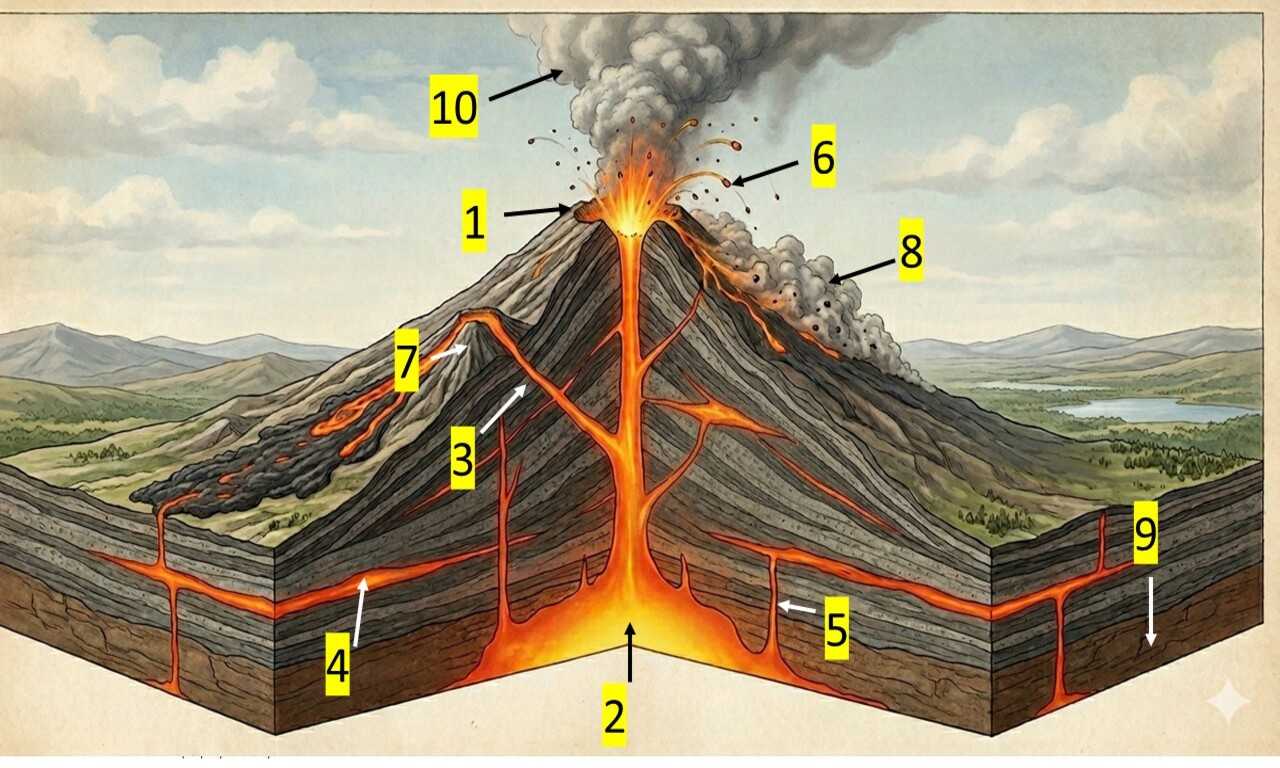
A volcano is a fascinating part of earth science. It is made up of multiple elements all working together. Match each label to the correct aspect of the pictured volcano's anatomy.
A label quiz
by stephgm67.
Estimated time: 3 mins.
Last 3 plays: terp0805 (8/10), james1947 (10/10), Guest 104 (10/10).
Click on image to zoom
Parasitic conePyroclastic flowEruption columnCraterMagma chamberSide ventVolcanic bombsSillCrustal rockDyke* Drag / drop or click on the choices above to move them to the answer list. View Image Attributions for This Quiz
The crater is the bowl-shaped depression or hollowed-out area typically found at the very top of the mountain and can be considered the exit point where things break through to the surface. It's usually formed by the explosive power of an eruption or by the ground collapsing inward after magma has left the area.
A crater can change size and shape every time a volcano erupts. If a massive eruption causes the entire top of the volcano to collapse, it creates a much larger version called a caldera. When a volcano isn't active, the crater often sits empty, or in some cases, it can fill with rainwater to create a crater lake.
2. Magma chamber
The magma chamber is a large pool of liquid rock located deep beneath the Earth's surface, hidden under the mountain itself. It holds molten rock (magma) which is under intense heat and pressure. The eruption itself starts here as more and more magma enters the chamber from deep in the ground. The pressure increases until it becomes too great for the surrounding rock to hold it and the magma is forced toward the surface.
The chamber is usually located very deep underground. The shape and size of the chamber can actually influence how the volcano looks on the outside; if the chamber is very large, the volcano might be huge also.
3. Side vent
A side vent is sometimes called a secondary vent. It is essentially a "backup exit" or a detour on the side of the volcano. It is an opening on the sloping side of the volcano rather than at the very top. Magma is always looking for the easiest way to the surface. If the main pipe is blocked or if the pressure is high enough to crack the sides of the mountain, magma will push through these side vents to erupt from the side.
Side vents are connected to the main vent by smaller tubes or cracks. During an eruption, these side vents can be unpredictable. They can open up in unexpected places, changing where the lava flows and making the eruption harder to track.
4. Sill
A sill is a flat, horizontal layer of magma that pushes its way between existing layers of rock underground. Instead of breaking through the surface to erupt, some magma can force itself sideways and get squeezed between two horizontal layers of older rock, eventually cooling and hardening into a solid shelf.
When magma forces its way into a sill, it can actually lift the entire layer of rock above it, causing the ground to bulge or rise slightly.
5. Dyke
A dyke is a vertical or diagonal sheet of magma that cuts across existing layers of rock. It's a wall-like sheet of magma that forces its way through cracks in the Earth's crust, crossing over different types of rock rather than going in between them. Unlike other volcanic features that follow the natural layers of the earth, a dyke creates its own path by cracking through that solid rock.
Sometimes, after a volcano has been extinct for millions of years, the softer surrounding mountain wears away, leaving the hard dyke standing alone like a giant stone wall sticking out of the ground.
6. Volcanic bombs
A volcanic bomb is a blob of molten rock that is thrown into the air during an eruption and hardens before it hits the ground. It starts as a chunk of liquid or semi-liquid magma that gets blasted out of the crater. Because it is flying through the air at high speeds, it morphs into a streamlined shape before it cools into solid rock and lands.
To be called a volcanic bomb, the chunk of rock has to be larger than 2.5 inches (64 mm) in diameter. Some can be as big as cars. Because they are so heavy and are launched with such force, they can land quite far from the main vent, making them one of the most immediate dangers to anything standing near an erupting volcano.
7. Parasitic cone
A parasitic cone is a smaller, secondary volcano that grows on the side of a much larger volcano. It gets its name because it feeds (like a parasite) off the main volcano's magma supply. It forms when the main vent is blocked or when the pressure is so high that magma forces its way out through a side vent, building up a new, smaller mountain on the slope.
A large volcano can have dozens of these cones. They can make the main mountain appear uneven rather than a "traditional" triangle shape. Sometimes, the large volcano might be quiet while a parasitic cone on its side is actively spitting out lava.
8. Pyroclastic flow
A pyroclastic flow is a fast-moving, incredibly hot cloud of ash, rock fragments, and gas that races down the side of a volcano during an eruption. Unlike slow-moving lava, this flow is a thick, turbulent mixture that can travel at speeds of over 100 mph (161 kmh) and can reach temperatures of about 1,000 degrees Celsius (1,832 degreees Fahrenheit).
Because they are so heavy and dense, they follow the shape of the volcano, rushing down valleys and flattening everything in their path. Once the flow stops, the ash and rocks settle and cool, often forming a thick layer of rock called tuff. This can bury entire landscapes (think of the city of Pompeii).
9. Crustal rock
Crustal rock is the solid, outermost layer of the Earth that the volcano sits on and must punch through to erupt. It is made up of many different types of minerals and rocks that have cooled over millions of years. Even though it seems solid, it is actually quite thin compared to the rest of the Earth. Before magma can become lava, it has to break through miles of this crustal rock.
As magma rises, it often gets so hot that it melts some of the crustal rock around it. This melted crust mixes with the magma, changing its chemical makeup and potentially making the eventual eruption more or less explosive.
10. Eruption column
The eruption column is the massive cloud of debris and vapor that a volcano shoots high into the atmosphere. It's a combination of tiny shattered rock particles (ash), water vapor (steam), and various gases (like sulfur and carbon dioxide) that are blasted out of the crater at high speeds. Unlike heavy lava that stays on the ground, ash and gas can rise miles into the sky. Strong winds can carry this volcanic ash around the world, sometimes blocking out the sun.
When the ash eventually falls back down to Earth, it settles in layers. Over time, these layers of ash harden and help build up the height and shape of the volcano's cone.
This quiz was reviewed by FunTrivia editor rossian before going online.
Any errors found in FunTrivia content are routinely corrected through our feedback system.