FREE! Click here to Join FunTrivia. Thousands of games, quizzes, and lots more!
Quiz about Jupiter the Bringer of Jollity

Jupiter, the Bringer of Jollity Quiz


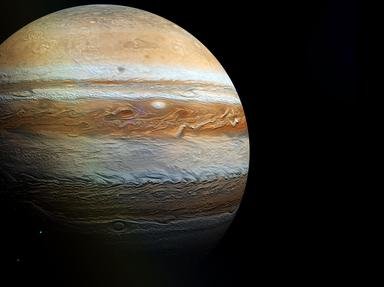
Inspired by Gustav Holst's orchestral suite "The Planets," here is my fourth of seven quizzes on the 'other' planets in our Solar System. What do you know of kingly Jupiter, the fifth planet from the Sun?

A photo quiz by reedy. Estimated time: 3 mins.
  1. Home
  2. »
  3. Quizzes
  4. »
  5. Science Trivia
  6. »
  7. Our Solar System
  8. »
  9. Jupiter

Author
reedy
Time
3 mins
Type
Photo Quiz
Quiz #
422,170
Updated
Apr 14 26
# Qns
10
Difficulty
Average
Avg Score
7 / 10
Plays
44
Last 3 plays: daver852 (5/10), bradncarol (5/10), ertrum (6/10).
-
Question 1 of 10
1. Gustav Holst gave Jupiter the title of "The Bringer of Jollity," which was a reference to the planet's importance in astrology. Which volatile astrological sign, associated with celebrations and enthusiasm, is ruled by Jupiter?
Hint


Question 2 of 10
2. Which ancient civilization was among the first to recognize Jupiter as one of a number of 'wandering stars' in the night sky, naming it after their chief deity, Marduk?


Hint


Question 3 of 10
3. Which astronomer was the first to recognize that Jupiter was a planet, and not simply a 'wandering star'? Hint


Question 4 of 10
4. Jupiter is the largest planet in our Solar System with an equatorial diameter eleven times wider than Earth's. Its volume is so great that it could fit approximately how many Earths inside it? Hint


Question 5 of 10
5. Comparing Jupiter to its nearest gas giant neighbour (Saturn), which of these statements is FALSE? Hint


Question 6 of 10
6. Jupiter's 'Great Red Spot' is a high-pressure anticyclonic storm that travels in the planet's southern hemisphere. Based on observations from the first quarter of the 21st century, it is large enough that you could fit the whole Earth inside of it.


Question 7 of 10
7. The four Galilean moons of Jupiter were the first satellites discovered in the Solar System (other than Earth's moon). Which of these four descriptions is INCORRECT? Hint


Question 8 of 10
8. Jupiter has been visited by multiple space probes in the decades since mankind first escaped Earth's gravity. Which of these was the first to do a flyby, making its closest approach on December 4, 1973?

Hint


Question 9 of 10
9. During another flyby of Jupiter in 1979, rings were seen for the first time around the planet, just faintly visible. They are comprised of the same type of material as the rings of Saturn (mainly ice).


Question 10 of 10
10. In 2011, a second probe was sent to go into orbit around Jupiter, arriving in 2016 with a mission to measure Jupiter's composition, gravitational field, magnetic field, and polar magnetosphere. Named for the mythological wife (and sister) of Jupiter, what is its designation?

Answer: (One Word)

(Optional) Create a Free FunTrivia ID to save the points you are about to earn:

arrow Select a User ID:
arrow Choose a Password:
arrow Your Email:


View Image Attributions for This Quiz

Most Recent Scores
Today : daver852: 5/10
Today : bradncarol: 5/10
Today : ertrum: 6/10
Today : Catreona: 6/10
Today : amarie94903: 10/10
Today : Guest 47: 3/10
Today : Guest 209: 7/10
Today : Guest 68: 4/10
Today : Guest 174: 10/10

Quiz Answer Key and Fun Facts
1. Gustav Holst gave Jupiter the title of "The Bringer of Jollity," which was a reference to the planet's importance in astrology. Which volatile astrological sign, associated with celebrations and enthusiasm, is ruled by Jupiter?

Answer: Sagittarius

Sagittarians are said to exhibit outgoing, optimistic, joyful, and expansive qualities, associated with celebrations and enthusiasm. Jupiter was also associated with the water sign Pisces (prior to the discovery of Neptune), but Pisceans, contrarily, express their energy in spiritual, internal, and dreamy ways, focusing on intuition and emotional sensitivity.

Thus, by subtitling this movement "The Bringer of Jollity," Holst chose to highlight the Sagittarian qualities of Jupiter in the music.
2. Which ancient civilization was among the first to recognize Jupiter as one of a number of 'wandering stars' in the night sky, naming it after their chief deity, Marduk?

Answer: Babylonian

Marduk - also known as Merodach - rose to prominence as Babylon's supreme deity, eventually becoming the leading figure of the entire Mesopotamian pantheon as the city's influence expanded. Revered as a god of authority and cosmic stability, he embodied ideals such as kingship, justice, creation, and the maintenance of order. Reflecting his power and stature, the Babylonians associated their god with the planet Jupiter, viewing the bright 'wandering star' as a celestial expression of his dominion.

The naming of Jupiter for the most powerful god of the pantheon was also reflected in Greek (Zeus) and Etruscan (Tinia) cultures, but other ancient civilizations also chose teacher figures or thunder/warrior gods who were powerful, but not necessarily the 'king of the gods.'
3. Which astronomer was the first to recognize that Jupiter was a planet, and not simply a 'wandering star'?

Answer: Galileo Galilei

In the early 1600s, most people thought of bright objects like Jupiter as 'wandering stars' because they moved against the background of fixed stars, but no one really knew why. Galileo Galilei (1564-1642) built and refined one of the first telescopes powerful enough for serious study and pointed it at Jupiter in 1610. What he noticed was astonishing: four small points of light near Jupiter that changed position night after night. He realized these were moons orbiting Jupiter, not stars drifting randomly.

This was groundbreaking because it showed, for the first time, that not everything in the heavens revolved around Earth. Galileo's careful observations - and his willingness to trust what he saw over what tradition said - helped establish Jupiter as a true planet with its own system and provided strong evidence for a Sun-centered Solar System.
4. Jupiter is the largest planet in our Solar System with an equatorial diameter eleven times wider than Earth's. Its volume is so great that it could fit approximately how many Earths inside it?

Answer: 1,300

As noted in the question, Jupiter is the largest planet in the Solar System, and its scale is hard to overstate. Its equatorial diameter is about 143,000 kilometers (roughly 89,000 miles). Earth, by comparison, is about 12,742 kilometers (7,918 miles) across. That means Jupiter is over 11 times wider than Earth. Because volume increases much faster than diameter, more than 1,300 Earths could fit inside Jupiter if it were hollow. In terms of mass, Jupiter is about 318 times as massive as Earth, and actually outweighs every other planet, combined.

Jupiter is classified as a gas giant, made mostly of hydrogen and helium, the same light elements that make up the Sun. Near the top, Jupiter has thick cloud layers composed of ammonia, ammonium hydrosulfide, and water vapor, which form the familiar colorful bands and giant storms such as the Great Red Spot.

As you travel deeper, pressure increases dramatically. Hydrogen gas is gradually compressed into liquid hydrogen, and even deeper it becomes metallic hydrogen, a strange state of matter that conducts electricity. This metallic layer is responsible for Jupiter's extremely powerful magnetic field, the strongest of any planet. At the very center, Jupiter is thought to contain a small, dense core of heavier elements.
5. Comparing Jupiter to its nearest gas giant neighbour (Saturn), which of these statements is FALSE?

Answer: Jupiter has faster winds

Jupiter and Saturn are both giant, fast‑spinning worlds, but they differ in noticeable ways once you look closely at their rhythms and weather. Jupiter's year lasts about 12 Earth years, while Saturn's year is much longer, stretching to nearly 29.5 Earth years. This difference comes simply from distance: Saturn orbits much farther from the Sun and moves more slowly along its path.

Despite their long years, both planets have remarkably short days. Jupiter has the shortest day of any planet, rotating once in just under 10 hours. Saturn is only slightly slower, with a day of about 10.5 hours. This rapid spinning shapes their appearances, flattening them at the poles and fueling powerful atmospheric motion.

That fast rotation also plays into their extreme winds. Jupiter's cloud-top winds commonly reach about 650 km/h (roughly 400 mph), driving huge storms like the Great Red Spot. Saturn's winds, however, are even faster and are the strongest measured in the Solar System - sometimes exceeding 1,600 km/h (1,000 mph) near the equator.

When it comes to moons, both planets are surrounded by large families of natural satellites. However, Jupiter is the poor cousin in this comparison, as Saturn has nearly three times as many natural moons as Jupiter. But, to balance things out, Jupiter can claim the largest moon in the Solar System.
6. Jupiter's 'Great Red Spot' is a high-pressure anticyclonic storm that travels in the planet's southern hemisphere. Based on observations from the first quarter of the 21st century, it is large enough that you could fit the whole Earth inside of it.

Answer: True

The Great Red Spot is one of the most famous features in the Solar System, and astronomers have been observing it for a remarkably long time. The storm was first noticed in the mid-1600s, shortly after the invention of the telescope, when early astronomers began carefully sketching Jupiter's cloud bands. While scientists still debate whether the earliest sightings were of the same storm seen today, records clearly show that the Great Red Spot has existed continuously since at least the 1800s. Over the centuries, its color, shape, and size have changed, but the storm itself has never disappeared. Modern spacecraft, from Voyager to Juno, have allowed scientists to track it in incredible detail, revealing it as a massive, swirling high-pressure system with winds far stronger than any hurricane on Earth.

In terms of size, the Great Red Spot is truly enormous, even though it has been gradually shrinking over time. In the late 1800s, it was large enough to swallow three Earths side by side. Today, it is smaller but still vast - about wide enough to fit one Earth comfortably inside. The storm stretches roughly 15,000 to 16,000 kilometers (9,321 to 9,942 miles) across, making it larger than our planet's diameter.
7. The four Galilean moons of Jupiter were the first satellites discovered in the Solar System (other than Earth's moon). Which of these four descriptions is INCORRECT?

Answer: Io - the most volcanoes in the Solar System

The Galilean moons - so named for Galileo Galilei who discovered them in 1610 - are each quite distinct from each other.

Io holds the title of the most geologically active body in the solar system. Its surface is constantly being reshaped by powerful volcanic eruptions driven by intense gravitational squeezing from Jupiter and neighboring moons. Interestingly, Io does NOT have the most volcanoes overall - Venus and even Earth have more. What makes Io special is how extreme and frequent its eruptions are, with lava fountains and flows that can rise hundreds of kilometers high. This nonstop activity means Io has very few impact craters, since its surface is being continually renewed.

Ganymede is the largest moon in the entire Solar System, and it's so big that it outshines some planets. It orbits Jupiter, but it's actually larger than the planet Mercury. Compared to Earth's Moon, Ganymede is enormous: it's about 1.5 times wider in diameter. If you could place it next to our Moon, the difference would be obvious right away. Despite its size, Ganymede is still classified as a moon because it orbits a planet rather than the Sun. It even has its own weak magnetic field, something no other moon in our Solar System can claim.

Europa looks calm and simple with a smooth, bright surface of ice crisscrossed by dark cracks. Beneath that icy shell, scientists believe there is a global ocean of liquid water, kept warm by tidal heating from Jupiter's gravity. This hidden ocean may contain more water than all of Earth's oceans combined. Because water is essential for life as we know it, Europa is considered one of the most promising places to search for life beyond Earth, even though its ocean is sealed beneath miles of ice.

Callisto, the outermost of the four large Galilean moons, tells a very different story. Its surface is ancient, dark, and heavily scarred by impacts, making it the most heavily cratered surface in the solar system. Unlike Io or Europa, Callisto shows little evidence of internal activity, so its surface has barely changed for billions of years. Each crater is like a preserved record of early Solar System history. In a sense, Callisto acts as a cosmic time capsule, showing what many worlds may have looked like long ago.
8. Jupiter has been visited by multiple space probes in the decades since mankind first escaped Earth's gravity. Which of these was the first to do a flyby, making its closest approach on December 4, 1973?

Answer: Pioneer 10

NASA's unmanned Pioneer 10 probe launched from Cape Canaveral on March 3, 1972, and sent back its first images of Jupiter on November 6,1973. Its closest approach to the planet occurred on December 4, when it came to within a distance of 132,252 km (82,178 mi). Pioneer 10 would continue on its journey, becoming the first manmade object to leave our Solar System. Its last transmission was received on January 23, 2003.

Three other probes were sent in the 1970s, including Pioneer 11 (launched April 6, 1973), Voyager 1 (launched September 5, 1977), and Voyager 2 (launched August 20, 1977), each with its own specific mission that included observation of Jupiter and some of its moons.

Before the end of the 20th century, the initial four visits were added to by the Galileo Orbiter (launched October 18, 1989), Ulysses (launched October 6, 1990), and Cassini (launched October 15, 1997). Ulysses and Cassini's trajectories just used Jupiter for a gravity assist while passing by, aiming for other targets, but both were still able to glean new information and images of the planet and its moons as they sailed past.

The first excursion of the 21st century was by New Horizons (launched January 19, 2006), followed by Juno (launched August 5, 2011).
9. During another flyby of Jupiter in 1979, rings were seen for the first time around the planet, just faintly visible. They are comprised of the same type of material as the rings of Saturn (mainly ice).

Answer: False

While Voyager 1's initial flyby detected the rings, further observation was needed to better understand their existence. This came with the Galileo Orbiter, which gathered information between 1995 and 2003.

Galileo's cameras and dust detectors showed that Jupiter's rings are not ancient, solid (and reflective) structures like Saturn's rings, but instead are thin, dusty, and constantly changing. The spacecraft observed that the ring material closely matched the orbits of several small inner moons - especially Metis, Adrastea, Thebe, and Amalthea. Galileo detected streams of tiny dust particles near these moons, leading scientists to conclude that micrometeorites regularly strike the moons' surfaces, knocking off fine dust. This dust then spreads out and forms the rings as it becomes trapped in orbit around Jupiter.

Galileo also helped solve a puzzle about why Jupiter's rings don't simply disappear. Dust particles should slowly spiral into Jupiter or get blown away by radiation pressure. Galileo's observations showed that the rings are constantly being 'refilled' by new dust from ongoing impacts on the moons. Without this steady replacement, Jupiter's rings would fade away in a relatively short time (on astronomical scales).
10. In 2011, a second probe was sent to go into orbit around Jupiter, arriving in 2016 with a mission to measure Jupiter's composition, gravitational field, magnetic field, and polar magnetosphere. Named for the mythological wife (and sister) of Jupiter, what is its designation?

Answer: Juno

NASA's Juno spacecraft is a robotic explorer designed to help scientists better understand how Jupiter formed and how it works beneath its thick clouds. Unlike earlier missions that stayed mostly around Jupiter's equator, Juno follows a highly elongated, polar orbit, allowing it to pass over the planet's poles and dive close to the cloud tops while avoiding the worst radiation belts.

Juno was launched on August 5, 2011, from Cape Canaveral, Florida, aboard an Atlas V rocket. After a long, looping journey of nearly five years through the inner Solar System, it finally reached its destination. On July 4, 2016, Juno fired its main engine and successfully entered orbit around Jupiter, becoming the first spacecraft to orbit the planet since Galileo more than a decade earlier.

The mission was originally planned to last about 20 months, focusing on Jupiter's interior, gravity, magnetic field, and atmosphere. However, Juno performed so well that NASA approved multiple mission extensions. During this extended phase, Juno's job expanded to include close flybys of major moons such as Ganymede, Europa, and Io, as well as new studies of Jupiter's faint rings and powerful auroras. The extended mission carried Juno's operations far beyond its initial expectations.
Source: Author reedy

This quiz was reviewed by FunTrivia editor rossian before going online.
Any errors found in FunTrivia content are routinely corrected through our feedback system.
4/14/2026, Copyright 2026 FunTrivia, Inc. - Report an Error / Contact Us