FREE! Click here to Join FunTrivia. Thousands of games, quizzes, and lots more!
Quiz about Saturn the Bringer of Old Age

Saturn, the Bringer of Old Age Quiz


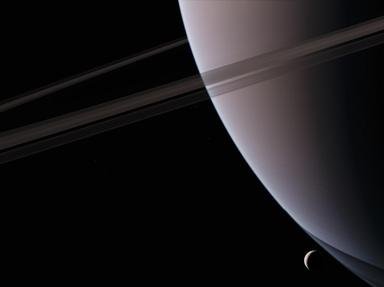
Welcome to the third quiz in my series inspired by Gustav Holst's orchestral suite "The Planets," looking at the 'other' seven planets in our Solar System. Approaching them in reverse order, I present Saturn, the sixth planet from our Sun.

A photo quiz by reedy. Estimated time: 3 mins.
  1. Home
  2. »
  3. Quizzes
  4. »
  5. Science Trivia
  6. »
  7. Our Solar System
  8. »
  9. Saturn

Author
reedy
Time
3 mins
Type
Photo Quiz
Quiz #
421,449
Updated
Dec 02 25
# Qns
10
Difficulty
Average
Avg Score
7 / 10
Plays
19
Last 3 plays: bg853 (4/10), miner8265 (5/10), cardsfan_027 (9/10).
-
Question 1 of 10
1. Gustav Holst gave Saturn the title of "The Bringer of Old Age," relating to Saturn as the Roman god of time and renewal, and agriculture. Which earthy astrological sign, similarly associated with time (patience and planning), is ruled by Saturn? Hint


photo quiz
Question 2 of 10
2. Visible to the naked eye, Saturn's existence has been known since time immemorial, but which astronomer was the first to spot Saturn's rings, originally referring to what he saw as 'ears'? Hint


Question 3 of 10
3. Saturn has been visited four times by different spacecraft. Which of these was the first? Hint


Question 4 of 10
4. With new information on Saturn's composition, Saturn was re-classified as an 'ice giant' in the early 1990s.


Question 5 of 10
5. Saturn is the least dense planet in our Solar System. Its density is so low, it would float in water (if there was an ocean large enough to hold it).


Question 6 of 10
6. It takes Saturn about 29.5 Earth years to complete one trip around the sun, but its day is much quicker than ours. How long does it take for Saturn to make one complete rotation? Hint


Question 7 of 10
7. At Saturn's north pole is a persistent storm that is what curious shape? Hint


Question 8 of 10
8. Saturn's rings are a spectacular and beautiful part of this unique planet. Why do they appear to be so bright? Hint


Question 9 of 10
9. Saturn has more moons than any other planet in our Solar System, and that's not even considering its rings. In March of 2025, how many newly-discovered moons were added to the official count? Hint


Question 10 of 10
10. Saturn's largest moon Titan has an atmosphere - a characteristic that is shared by only nine other moons in the Solar System. What is its atmosphere primarily comprised of? Hint


(Optional) Create a Free FunTrivia ID to save the points you are about to earn:

arrow Select a User ID:
arrow Choose a Password:
arrow Your Email:


View Image Attributions for This Quiz

Most Recent Scores
Today : bg853: 4/10
Today : miner8265: 5/10
Today : cardsfan_027: 9/10
Today : GoodwinPD: 10/10
Today : psnz: 10/10
Today : AmandaM: 8/10
Today : cubbaby: 4/10
Today : Reamar42: 3/10
Today : Guest 4: 2/10

Quiz Answer Key and Fun Facts
1. Gustav Holst gave Saturn the title of "The Bringer of Old Age," relating to Saturn as the Roman god of time and renewal, and agriculture. Which earthy astrological sign, similarly associated with time (patience and planning), is ruled by Saturn?

Answer: Capricorn

Saturn is regarded as the planet of structure, discipline, and the passage of time, which aligns closely with Capricorn, the 10th sign of the zodiac. Capricorn is deeply associated with themes of:

Responsibility and ambition
Patience and perseverance
Authority and boundaries
Practicality and long-term goals
Mastery through experience

As one of the three earth signs (along with Taurus and Virgo), it makes sense that Capricorn would be connected with Saturn, a planet named for the Roman god of agriculture and time - often depicted with a scythe, symbolizing cycles and mortality.

Holst chose a fitting title for his musical work, as Saturn's influence is tied to the concept of time in both myth and astrology: it governs life lessons, maturity, and karmic patterns, urging growth through challenges.
2. Visible to the naked eye, Saturn's existence has been known since time immemorial, but which astronomer was the first to spot Saturn's rings, originally referring to what he saw as 'ears'?

Answer: Galileo Galilei

When Galileo first turned his telescope toward Saturn in 1610, he expected to see a simple sphere like the other planets. Instead, he observed what looked like a triple planet - two smaller bodies flanking the planet with 'ears,' as he called them - because his instrument was too primitive to reveal their true nature.

Galileo noted that these strange appendages seemed to change shape and even disappear over time, leaving him puzzled. In reality, he was glimpsing Saturn's rings, though their delicate structure was beyond the resolution of his telescope. It wasn't until decades later (in 1659), with improved optics, that Christiaan Huygens correctly identified them as a vast system of rings encircling the planet.
3. Saturn has been visited four times by different spacecraft. Which of these was the first?

Answer: Pioneer 11

The first spacecraft to approach Saturn, Pioneer 11 was launched in April of 1973 and reached the ringed planet on September 1, 1979. Its daring trajectory revealed the mysterious F ring and two previously unknown moons, while also testing safe paths for future missions. This pioneering flyby opened the door for deeper exploration of the outer solar system.

The next two spacecraft to do flybys of Saturn came in quick succession, with Voyager 1 passing by in November of 1980, followed closely by Voyager 2 in August of 1981.

The fourth visit, however, was a much longer stay. The Cassini-Huygens mission was launched in October of 1997, arriving at Saturn on July 1, 2004. For 13 years, Cassini orbited the planet, sending back breathtaking images and groundbreaking data. Its companion, the Huygens probe, made history in 2005 by landing on (Saturn's largest moon) Titan's surface. Cassini's mission concluded with a dramatic plunge into Saturn's atmosphere in September of 2017.
4. With new information on Saturn's composition, Saturn was re-classified as an 'ice giant' in the early 1990s.

Answer: False

Before Voyager 2 visited Neptune and Uranus, all four of the giants in our Solar System were referred to as 'gas giants.' With the new information gleaned by those flybys, the farther planets were reclassified as 'ice giants,' with a different atmospheric composition.

Saturn is composed primarily of hydrogen (~ 96%) and helium (~ 3%) with trace elements filling in the final ~ 1%. There is no true surface beneath the thick layers of atmosphere, but it is surmised that there is a small rocky or icy core surrounded by metallic hydrogen beneath it all.
5. Saturn is the least dense planet in our Solar System. Its density is so low, it would float in water (if there was an ocean large enough to hold it).

Answer: True

Saturn's average density is 0.69 g/cm3 (0.69 lb/cu in), which is lighter than water's density at 1.0 g/cm3 (1 lb/cu in). So, theoretically, if there was an ocean large enough for Saturn to float in, it would probably float - inasmuch as a gaseous body would be able to 'float' in water.
6. It takes Saturn about 29.5 Earth years to complete one trip around the sun, but its day is much quicker than ours. How long does it take for Saturn to make one complete rotation?

Answer: 10 hours, 33 minutes

The four times given are the sidereal days for each of the giants in our Solar System:
Jupiter's is the fastest time at just under 10 hours;
Saturn is the second fastest at about 10.5 hours;
Neptune holds the third fastest time at just shy of 16 hours; and
Uranus has the slowest day among this group at about 17.25 hours.

Given Saturn's low density, the high speed of its rotation causes it to flatten at the poles and bulge at the equator. Speaking of the equator, the speed of Saturn's revolution at the equator is a whopping 36,840 km/h (22,891 mph).
7. At Saturn's north pole is a persistent storm that is what curious shape?

Answer: Hexagonal

The remarkable atmospheric phenomenon at Saturn's north pole is a vast, six-sided storm that has persisted for decades. This hexagon spans nearly 29,000 km (18,000 mi) across, making it large enough to contain several Earths. It is formed by a powerful jet stream circling the pole at speeds of about 320 kilometers per hour, enclosing a massive polar vortex at its center.

Scientists believe the geometric shape arises from complex fluid dynamics and wave patterns in Saturn's fast-rotating atmosphere, a behavior that has been replicated in laboratory experiments with rotating fluids. Seasonal changes on Saturn also alter the storm's appearance, shifting its color from bluish tones to golden hues over time. This enduring feature has provided valuable insights into atmospheric physics and the stability of weather systems on gas giants.
8. Saturn's rings are a spectacular and beautiful part of this unique planet. Why do they appear to be so bright?

Answer: They reflect sunlight off icy particles

Saturn's rings are an immense and intricate system of icy particles orbiting the planet, stretching out tens of thousands of kilometers yet remaining only a few meters thick. They are primarily composed of water ice mixed with dust and rocky material, ranging in size from tiny grains to chunks several meters across.

Scientists believe these rings formed either from remnants of moons shattered by Saturn's gravity or leftover material from the planet's early formation. The rings are divided into distinct sections - such as the A, B, and C rings - separated by gaps like the Cassini Division, which are shaped by gravitational interactions with Saturn's moons. Despite their delicate appearance, the rings are dynamic, with particles constantly colliding, clumping, and spreading, creating waves and patterns influenced by Saturn's powerful gravitational field. While rings have been discovered around the other three giants, this spectacular structure truly sets Saturn apart.
9. Saturn has more moons than any other planet in our Solar System, and that's not even considering its rings. In March of 2025, how many newly-discovered moons were added to the official count?

Answer: 128

The timeline of the discoveries of all of Saturn's (so far) 274 moons has been a long process, beginning with Dutch astronomer Christiaan Huygens discovery of Titan in 1655.

Including Titan, there are seven major moons - large, spherical, and with prograde orbits. Italian-French astronomer Giovanni Domenico Cassini discovered Rhea, Iapetus, Dione and Tethys between 1671 and 1684, while William Herschel spotted Enceladus and Mimas in 1789.

Prior to the 2025 announcement by the International Astronomical Union (IAU)'s Minor Planet Center of an additional 128 moons confirmed in orbit around Saturn, the total had already reached 146 in 2023, when just one planet had been added to the count.
10. Saturn's largest moon Titan has an atmosphere - a characteristic that is shared by only nine other moons in the Solar System. What is its atmosphere primarily comprised of?

Answer: Nitrogen

Titan is the biggest of Saturn's moons and the second-largest in the entire Solar System, even surpassing Mercury in size. What makes Titan extraordinary is its dense, nitrogen-rich atmosphere, which gives it an orange haze and hides its surface from direct view. Beneath this shroud lies a world of frozen water and hydrocarbon lakes, primarily composed of liquid methane and ethane. These lakes and rivers create a landscape that, in many ways, resembles Earth's hydrological cycle, but with methane playing the role of water.

Titan's surface temperature hovers around -179 degrees Celsius (-290 degrees Fahrenheit), making water ice as hard as rock and methane stable as a liquid. Scientists believe Titan may harbor a subsurface ocean of liquid water mixed with ammonia, raising the possibility of microbial life in its depths.

The Cassini-Huygens mission provided detailed images and data, revealing dunes, mountains, and seasonal weather patterns driven by methane rain. Titan is not only a fascinating moon but also a natural laboratory for studying prebiotic chemistry and conditions that might resemble early Earth.
Source: Author reedy

This quiz was reviewed by FunTrivia editor rossian before going online.
Any errors found in FunTrivia content are routinely corrected through our feedback system.
12/2/2025, Copyright 2025 FunTrivia, Inc. - Report an Error / Contact Us