FREE! Click here to Join FunTrivia. Thousands of games, quizzes, and lots more!
Quiz about The Magnificent Letter M

The Magnificent Letter M Trivia Quiz

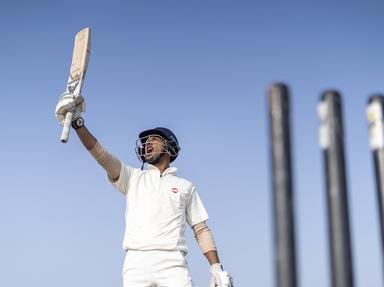
Cricket Legends Whose Surnames Begin With M

We will assemble a squad of 20 cricketers whose surnames begin with the letter M. Best of luck.

A multiple-choice quiz by thomas1975. Estimated time: 5 mins.
  1. Home
  2. »
  3. Quizzes
  4. »
  5. Sports Trivia
  6. »
  7. Cricket
  8. »
  9. Cricket Players

Author
thomas1975
Time
5 mins
Type
Multiple Choice
Quiz #
425,502
Updated
Sep 04 26
# Qns
20
Difficulty
New Game
Avg Score
16 / 20
Plays
13
Last 3 plays: sarryman (13/20), elfharry (18/20), Stoaty (10/20).
- -
Question 1 of 20
1. An opener considered by Don Bradman to be the best left handed opener he ever saw in action. Who was this New South Welshman with whom Bradman once shared a test match winning partnership of over 300? (1940s and 50s) Hint


Question 2 of 20
2. This right handed opener only got to play 10 test matches over an 18 year period, averaging 47.22 in those games. Who was this business like opener? (1930s-50s) Hint


Question 3 of 20
3. An attacking right handed batter who also bowled left arm orthodox spin. Who was this 'Governor General of cricket'? (1900s-1920s) Hint


Question 4 of 20
4. This long serving left hander was a man who played for Hampshire has a name that links to an alcoholic beverage of olden times. Who was he? (1900s-30s)


Question 5 of 20
5. This prolific but somewhat controversial Pakistani was this middle order batter who was once kicked by an opponent on the field of play? (1970s-1990s) Hint


Question 6 of 20
6. A dashing batter and a great fast bowler, he was also famous for dismissing the notion that there was pressure in cricket. Can you name him? (1940s and 1950s) Hint


Question 7 of 20
7. This Australian wicket keeper rates as one of the finest ever and was a more than useful middle order batter into the bargain. In later years he coached England. Can you name him? (1970s and 80s) Hint


Question 8 of 20
8. This man was an integral part of West Indies sides for a decade in which they ruled the cricket world, and also served Hampshire for many years as an overseas player. Who was this legend? (1980s) Hint


Question 9 of 20
9. He is regarded as Pakistan's first great bowler, and was an acknowledged master of the leg cutter. Can you name this star of the 1950s?


Question 10 of 20
10. From Sri Lanka, a taker of 800 test wickets, and an integral part of the 1996 world cup winning side to boot. Who was this off spinner of the 1990s and 2000s? Hint


Question 11 of 20
11. This Australian who spearheaded the pace attack when the Australian men's side had the greatest period of domination of the world game, in the 1990s and 2000s, that they have ever enjoyed. Who was this colossus? Hint


Question 12 of 20
12. A top order batter and captain in the 1950s and a chairman of selectors in the 1980s. can you name this Surrey and England great? Hint


Question 13 of 20
13. This cricketer is controversial in some circles because of a type of dismissal that has been named after him. The indisputable fact is that he was a great all rounder, reaching the career double of 1,000 runs and 100 wickets in test cricket in just his 23rd match at that level. Who was this played who batted right handed and bowled left arm spin? (1940s and 50s)


Question 14 of 20
14. Pakistan - another top class all rounder, one whose bowling stock in trade was leg spin. A test cricketer at just 15 years of age, he later played English county cricket as well. Can you name him? (1950s-70s) Hint


Question 15 of 20
15. This player is an opening batter, and regarded as the greatest of Pakistan's early history. Who was this opener, known his ability to bat for huge periods of time (1950s and 1960s) Hint


Question 16 of 20
16. He was an attacking middle order batter and a useful medium pacer. On one occasion he was batting so brilliantly that his captain, Don Bradman, called the rest of the Australian team to come out on to the pavilion balcony to watch, saying "You will never see batting like this again!" Can you complete the name: Stan ______?

Answer: (Bonaparte?)
Question 17 of 20
17. This wicket keeper played for India in the late 1980s and early 1990s. A fine keeper and a useful lower order middle order batter, his surname reads like an English comparative word. Can you name him? Hint


Question 18 of 20
18. This fast bowler who was one half of test cricket's first all-pace new ball pair. Can you name this Tasmanian born speedster who became a Lancashire stalwart? (1920s) Hint


Question 19 of 20
19. This West Indian speedster took his test wickets at 21 a piece and was part of an exercise in giving an opposition team a taste of their own medicine. Can you name him? (1920s and 30s) Hint


Question 20 of 20
20. This player was a left arm pacer. He was the first ever to take 17 wickets in a first class match, in 1876. There is a claim that he helped to inspire the naming of a famous fictional character. Can you name him? Hint


(Optional) Create a Free FunTrivia ID to save the points you are about to earn:

arrow Select a User ID:
arrow Choose a Password:
arrow Your Email:


Most Recent Scores
Today : sarryman: 13/20
Today : elfharry: 18/20
Today : Stoaty: 10/20
Today : bluepeter46: 15/20
Today : rivenproctor: 19/20
Today : bernie73: 6/20
Today : MalStone: 20/20
Today : wwe84: 17/20
Today : genoveva: 20/20

Quiz Answer Key and Fun Facts
1. An opener considered by Don Bradman to be the best left handed opener he ever saw in action. Who was this New South Welshman with whom Bradman once shared a test match winning partnership of over 300? (1940s and 50s)

Answer: Arthur Morris

Arthur Morris started his first class career with centuries in each innings of his debut match. HIs greatest period happened in England in 1948. In the five test matches of that summer he scored 696 runs at 87.00. That included 182 in the fourth match at Headingley, when he and Bradman had the partnership mentioned above, and Australia made light work of a target of 404, winning by seven wickets, and 196 in the final match at The Oval, batting through the Australian innings after England had been knocked over for a paltry 52. Hugh Morris was a fine opener for Glamorgan, and probably should have played more often for England than he did. John Morris was a middle order batter for Derbyshire who never delivered at a higher level. Sean Morris played for Hampshire and was a decent county batter but never seriously considered for higher things.
2. This right handed opener only got to play 10 test matches over an 18 year period, averaging 47.22 in those games. Who was this business like opener? (1930s-50s)

Answer: Vijay Merchant

Vijay Merchant averaged 71 in first class cricket, second only among those who played enough to qualify to Bradman (95.14). He made two tours of England, in 1936 and 1946, and in conditions in which Indian batters often struggle he amassed over 4,000 first class runs across the two tours. Uday Merchant, five years Vijay's junior, played 42 matches for Mumbai, averaging over 55 with the bat but never being picked for a test match.
The other two Merchants are minor figures, Cameron a New Zealand and Maroof from the United Arab Emirates.
3. An attacking right handed batter who also bowled left arm orthodox spin. Who was this 'Governor General of cricket'? (1900s-1920s)

Answer: Charles Macartney

Charles Macartney, nicknamed Governor General for his imperious batting, played for Australia from 1907-1926. In that final series in 1926 he scored three successive centuries, all in games that ended up being drawn due to bad weather. England won the only match to be decided and thus regained The Ashes that they had last won in 1911-12. In 1921 he scored 345 against Nottinghamshire in a tour match, an innings that took him less than four hours. His bowling while definitely overshadowed by his batting was good enough that he was a test match winner in that department once, taking 11-85 across the two innings, at Leeds in 1909.

Archie MacLaren could certainly be imperious at the crease, but he was not a bowler, and was English, not Australian. Colin McDonald was an Australian opener of the 1950s, noted for defensive displays. Alan Marshal was an attack minded batter, Australian born, but playing a lot of his cricket for Surrey.
4. This long serving left hander was a man who played for Hampshire has a name that links to an alcoholic beverage of olden times. Who was he? (1900s-30s)

Answer: Phil Mead

Phil Mead did not make the grade at Surrey, partly because they were looking more at his owling than at the batting with which he ultimately made his name. He moved south to Hampshire, and scored over 48,000 runs for that county, including 138 centuries (in all first class cricket his figures were 55,000 runs, and 153 centuries). He did well in the relatively few opportunities he got at test level, averaging 49.
Walter Mead was a bowler of mixed spin (both off and leg spin) for Essex, whose career highlight was a match haul of 17 wickets in a tour match against the 1893 Australians.
Mead is a drink made from fermented honey, and was popular in Anglo-Saxon times.
5. This prolific but somewhat controversial Pakistani was this middle order batter who was once kicked by an opponent on the field of play? (1970s-1990s)

Answer: Javed Miandad

Javed Miandad scored 8,832 test runs at an average of 52, and at no stage of his long career did that average drop below 50. The kick referred to was administered by Dennis Lillee. The wrong answers were all Pakistan players of high standing, one all rounder and two specialist batters.
6. A dashing batter and a great fast bowler, he was also famous for dismissing the notion that there was pressure in cricket. Can you name him? (1940s and 1950s)

Answer: Keith Miller

Keith Ross Miller was an RAAF flying ace in World War II, and it was that experience that led to his most famous quote "There is no pressure in cricket - pressure is flying a Mosquito with two Messerschmidts up your arse". He averaged 37 in test cricket as a dashing middle order batter and took his wickets at just under 23 a piece.

Geoff Miller played for England in the late 1970s and early 1980s with no great distinction, Colin Miller was a bowler of both medium pace and off-spin who briefly played for Australia in the early 2000s, and David 'Killer' Miller is a present day 'gun for hire' in T20 (20 overs per side) leagues around the world.
7. This Australian wicket keeper rates as one of the finest ever and was a more than useful middle order batter into the bargain. In later years he coached England. Can you name him? (1970s and 80s)

Answer: Rod Marsh

Rodney William Marsh made over 350 dismissals in the course of his long career, 95 of them off the bowling of his good mate Dennis Lillee. He was also the first Australian wicket keeper to record a test century, though several others have since done so.
Steve is the only one of the other Marshes listed to have numbered wicket keeping among his skills - Mitchell is a hard hitting batter and medium paced bowler, Laura was a bowler of off spin and medium pace and an obdurate batter.
8. This man was an integral part of West Indies sides for a decade in which they ruled the cricket world, and also served Hampshire for many years as an overseas player. Who was this legend? (1980s)

Answer: Malcolm Marshall

Malcolm Marshall took 376 test wickets at 20.94 a piece. The West Indies had an incredible number of excellent fast bowlers in the 1980s, but he stood out even from that elite crowd. At Headingley in 1984 he took 7-53 with his non-bowling arm in a sling! At the same ground four years later he destroyed England with 7-22. England had gone into the final day needing to bat through it to secure a draw, and thanks to Marshall they did even make it as far as the lunch interval. Manny Martindale was a West Indian fast bowler of earlier vintage, playing for them from their elevation to test match status in 1928 to 1939. Martin McIntyre was a 19th century fast bowler. Chris Martin played for New Zealand in the early 21st century, and was a left arm pacer and one of the most genuine of genuine number 11s with the bat.
9. He is regarded as Pakistan's first great bowler, and was an acknowledged master of the leg cutter. Can you name this star of the 1950s?

Answer: Fazal Mahmood

Fazal Mahmood was the star of many of Pakistan's early victories, perhaps most notably at The Oval in 1954, when he took 12 wickets in the match, including helping his side to defend a modest 168 in the final innings.
Khan Mohammad also played for Pakistan as a pace bowler in the 1950s.
10. From Sri Lanka, a taker of 800 test wickets, and an integral part of the 1996 world cup winning side to boot. Who was this off spinner of the 1990s and 2000s?

Answer: Muthiah Muralidaran

Muthiah Muralidaran (this is the preferred spelling, not the older Muttiah Muralitharan) sometimes caused controversy with his unconventional action, but there is no doubt about his ability. At The Oval in 1998 he had a match haul of 16 wickets, 7-155 on a very flat pitch in the first innings of the match, and 9-65 to destroy the second England innings on a pitch that was wearing by then but could hardly be described as a terror track. Of the wrong answer Maharoof is Sri Lankan, but he bowled seam. Mascarenhas was an all rounder for Hampshire and England, and Marks, the only off spinner of the three, played for Somerset and England.
11. This Australian who spearheaded the pace attack when the Australian men's side had the greatest period of domination of the world game, in the 1990s and 2000s, that they have ever enjoyed. Who was this colossus?

Answer: Glenn McGrath

Glenn McGrath captured 563 test wickets at 21 a piece in his long career. In a career that stretched from 1993 to 2007 he was only once on the losing end of an Ashes series, in 2005, when he was injured for both matches that Australia lost.
The three wrong answers are all Australian fast bowlers, but only McDonald comes remotely close to McGrath - McCurdy played a few internationals in the 1980s, and McKay was one of the better domestic bowlers of the late 2000s and early 2010s.
12. A top order batter and captain in the 1950s and a chairman of selectors in the 1980s. can you name this Surrey and England great?

Answer: Peter May

Peter May was among the best batters of the 1950s, averaging 46 in test cricket in that decade. Among his big innings was a 285 not out at Edgbaston in 1957 when he, assisted by Colin Cowdrey, effectively finished Sonny Ramadhin as a top level performer, The West Indian spinner, a tormentor of England since his debut in 1950, was forced to toil through 98 overs in the course of that innings, and perhaps unsurprisingly was never quite the same bowler again. Of the wrong answers only Australian off spinner Tim May has a cricketing connection. John May is a fictional character, partner to Arthur Bryant in Christopher Fowler's series of novels that feature the Peculiar Crimes Unit.

Theresa May is a former UK prime minister.
13. This cricketer is controversial in some circles because of a type of dismissal that has been named after him. The indisputable fact is that he was a great all rounder, reaching the career double of 1,000 runs and 100 wickets in test cricket in just his 23rd match at that level. Who was this played who batted right handed and bowled left arm spin? (1940s and 50s)

Answer: Mulvantrai 'Vinoo' Mankad

Mulvantrai Himmatlal Mankad to give him his full name had averages just the wrong way round - 31 with the bat and 32 with the ball, through a combination of the bowling workload he often had to shoulder and the fact that, especially overseas, he often had to open the batting because there was no one else with the technique to do so.

The dismissal named after him consists of running out the non-striking batter if they have backed up so far so early that they are out their ground before the bowler is into their delivery stride. Personally I do not regard a batter who is dismissed in such fashion as deserving any sympathy. Ashok Mankad is one of his sons, and also played for India, in the late 1970s in his case.
14. Pakistan - another top class all rounder, one whose bowling stock in trade was leg spin. A test cricketer at just 15 years of age, he later played English county cricket as well. Can you name him? (1950s-70s)

Answer: Mushtaq Mohammad

Mushtaq Mohammad achieved the double feat of a century and a five-wicket innings haul in the same match on two occasions in his career. He averaged 39 with the bat and 29 with the ball.
The three wrong answers are all former Pakistan internationals, although only Azhar Mahmood could be considered an all rounder.
15. This player is an opening batter, and regarded as the greatest of Pakistan's early history. Who was this opener, known his ability to bat for huge periods of time (1950s and 1960s)

Answer: Hanif Mohammad

Hanif Mohammad once batted over 16 hours in a single innings, a score of 337 against the West Indies. On many other occasions he held Pakistan innings together. He once scored 499 in a first class match, for Karachi against Bahawalpur. He was run out, either trying to keep the strike for the following day, or trying to get the 500th run of his innings, depending on which version you believe. The other Mohammads were all Pakistan batters, and all related to Hanif, Nazar and Wazir being brothers of his, and Shoaib being his son, and having himself once batted for over 12 hours in a test innings.
16. He was an attacking middle order batter and a useful medium pacer. On one occasion he was batting so brilliantly that his captain, Don Bradman, called the rest of the Australian team to come out on to the pavilion balcony to watch, saying "You will never see batting like this again!" Can you complete the name: Stan ______?

Answer: McCabe

Stan McCabe, nicknamed 'Napper' because of supposed resemblance to Corsican born French dictator Napoleon Bonaparte, averaged 48 with the bat in test cricket. Three of his innings are considered especially notable: 187 not out in the first innings of the 1932-3 Ashes, in the face of some fierce fast bowling from Harold Larwood, 189 not out against South Africa, when they, having been favourites at the start of the innings ended up being the ones who wanted to go off for bad light, and 232 not out at Trent Bridge in 1938, which was the one that had Bradman call his team mates out to watch it unfold.
17. This wicket keeper played for India in the late 1980s and early 1990s. A fine keeper and a useful lower order middle order batter, his surname reads like an English comparative word. Can you name him?

Answer: Kiran More

In a 49 match test career Kiran More made 130 dismissals behind the stumps and scored almost 1,300 runs with the bat.
The wrong answers all combine forenames of earlier India keepers with his surname - respectively Messrs Kirmani, Engineer and Kunderan.
18. This fast bowler who was one half of test cricket's first all-pace new ball pair. Can you name this Tasmanian born speedster who became a Lancashire stalwart? (1920s)

Answer: Ted McDonald

Ted McDonald played for Australia in the first two post-WWI Ashes series, in 1920-21 and 1921, participating in eight successive test matches, until some stubborn batting by Phil Mead enabled England draw the fourth and fifth matches of the home series. He then signed for Lancashire, and was fast bowling spearhead for a period of glorious success for that county.
Andrew McDonald was a pace bowling all rounder of the 21st century, Colin a defensive batter of the 1950s. Ronald McDonald is of course the mascot of a famous chain of fast food establishments.
19. This West Indian speedster took his test wickets at 21 a piece and was part of an exercise in giving an opposition team a taste of their own medicine. Can you name him? (1920s and 30s)

Answer: Manny Martindale

Manny Martindale played for the West Indies from their accession to test status in 1928 until 1939. In England in 1933 he and Learie Constantine, a formidable all rounder, dished out their own version of the tactics that had caused so much aggro in Australia a few months previously, turning them on their English creators. England as a whole did not enjoy the experience - Walter Hammond had his chin split open - but their captain Douglas Jardine rose to the challenge, scoring his only test century against the tactics he himself had created. Of the wrong options only McDermott could be described as a fast bowler, and he played for Australia in the 1980s. Mackay was a middle order batter and medium pacer, Peter Martin a bowler of fast-medium pace who was good for Lancashire but did not deliver for England.
20. This player was a left arm pacer. He was the first ever to take 17 wickets in a first class match, in 1876. There is a claim that he helped to inspire the naming of a famous fictional character. Can you name him?

Answer: William Mycroft

William Mycroft took 809 first class wickets at just 12 a piece in the course of his first class career. He played just before the dawn of test cricket.
His 17 wicket haul, against Hampshire, ironically came in losing cause, the southern shire winning by one wicket.
The fictional character whose name he may share responsibility for is Mycroft Holmes. There is a suggestion that Conan Doyle, a keen cricket fan, and indeed a fine player in his own right, created Sherlock as a portmanteau of Shacklock and Sherwin, a fast bowler and keeper for Nottinghamshire, and Mycroft from William and Thomas Mycroft who played the same roles for Derbyshire.
All of the wrong answers were 19th century fast bowlers, and Morley and Martin were both left armers as well.
Source: Author thomas1975

This quiz was reviewed by FunTrivia editor gtho4 before going online.
Any errors found in FunTrivia content are routinely corrected through our feedback system.
9/4/2026, Copyright 2026 FunTrivia, Inc. - Report an Error / Contact Us