FREE! Click here to Join FunTrivia. Thousands of games, quizzes, and lots more!
Quiz about The Mysterious Stones of Costa Rica

The Mysterious Stones of Costa Rica Quiz


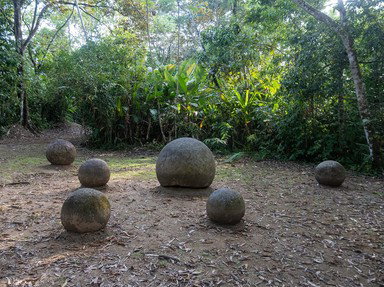
The country of Costa Rica contains a cultural mystery. Many perfectly round, smooth rocks lie in various formations on the ground. Come learn a bit about these ancient spheres.

A multiple-choice quiz by stephgm67. Estimated time: 3 mins.
  1. Home
  2. »
  3. Quizzes
  4. »
  5. World Trivia
  6. »
  7. World Sites
  8. »
  9. Archaeological Sites & Ruins

Author
stephgm67
Time
3 mins
Type
Multiple Choice
Quiz #
426,642
Updated
Nov 21 26
# Qns
10
Difficulty
New Game
Avg Score
6 / 10
Plays
10
Last 3 plays: looney_tunes (9/10), Kabdanis (3/10), lethisen250582 (10/10).
- -
Question 1 of 10
1. In which region of Costa Rica were the majority of the pre-Columbian stone spheres discovered? Hint


Question 2 of 10
2. What major 1930s agricultural project led to the widespread exposure of the stone spheres? Hint


Question 3 of 10
3. Who (with an ironic name) conducted and published the first scientific investigation of the stone spheres in 1943? Hint


Question 4 of 10
4. What type of rock were the vast majority of Costa Rica's stone spheres carved from? Hint


Question 5 of 10
5. What tools did the Indigenous artisans use to carve and smooth the spheres? Hint


Question 6 of 10
6. What evidence led archaeologists to conclude that perhaps the large spheres served as status symbols? Hint


Question 7 of 10
7. Why did some plantation workers destroy stone spheres with dynamite in the mid-20th century? Hint


Question 8 of 10
8. Approximately what percentage of the stone spheres are estimated to remain in their original locations today? Hint


Question 9 of 10
9. Besides massive multi-ton monuments, what size were the smallest documented stone spheres? Hint


Question 10 of 10
10. How many archaeological sites in the Diquís Delta make up the UNESCO World Heritage designation protecting these mysterious stone spheres? Hint


(Optional) Create a Free FunTrivia ID to save the points you are about to earn:

arrow Select a User ID:
arrow Choose a Password:
arrow Your Email:


Most Recent Scores
Nov 21 2026 : looney_tunes: 9/10
Nov 21 2026 : Kabdanis: 3/10
Nov 21 2026 : lethisen250582: 10/10
Nov 21 2026 : amarie94903: 10/10
Nov 21 2026 : Reamar42: 6/10
Nov 21 2026 : Guest 82: 4/10
Nov 21 2026 : mjgrimsey: 4/10
Nov 21 2026 : bernie73: 2/10
Nov 21 2026 : Guest 77: 7/10

Quiz Answer Key and Fun Facts
1. In which region of Costa Rica were the majority of the pre-Columbian stone spheres discovered?

Answer: Diquís Delta

The Diquís Delta is a lush, tropical rainforest and river floodplain region located in southwestern Costa Rica near the Pacific coast (specifically along the Sierpe and Térraba rivers near the Osa Peninsula).

Along with Isla del Caño, a small island just offshore, this wetland and jungle area is where more than 300 of these ancient stone sculptures have been found. Locally, Costa Ricans refer to these artifacts as "las bolas de piedra" ("the stone balls"), and their archaeological sites in the region were designated as UNESCO World Heritage sites in 2014.
2. What major 1930s agricultural project led to the widespread exposure of the stone spheres?

Answer: Clearing rainforest for banana plantations

In the 1930s, the United Fruit Company used bulldozers to clear swathes of rainforest and dig drainage ditches in the Diquís Delta to make way for banana plantations. While digging, workers accidentally uncovered the ancient spheres (around 300 documented ones), many of which had been buried under large amounts of river sediment over the centuries.

Unfortunately, heavy machinery and train cars originally meant for shipping all those bananas were subsequently used to haul many of the spheres away from their original locations.
3. Who (with an ironic name) conducted and published the first scientific investigation of the stone spheres in 1943?

Answer: Doris Stone

American archaeologist Doris Stone, who was the daughter of a United Fruit Company executive, authored the first archaeological report on the spheres. She wrote about them in "American Antiquity" in 1943, noting their association with ancient pottery.

Her work sparked later expeditions by researchers like Samuel Kirkland Lothrop and helped bring international academic attention to Costa Rican heritage. Before her study, the mysterious spheres were well known to local residents, though they had not yet been formally documented by outside scholars.
4. What type of rock were the vast majority of Costa Rica's stone spheres carved from?

Answer: Gabbro

Most of the stone spheres were sculpted from gabbro, a dark, coarse-grained igneous rock similar to basalt. A smaller number were made from limestone, sandstone, or andesite. Between roughly AD 600 and AD 1500 (with some specialists dating them back to 200 BC), ancient artisans hauled these multi-ton boulders several miles from mountain foothills down to the delta.

These people hauled the stones without using wheels or draft animals. Also, because gabbro is an exceptionally hard volcanic rock, transporting and shaping it required immense labor and coordination from large teams of workers.
5. What tools did the Indigenous artisans use to carve and smooth the spheres?

Answer: Hard stones and sand

Because the pre-Columbian sculptors had no iron or steel chisels, they relied on controlled heating and cooling. They used fire and cold water to crack away rough outer layers of rock. Craftspeople then hammered and pecked the boulders with harder river stones to slowly chip them into a near-perfect rounded shape. Finally, they ground and polished the exterior surfaces smooth using sand, achieving remarkable symmetry entirely by hand.
6. What evidence led archaeologists to conclude that perhaps the large spheres served as status symbols?

Answer: Spheres were found flanking entrance ramps to house platforms

Because the Indigenous makers left no written records and the vast majority of spheres were moved from their original spots, complicating further study, nobody knows for certain what they were used for. For the most part, the reason for the stones is a mystery.

However, during field excavations in the 1990s, archaeologist Francisco Corrales uncovered stone spheres flanking both sides of an entrance ramp leading up to an elevated cobblestone house foundation. Since the region's Indigenous societies were ruled by local chiefs who lived on raised mounds to avoid flooding, researchers believe placing these monumental sculptures at entryways was a way to display social rank and prestige.
7. Why did some plantation workers destroy stone spheres with dynamite in the mid-20th century?

Answer: Rumors spread that the spheres contained hidden gold or treasure

Shortly after the spheres were uncovered during land clearing, false rumors circulated among workers that the stones held buried gold or precious metals inside. Acting on this belief, some workers drilled into the spheres and used dynamite to blow them apart, destroying a significant number of artifacts before local authorities intervened.

Several of those fractured spheres were later pieced back together and reconstructed by the National Museum of Costa Rica.
8. Approximately what percentage of the stone spheres are estimated to remain in their original locations today?

Answer: 10%

Researchers estimate that only about 10% of the surviving stone spheres remain in their original archaeological positions. After being unearthed in the 1930s and 1940s, hundreds of spheres were hauled away to decorate private gardens, banks, government buildings, and museums both inside and outside of Costa Rica.

In the 1980s, the Costa Rican government officially declared the remaining spheres national treasures and prohibited their export.
9. Besides massive multi-ton monuments, what size were the smallest documented stone spheres?

Answer: Roughly the size of a ping-pong ball

While the largest stone spheres measure nearly nine feet (2.7 meters) across and weigh up to 26 tons, archaeologists have also found miniature spheres measuring just a few inches in diameter - roughly the size of a ping-pong ball.

Archaeologist Samuel Kirkland Lothrop discovered some of these small, portable spheres inside Diquís Delta grave sites. Researchers have noted that they were likely valued personal items buried with individuals or used as temporary stand-ins while larger spheres were being prepared.
10. How many archaeological sites in the Diquís Delta make up the UNESCO World Heritage designation protecting these mysterious stone spheres?

Answer: 4

In 2014, UNESCO designated a property consisting of four distinct archaeological sites in the Diquís Delta (Finca 6, Batambal, El Silencio, and Grijalba-2) as a World Heritage Site. To protect the spheres from flooding, looting, and nearby urban or infrastructure expansion, Costa Rica conducts annual site inspections, maintains protective buffer zones, and keeps the majority of the buried artifacts unexcavated beneath protective layers of river sediment.

Currently, Finca 6 features a museum and walking trails open to visitors, while conservation plans are underway to safely prepare the other three sites for future public access.
Source: Author stephgm67

This quiz was reviewed by FunTrivia editor trident before going online.
Any errors found in FunTrivia content are routinely corrected through our feedback system.
11/22/2026, Copyright 2026 FunTrivia, Inc. - Report an Error / Contact Us