FREE! Click here to Join FunTrivia. Thousands of games, quizzes, and lots more!
Good For Nothing Trivia Quiz
Many sites around the world were prosperous, thriving places until some kind of catastrophe occurred. They then became ghost towns, good for nothing. (The title I was given for this challenge).
A classification quiz
by stephgm67.
Estimated time: 3 mins.
In 1900, two prospectors spotted a massive green patch on a mountainside in the Alaskan wilderness. It turns out it was a huge copper vein. A group of wealthy investors (including the Guggenheim and Morgan families) poured millions into the site and created the Kennecott Copper Corporation. At the site, they built a state-of-the-art town with electricity, a hospital, a school, a tennis court, and even a dairy to provide fresh milk. A giant 14-story mill towered above the town.
By the late 1930s, the high-grade copper ore, some of the richest ever found, was completely exhausted. In 1938, the company shut everything down so quickly that workers left their tools and furniture behind. The heavy equipment also stayed behind. The now ghost town, still displaying the red paint that covered most of the buildings, became a time capsule of that era in America.
2. Humberstone, Chile
Answer: Natural Resource Depletion
In the late 1800s, the Atacama Desert in Chile was famous due to a mineral called saltpeter (nitrate). The resource was in high demand globally for both fertilizer to grow crops and for making explosives. Soon, a huge industrial town called Humberstone was built there. Despite the harsh environment, the area became a thriving oasis. It boasted a grand theater for traveling performers, a hotel, a market, and even a massive swimming pool made from the iron hull of a ship. Many workers and their families called it home.
Later, during World War I, scientists in Germany figured out how to create synthetic nitrates in a laboratory to replace the depleting resources' from Chile. The company and town struggled to compete with the cheaper lab-grown version for a few decades, but by 1960 it had all collapsed. The town was abandoned, leaving behind a ghost town of rusted machinery and empty houses. The dry air of the desert would keep it almost perfectly preserved.
3. Bodie, California
Answer: Natural Resource Depletion
In 1859, a prospector named W.S. Bodey discovered a large deposit of gold in the mountains of the High Sierra. Though he died in a blizzard shortly after, the town of Bodie was named in his honor. By 1879, it was a booming city of 10,000 people with over 60 saloons, dance halls, and a bustling main street. It was so famous for its rough-and-tumble lifestyle that it earned a reputation for being a place where "a man was killed every morning for breakfast". Millions of dollars in gold were pulled from the Standard Mine there.
By the early 1880s, the richest pockets of gold had been mined out, and the easily reachable ore was gone. As the gold grew harder and more expensive to find, the big mining companies began to leave, and the crowd of miners and gamblers left the dying town. A large fire in 1932 destroyed many of the crumbling buildings. In 1962, California took over the site as a State Historic Park and maintained it as it existed so people could see a ghost town of the gold era.
4. Fordlandia, Brazil
Answer: Natural Resource Depletion
In the late 1920s, the famous American car maker Henry Ford decided he didn't want to buy rubber from other countries anymore. But he needed a steady supply of rubber for the tires of his cars, so he bought a huge piece of land in the Amazon Rainforest in Brazil. He built a town called Fordlandia, which was designed to look exactly like a small town in Michigan. It had paved streets, white picket fences, a hospital, a golf course, and even a movie theater. The Brazilian workers there lived "the American dream".
Unfortunately, Ford's managers planted millions of rubber trees too close together. So when a leaf fungus appeared it spread like wildfire and killed almost all of the trees. At the same time, the workers began to revolt because they did not like being forced to live like Americans. By 1945, with the trees dying and people leaving, the project was a total failure. Ford's son sold the land back to the Brazilian government for a tiny fraction of what it cost to build. What remained became a ghost town.
5. Pripyat, Ukraine
Answer: Environmental & Man-Made Disasters
Built in 1970, Pripyat was designed to be a "model Soviet city" for the workers of the nearby Chernobyl Nuclear Power Plant. The city featured modern luxuries that were rare in other parts of the Soviet Union, including high-rise apartments, a sports stadium, multiple swimming pools, and a beautiful riverside cafe. By 1986, nearly 50,000 people called Pripyat home, and they were even preparing to open a new amusement park.
On April 26, 1986, a safety test at the Chernobyl Power Plant went horribly wrong, causing a massive explosion and a nuclear meltdown in one of the reactors. At first, very few in the town realized the severity of the problem. During the afternoon of April 27, an announcement over the radio told everyone to pack enough food and clothing for three days and board a fleet of buses. They were told they would be coming back soon. They never came back. The radiation levels were too high for human life, and a 1,000 square mile (2,600 square km) "Exclusion Zone" was created. The city immediately became a ghost town with things still left where they were dropped.
6. Plymouth, Montserrat
Answer: Environmental & Man-Made Disasters
Plymouth was once the thriving capital of the Caribbean island of Montserrat. It was the center of the island's government, trade, and tourism activities. It featured many historic stone buildings dating back to the 1700s, busy markets, and a harbor where cruise ships regularly docked. Many residents lived there and enjoyed a tropical lifestyle.
However, in July of 1995, the Soufriere Hills Volcano, which had been silent for centuries, suddenly began erupting. Over the next few years, a series of massive eruptions continued and sent gas and rock racing down the mountainside. In 1997, another massive eruption sent a wall of mud and ash directly into the city. Plymouth wasn't just abandoned; it was physically buried. The ruined city was considered part of an evacuation zone. Interestingly, the ghost town remains the official legally designated capital city.
7. Centralia, Pennsylvania, USA
Answer: Environmental & Man-Made Disasters
Founded in the mid-1800s, Centralia was a thriving coal mining town in the mountains of Pennsylvania. It was built directly on top of one of the richest deposits of coal in the world. At its peak, the town had 2,000 residents, several schools, five hotels, and seven churches. For over a century, Centralia was a classic American blue-collar community where generations of families worked in the local mines.
In May 1962, a fire that was meant to burn trash reached a massive coal seam underground and began to burn uncontrollably. Because anthracite coal is so dense, it can burn for decades without going out. For 20 years, the town tried to ignore the fire, but by the 1980s, the danger became unavoidable. Sinkholes opened up, the ground became hot to the touch, and deadly carbon monoxide gas began seeping into people's homes. In 1984, the U.S. government spent over $42 million to relocate nearly everyone. Centralia became a ghost town where smoke and steam could be seen rising from cracks in the ground.
8. Wittenoom, Australia
Answer: Environmental & Man-Made Disasters
In the late 1930s, a large deposit of blue asbestos was discovered in the Hammersley Ranges of Western Australia. To harvest this asbestos, a mining town called Wittenoom was built in a local canyon. At its peak in the 1950s, it was the only source of blue asbestos in Australia and was a thriving community of over 20,000 people. There were schools, cinemas, and a hotel. Because the leftover crushed asbestos was so plentiful the town used it to pave roads, build playgrounds, and landscape yards.
Unfortunately, scientists discovered that blue asbestos is tremendously dangerous because its tiny fibers can be breathed into the lungs, causing deadly diseases like mesothelioma. By 1966, the mine was shut down because it was no longer profitable and the health risks were becoming clear. Because the town had been built using the asbestos waste, the entire landscape-the dirt, the air, and the buildings-was contaminated. The Australian government shut off the electricity and water, removed the town from all official maps, and even changed the road signs so people wouldn't accidentally drive there. It became a highly contaminated ghost town.
9. Varosha, Cyprus
Answer: Conflict & Political Upheaval
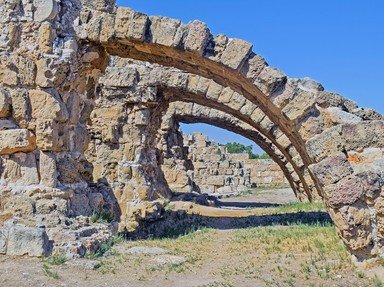
In the early 1970s, Varosha was one of the most glamorous tourist destination in the Mediterranean. Located on the island of Cyprus, it was a playground for the rich and famous, including stars like Elizabeth Taylor. The shoreline was filled with high-rise luxury hotels, trendy boutiques, and expensive restaurants. It attracted over 700,000 tourists a year. By 1974, it was a key part of the economy and represented ultimate luxury.
However, in July of 1974, following years of tension between Greek and Turks, the Turkish army invaded the northern part of the island. As Turkish tanks approached, the 40,000 residents of Varosha fled in terror, thinking they would return in a few days. The Turkish military fenced off the entire area with barbed wire and "No Trespassing" signs. It sat that way for over fifty years. Sea turtles soon became the only living inhabitants of the once-rich ghost town.
10. Agdam, Azerbaijan
Answer: Conflict & Political Upheaval
Founded in the 18th century AD, Agdam was a major cultural and industrial center in the mountainous region. It was famous for its varied agriculture, especially its vineyards and wineries, as well as for its butter. The city featured a beautiful, twin-minaret mosque, a large theater, and several schools. It was a city where families lived for generations, known for its busy markets and the "Bread Museum," which was one of only two in the world at the time.
The end of Agdam was caused by the First Nagorno-Karabakh War between Armenia and Azerbaijan in the early 1990s. In 1993, as the war intensified, Armenian forces captured the city. The 40,000 residents had to flee for their lives, leaving everything behind. The city was kept as a "buffer zone" and to prevent anyone from coming back, it was systematically dismantled. It soon became a ghost town with skeletons of buildings and the lonely mosque.
11. Oradour-sur-Glane, France
Answer: Conflict & Political Upheaval
Oradour-sur-Glane was a quiet farming village in central France. For centuries, it was a close-knit community where life revolved around the town square, the church, and several local shops. During the early years of World War II, it remained very peaceful, even as the rest of the country was occupied by Nazi Germany. By June 1944, the village was home to about 650 people, including several families who had moved there to escape the heavier fighting in other parts of France.
On June 10, 1944, just four days after the D-Day landings, a division of the Nazi SS surrounded the village. The soldiers ordered everyone to the village square. The men were then led into barns and garages, while the women and children were locked inside the village church. In a few hours, the soldiers killed almost every person in the town and set the buildings on fire. Only a handful of people escaped. After the war, the French President, Charles de Gaulle, ordered that the ruins should never be rebuilt or touched. He wanted the village to remain exactly as it was on that day as a permanent memorial to the cruelty of war.
12. Lifta, Israel
Answer: Conflict & Political Upheaval
Lifta is an ancient village sitting at the western entrance to Jerusalem, located on a steep hillside overlooking a natural spring. For centuries, it was a prosperous and beautiful community known for its stone architecture and its olive groves and orchards. It was a place of deep history, with some of the building foundations dating back to the Crusades or even earlier. By the early 1940s, Lifta was a Palestinian village of nearly 3,000 people, serving as a gateway between the coast and the holy city.
The end of Lifta happened during the 1947-1948 Civil War in Mandatory Palestine. As fighting greatly intensified between Jewish and Arab forces, the residents of Lifta began to flee their homes to seek safety elsewhere. By the time the war ended and the State of Israel was established, the village was completely empty. The town was neither demolished nor resettled as the years moved on. It became a protected heritage site and a ghost town where weeds grew thickly around the spring.
This quiz was reviewed by FunTrivia editor stedman before going online.
Any errors found in FunTrivia content are routinely corrected through our feedback system.