FREE! Click here to Join FunTrivia. Thousands of games, quizzes, and lots more!
Quiz about Columbidae Columbinight

Columbidae Columbi-night Trivia Quiz


The Columbidae family includes pigeons and doves, birds that we often encounter in our everyday lives. How much do you really know about this large, widespread family of birds?

A multiple-choice quiz by LadyNym. Estimated time: 3 mins.
  1. Home
  2. »
  3. Quizzes
  4. »
  5. Animal Trivia
  6. »
  7. Wild Birds
  8. »
  9. Specific Bird Species

Author
LadyNym
Time
3 mins
Type
Multiple Choice
Quiz #
422,569
Updated
Jan 12 26
# Qns
10
Difficulty
Average
Avg Score
8 / 10
Plays
24
Last 3 plays: Morrigan716 (7/10), lethisen250582 (10/10), bernie73 (6/10).
- -
Question 1 of 10
1. Which of these statements best describes the distribution of the birds in the family Columbidae? Hint


Question 2 of 10
2. Columbids are distinguished by which of these physical features? Hint


Question 3 of 10
3. Many Columbidae species are granivorous - meaning they feed primarily on what matter? Hint


Question 4 of 10
4. The young of pigeons and doves are fed a secretion produced by both sexes, known as crop milk.


Question 5 of 10
5. The wild ancestor of domestic and feral pigeons, Columba livia is known by what musical-sounding common name? Hint


Question 6 of 10
6. Boasting the largest population of all Columbidae species, with over 400 million individuals, the mourning dove is native to which continent? Hint


Question 7 of 10
7. One of the smallest columbids, the common ground dove, is only slightly larger than what diminutive bird, often found in urban areas? Hint


Question 8 of 10
8. The largest extant Columbidae, crowned pigeons are endemic to what large island, also home to birds of paradise and various marsupial species? Hint


Question 9 of 10
9. The dodo, which went extinct in the 17th century, was the largest member of the Columbidae to have ever existed. What other peculiarity did this bird have?


Question 10 of 10
10. Large-scale hunting was the main cause for the extinction of what North American columbid, whose last specimen died in 1914? Hint


Most Recent Scores
Jan 12 2026 : Morrigan716: 7/10
Jan 12 2026 : lethisen250582: 10/10
Jan 12 2026 : bernie73: 6/10
Jan 12 2026 : GoodVibe: 2/10
Jan 12 2026 : Kabdanis: 8/10
Jan 12 2026 : amarie94903: 8/10
Jan 12 2026 : FlicksBuff: 10/10
Jan 12 2026 : Dizart: 10/10
Jan 12 2026 : Triviaballer: 10/10

Quiz Answer Key and Fun Facts
1. Which of these statements best describes the distribution of the birds in the family Columbidae?

Answer: they are found almost everywhere on Earth

Comprising 52 genera and 353 species (13 of which are extinct), Columbidae is the only family in the bird order Columbiformes. In English, the smaller members of the family are usually referred to as "doves", and the larger ones as "pigeons". Columbids have worldwide distribution, and have adapted to a wide range of habitats, including urban ones. The only places where they do not occur are polar regions and very dry desert areas.

A number of species are endemic to small islands, while the species with the largest populations range from cooler regions (such as Canada or Northern Europe) to tropical ones. The greatest diversity of Columbidae species is found in the Indomalayan and Australasian biogeographical realms, which extend from South Asia to New Zealand.
2. Columbids are distinguished by which of these physical features?

Answer: small heads and stout bodies

Pigeons and doves have an easily recognizable shape, with their stout, compact bodies, short legs and necks, and small heads. Their bills are also short and slender, slightly curved at the tip and often topped by a cere - a fleshy mass of tissue located above the nares (nostrils). They also have large, highly mobile wings, which enable some species to cover long distances during migration, and allow them to fly away quickly when attacked by predators. Columbid wings, however, are wider than they are long, unlike those of seabirds such as albatrosses and gulls, whose long, tapering wings are made for soaring. As anyone who has seen pigeons in urban areas will have noticed, Columbids also have a distinctive, head-bobbing walking gait.

Large eyes and flat faces are distinguishing features of owls, which belong to the order Strigiformes. Hooked beaks are typical of all species of raptors (birds of prey), as well as parrots and their relatives (order Psittaciformes).
3. Many Columbidae species are granivorous - meaning they feed primarily on what matter?

Answer: seeds

Granivory (also referred to as seed predation) involves feeding on the seeds of plants, both before and after their dispersal. Many bird species, as well as some invertebrates and mammals such as rodents, are granivorous, though seeds are rarely the only thing they consume. Columbidae can be roughly divided between granivorous and frugivorous (fruit-eating) species: the former tend to be terrestrial and dull-coloured, while the latter are mainly arboreal and often bright-coloured. This difference in diet is reflected in the birds' anatomy, as fruit eaters have shorter intestines with thinner walls than those of seed eaters.

There are a few Columbidae species that consume both seeds and fruits, and others that supplement their diet with other foods - including insects and other invertebrates. Feral pigeons are omnivorous, and often eat food left or discarded by humans.

Animals that feed on grass (such as horses) are called graminivores, while those that feed on leaves (such as koalas and gorillas) are known as folivores.
4. The young of pigeons and doves are fed a secretion produced by both sexes, known as crop milk.

Answer: True

As its name implies, crop milk is produced by the sloughing of cells from the lining of the crop - a part of the digestive tract of most birds that is used for the temporary storage of food. As in mammals, the production of crop milk is controlled by the hormone prolactin. However, both male and female columbids can produce this secretion, which is fed to squabs (baby pigeons and doves) for the first week of their life; after that, they are gradually introduced to adult food.

Unlike mammalian milk, which also contains carbohydrates, pigeon crop milk is a curd-like, semi-solid substance, mainly consisting of fat and protein. A pair of columbids can produce enough crop milk to feed two squabs adequately - which is why these birds usually lay no more than two eggs.

Crop milk is also produced by flamingos and male emperor penguins. While penguin crop milk is similar in texture to the one produced by columbids, flamingo crop milk is a bright red fluid that resembles blood.
5. The wild ancestor of domestic and feral pigeons, Columba livia is known by what musical-sounding common name?

Answer: rock dove

While Columba livia is sometimes referred to as rock pigeon or common pigeon, the official common name given to the species by the International Ornithological Committee is rock dove. This name reflects the affinity of these birds for caves, cliff faces and other rock formations, where they usually nest. The specific name "livia" comes from the Latin "livida", meaning bluish-grey - a reference to the colour of this species' plumage, which does not display as much variation as in domestic or feral pigeons. A distinctive feature of wild rock doves is the two black bars on each wing.

Native to Southern Europe, North Africa and Western Asia, the rock dove was introduced to the Americas by European ships in the early years of the 17th century. Now the species counts a global population of over 260 million individuals - a figure that includes both wild rock doves and domestic and feral pigeons. Nine subspecies of Columba livia are recognized, most of which (with the exception of the nominate subspecies, Columba livia livia) are found in Africa and Asia.

Collared doves and turtle doves belong to the genus Streptopelia, and are native to the Old World. Wood doves (genus Turtur) are found in sub-Saharan Africa.
6. Boasting the largest population of all Columbidae species, with over 400 million individuals, the mourning dove is native to which continent?

Answer: North America

The mourning dove (Zenaida macroura) is estimated to be the world's third-most abundant bird after the domestic chicken and the red-billed quelea, a small African bird. This columbid is found year-round in most of North America, from southern Canada to Mexico and the Greater Antilles, while it visits the Canadian prairie in summer for breeding, and winters in Central America. It has also been introduced to Hawaii. The mourning dove favours open and semi-open areas, and is often encountered around human habitation; it feeds almost exclusively on seeds.

The mourning dove is a medium-sized, slender-bodied bird with a long tail (the meaning of its specific name, "macroura") and broad, elliptical wings. It is generally beige-gray in colour, with a lighter, pinkish underside. The species owes its common name to the plaintive call uttered by males when trying to attract females. Mourning doves are popular gamebirds in North America, with over 20 million individuals shot every year.

The genus Zenaida, which contains a total of seven species, was named after Zenaïde Bonaparte, a niece of Napoleon Bonaparte, and the wife of French naturalist Charles Lucien Bonaparte - who was also a nephew of the former emperor.
7. One of the smallest columbids, the common ground dove, is only slightly larger than what diminutive bird, often found in urban areas?

Answer: house sparrow

The common ground dove's binomial name, Columbina passerina, hints at its resemblance to the house sparrow (Passer domesticus), at least regarding size. This small bird, found in the southern US, Central America and northern South America, has an average length of 15-18 cm (5.9-7.1 in), and can weigh as little as 22 g (0.78 oz). Its plumage is brown, with a scale-like appearance on the head and upper breast. As its name implies, the common ground dove spends most of the time on the ground, where it forages for food (mainly fruits and seeds, but also insects and snails). It lives in open areas with some trees and bushes, and does not migrate.

There are 17 recognized subspecies of Columbina passerina. The genus Columbina contains nine species, all native to southern North America and South America. The common ground dove is the smallest columbid in North America.

The three wrong answers are also passerine birds (order Passeriformes), though they are all larger than the house sparrow.
8. The largest extant Columbidae, crowned pigeons are endemic to what large island, also home to birds of paradise and various marsupial species?

Answer: New Guinea

The genus Goura of the family Columbidae includes four species of birds endemic to the island of New Guinea, where they are found in different regions. These birds are known as crowned pigeons because of the lacy feather crests over their heads; the generic name Goura is the aboriginal name for them. They are all large birds, nearly the size of a small turkey, and very similar to each other with their blue-grey bodies and maroon breasts.

The type species is the western crowned pigeon (Goura cristata), a denizen of the lowland rainforests of northwestern New Guinea. The striking Victoria crowned pigeon (Goura victoria) of northern New Guinea is often cited as the world's largest columbid, with an average length of 73-75 cm (29-30 in), and a weight of 3.5 kg (7.7 lb). Crowned pigeons are ground dwellers, and inhabit forested areas; their diet consists mainly of fruit. Unfortunately, all four species are threatened by hunting and habitat loss.
9. The dodo, which went extinct in the 17th century, was the largest member of the Columbidae to have ever existed. What other peculiarity did this bird have?

Answer: it was flightless

In the three-odd centuries since the species died out, the dodo (Raphus cucullatus) has become a symbol of animal extinction. This large bird - one of two members of the subtribe Raphina of the subfamily Raphinae - was endemic to the island of Mauritius, in the Indian Ocean. The other member of the subtribe, the Rodrigues solitaire (Pezophaps solitaria), was endemic to the nearby island of Rodrigues, and went extinct some time in the 18th century. Both species were flightless, though their closest living relative, the Nicobar pigeon (Caloenas nicobarica), is a strong flier like most other columbid species.

The dodo was much larger than the largest extant columbid, with a height of 62.6-75 cm (2.05-2.46 ft) and a likely weight of 10.6-17.5 kg (23-39 lb). Not much is known about its appearance and habits, except for what can be gleaned from drawings, paintings and written accounts. However, skeletal remains have revealed that it had a large beak with a hooked upper tip, quite different from that of most Columbidae. The dodo is believed to have lived in wooded areas on the coast of Mauritius, and to have been primarily frugivorous. First encountered by Dutch sailors in the late 16th century, it was driven to extinction less than a century later - by the impact of introduced species as much as by hunting.
10. Large-scale hunting was the main cause for the extinction of what North American columbid, whose last specimen died in 1914?

Answer: passenger pigeon

Most of the 13 extinct Columbidae species were island dwellers - the sole exception being the passenger pigeon (Ectopistes migratorius), a North American native that was closely related to the mourning dove (Zenaida macroura). Named for its migratory habits, this denizen of the deciduous forests of eastern North America was once the most abundant bird in the continent, numbering up to 5 billion individuals. A strong and fast flier, the passenger pigeon migrated in huge flocks searching for its primary food source - the fruit of forest trees and shrubs, known as mast.

Though passenger pigeons had been routinely hunted by Native Americans, the arrival of European settlers changed the situation for the worse, as these birds were seen as a ready source of cheap meat. In the 19th century, large-scale hunting - coupled with habitat loss due to deforestation - led to the rapid decline of the species' population. The last wild bird was shot in 1900, while the last captive specimen died on 1 September 1914 at Cincinnati Zoo. The sad story of the passenger pigeon is one of the most notable examples of anthropogenic extinction, and a cautionary tale for anyone engaged in nature conservation.

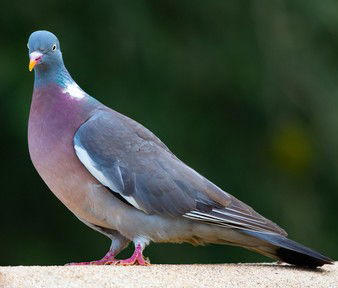
The wood pigeon (Columba palumbus) is an Old World native, closely related to the rock dove. The crested pigeon (Ocyphaps lophotes) is endemic to Australia, while the snow pigeon (Columba leuconota) is found in Central Asia.
Source: Author LadyNym

This quiz was reviewed by FunTrivia editor rossian before going online.
Any errors found in FunTrivia content are routinely corrected through our feedback system.
1/13/2026, Copyright 2026 FunTrivia, Inc. - Report an Error / Contact Us