FREE! Click here to Join FunTrivia. Thousands of games, quizzes, and lots more!
Quiz about Frilled Lizards

Frilled Lizards Trivia Quiz


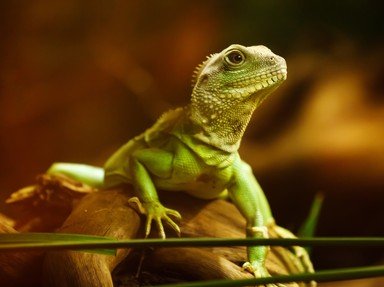
This is a quiz on the frilled or frill-necked lizard (Chlamydosaurus kingii). Original quiz was written by Cornsnakeman, adopted and expanded by MotherGoose.
This is a renovated/adopted version of an old quiz by author Cornsnakeman

A multiple-choice quiz by MotherGoose. Estimated time: 3 mins.
  1. Home
  2. »
  3. Quizzes
  4. »
  5. Animal Trivia
  6. »
  7. Reptiles and Amphibians
  8. »
  9. Lizards

Author
MotherGoose
Time
3 mins
Type
Multiple Choice
Quiz #
98,047
Updated
Sep 02 26
# Qns
10
Difficulty
New Game
Avg Score
8 / 10
Plays
20
Last 3 plays: KattRazz (9/10), Alcoholic63 (3/10), Jdoerr (7/10).
- -
Question 1 of 10
1. The frilled lizard is native to which continent? Hint


Question 2 of 10
2. Why are they called frilled lizards? Hint


Question 3 of 10
3. When are frilled lizards most active? Hint


Question 4 of 10
4. What is the conservation status of frilled lizards? Hint


Question 5 of 10
5. In terms of habitat, where would you most likely find a frilled lizard? Hint


Question 6 of 10
6. Why are they described as sexually dimorphic?


Question 7 of 10
7. What do frilled lizards mainly eat? Hint


Question 8 of 10
8. What is an unusual feature of the frilled lizard's normal method of locomotion? Hint


Question 9 of 10
9. Why do frilled lizards have such long tails? Hint


Question 10 of 10
10. Which of the following was *NOT* inspired by the frilled lizard? Hint


(Optional) Create a Free FunTrivia ID to save the points you are about to earn:

arrow Select a User ID:
arrow Choose a Password:
arrow Your Email:


Most Recent Scores
Today : KattRazz: 9/10
Today : Alcoholic63: 3/10
Today : Jdoerr: 7/10
Today : HemlockJones: 7/10
Today : Guest 68: 10/10
Today : thomas1975: 6/10
Today : kvanhoy: 8/10
Today : Guest 18: 7/10
Today : Guest 173: 10/10

Quiz Answer Key and Fun Facts
1. The frilled lizard is native to which continent?

Answer: Australia

Frilled or frill-necked lizards are native to the continent of Australia; specifically, they are found in northern Australia and southern New Guinea. (NB: New Guinea is considered part of the continent of Australia because it is located on the same continuous continental shelf and tectonic plate).

The colour of the lizard's frill when displayed varies according to where it lives. In northern Western Australia (the Kimberley region), the frills are deep red. In the Northern Territory (the Top End region), the frills are vibrant orange. In northern Queensland and New Guinea they are bright yellow and in southern Queensland they are whitish or light yellow.
2. Why are they called frilled lizards?

Answer: They have a flap of skin that goes out to make the frill

The frilled lizard has a large, umbrella-like fold of skin around its neck and throat. For this reason, it is sometimes referred to as the umbrella lizard. The frill can measure up to about 30 centimetres (12 inches) across when fully extended. It is made of a loose flap of skin supported by long spines made of cartilage which are connected to two hyoid bones in the throat. Its functions are to attract a mate, to display dominance over other frilled lizards, but mainly to act a defence mechanism against predators by both startling the predator and exaggerating the lizard's size, enabling them to get away. As noted in the interesting information section of question 2, the colours of the frill when extended vary according to locality.

The presence of the frill is what gives this species their scientific name, Chlamydosaurus kingii. The genus name Chlamydosaurus is derived from the Greek words "khlamydos", meaning mantle or cloak, and "sauros" meaning lizard. The species was discovered in 1825 during an expedition led by Captain Phillip Parker King, hence the species name "kingii".
3. When are frilled lizards most active?

Answer: at dawn and dusk

Frilled lizards are described as both diurnal (active during the day) and crepuscular (most active around dawn and dusk). They can also be described as arboreal because they spend about 90% of their day up in the tree canopy. Around sunrise and sunset, they come down from the trees to move around, feed and mate.

They spend their mornings sunning themselves on tree trunks to absorb warmth because they are ectothermic (cold-blooded). Around midday, the hottest part of the day, they retreat to the tree canopy to find shade, rest and avoid overheating.
4. What is the conservation status of frilled lizards?

Answer: least concern

The International Union for Conservation of Nature categorises the frilled lizard as of "least concern" due to its abundance and wide range. However, this lizard still faces a number of threats, such as poaching (for the exotic pet trade), habitat loss due to deforestation and land clearing, predation by feral species such as cats, and bushfires.

It is unknown how stable the overall population of frilled lizards is, but some decline in regional populations has been noted in both Australia and New Guinea.
5. In terms of habitat, where would you most likely find a frilled lizard?

Answer: up a eucalyptus tree

Frilled lizards spend about 90 percent of their lives high up on tree trunks, favouring eucalyptus trees in woodland areas. When their frill is not extended, their scales are mottled grey and brown in colour, which helps to camouflage them against the bark.

Of the incorrect answers, they are not burrowing animals and they avoid swampy lowlands because they require well-drained soil to hunt, nest, and survive. They avoid open areas which lack trees for shelter and protection, as well as areas where there is dense ground cover because it blocks their view of prey on the ground.
6. Why are they described as sexually dimorphic?

Answer: males are much bigger than females

If a species is described as sexually dimorphic, it means that the male and female look distinctly different. In the case of frilled lizards, males and females differ greatly in body size, head shape and frill proportions. The males are significantly bigger and heavier, typically twice as heavy as the females, and usually about one-third longer.

The males have wider heads, thicker jaws, and a more muscular build. The females tend to have shorter frills relative to their body size and a thicker and broader abdominal area, especially when carrying eggs.

Their basic body colouring is similar but the males have more brightly coloured frills.
7. What do frilled lizards mainly eat?

Answer: insects and spiders

Frilled lizards primarily eat small invertebrates, such as insects, particularly ants, beetles, cicadas, grasshoppers, and caterpillars. In particular, termites are an important food source during the dry season and the larvae of butterflies and moths during the wet season. They also eat spiders, scorpions, and centipedes. They will sometimes eat small vertebrates and tiny nestling birds, but this is not common.

Frilled lizards are described as "sit-and-wait" or ambush predators. They watch for food from tree branches and climb down to the ground when they spot prey.
8. What is an unusual feature of the frilled lizard's normal method of locomotion?

Answer: bipedal sprint

Most lizards walk or run on four legs using a gait described as a "walking trot" where diagonally opposite pairs of limbs move together with lateral (sideways) flexion of the spine, resulting in a characteristic wriggling motion. This is the way frilled lizards normally move but they are also capable of bipedal running; that is, running on two legs. When threatened, they rear up on their hind legs and sprint away on two feet.

In terms of mechanics, bipedal running is less efficient than running on four legs. However, the advantage is that they can accelerate faster on two legs than on four. When being threatened, a rapid first step can be crucial.

When running in this fashion, their legs are slightly splayed and move in a circular pumping motion, which makes them look as if they are riding an invisible bicycle, earning them the nickname of "bicycle lizards". They are capable of running up to 14-15 kilometres/hour (approximately 9 miles/hour) with occasional bursts of speed up to 25 kph (15.5 mph). However, this can only be sustained for a brief period of time, up to 10-15 seconds, giving them just enough time to retreat to the nearest tree. The longest recorded bipedal sprint is 50 metres (55 yards).
9. Why do frilled lizards have such long tails?

Answer: to maintain balance when running on their hind legs

Adult frilled lizards grow to an overall length of about 80 to 90 centimetres (2.6 to 3 feet) from the tip of the head to the tip of the tail. About two-thirds of the lizard's total length is its long tail.

The tail has multiple functions. It is essential to maintain stability for bipedal running. In order to balance, the lizard leans its head far backward so its upper body weight aligns closer to the base of the tail. This shifts the center of gravity backward toward the hips, allowing the front legs to lift off the ground during rapid acceleration or escape. The tail acts as a counterbalance to keep it from tipping forward. It also helps stabilize the lizard as it climbs and navigates tree trunks.

Frilled lizards can lash or whip their tails during territorial displays or when cornered by predators. If a predator grabs their tail, they can detach and drop it to distract the predator while they escape, a natural defense mechanism called autotomy. Autotomy means "self-amputation" or "self-severing" (from the Greek "autos" meaning self and "tomia" meaning cutting). Frilled lizards can then slowly regenerate a new tail over time.

Many reptiles have short, stubby tails used primarily for fat storage. However, frilled lizards have a long slender tail and store fat in their abdomen instead.
10. Which of the following was *NOT* inspired by the frilled lizard?

Answer: the invention of the umbrella

Australia's 2-cent coin featured the frilled lizard on its reverse side. It was in circulation from 1966, when decimal currency was introduced into Australia, until 1991-92, when the 1- and 2-cent coins were phased out of usage. They are now collectors' items, particularly in Japan.

"The Adventures of Priscilla, Queen of the Desert" is a 1994 Australian movie which won an Academy Award/Oscar in 1995 for Best Costume Design. At one stage in the movie, the characters perform wearing costumes inspired by the frilled lizard which featured large, expandable neck frills.

The frilled lizard also inspired the characteristics of the dinosaur Dilophosaurus in the movie "Jurassic Park" (1993). In this movie, the Dilophosaurus stalks one of the human characters, hissing, spitting venom and displaying a large, colorful skin frill from its neck. However, according to palaeontologists, there is no evidence that the real Dilophosaurus had those features.

Frilled lizards did not inspire the invention of the umbrella, which dates back over 4,000 years ago in ancient civilizations in China, Egypt, and Mesopotamia.
Source: Author MotherGoose

This quiz was reviewed by FunTrivia editor rossian before going online.
Any errors found in FunTrivia content are routinely corrected through our feedback system.
9/2/2026, Copyright 2026 FunTrivia, Inc. - Report an Error / Contact Us