FREE! Click here to Join FunTrivia. Thousands of games, quizzes, and lots more!
Quiz about The Elusive Okapi

The Elusive Okapi Trivia Quiz


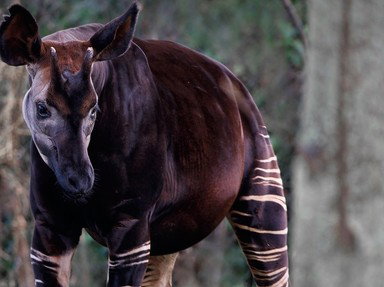
If you're looking for an animal with the body of a horse, the legs and hindquarters of a zebra, the horns of a giraffe, and the ears of a mule deer, then you've come to the right place. Here are ten questions about the okapi. Have fun!

A photo quiz by NeuralSpicy. Estimated time: 2 mins.
  1. Home
  2. »
  3. Quizzes
  4. »
  5. Animal Trivia
  6. »
  7. Wild Mammals
  8. »
  9. Artiodactyls- Deer, Antelopes, Pigs etc.

Author
NeuralSpicy
Time
2 mins
Type
Photo Quiz
Quiz #
424,794
Updated
Jul 07 26
# Qns
10
Difficulty
Easy
Avg Score
9 / 10
Plays
29
Last 3 plays: coltpython (10/10), lethisen250582 (10/10), AxolotlU (8/10).
-
Question 1 of 10
1. The okapi looks like it was cobbled together with leftover parts. To which animal is the okapi most related? Hint


Question 2 of 10
2. In what type of habitat would you typically find a wild okapi? Hint


Question 3 of 10
3. What is the primary diet of okapis? Hint


Question 4 of 10
4. What name is given to a young okapi? Hint


Question 5 of 10
5. Wild okapis exist in only one country on Earth. What country does the okapi call home? Hint


Question 6 of 10
6. Only female okapis present with ossicones, those bony protrusions on the head.


Question 7 of 10
7. What especially prominent oral feature(s) does the okapi boast? Hint


Question 8 of 10
8. What social behavior is typical of adult okapis? Hint


Question 9 of 10
9. While okapis have an excellent sense of smell, what other sense do they possess that is especially important for them in their poorly lit natural environment? Hint


Question 10 of 10
10. Which hunter is the okapi's main predator in its native habitat? Hint


(Optional) Create a Free FunTrivia ID to save the points you are about to earn:

arrow Select a User ID:
arrow Choose a Password:
arrow Your Email:


View Image Attributions for This Quiz

Most Recent Scores
Today : coltpython: 10/10
Today : lethisen250582: 10/10
Today : AxolotlU: 8/10
Today : CardoQ: 6/10
Today : cardsfan_027: 10/10
Today : bernie73: 4/10
Today : bobby82: 10/10
Today : sadwings: 8/10
Today : amarie94903: 10/10

Quiz Answer Key and Fun Facts
1. The okapi looks like it was cobbled together with leftover parts. To which animal is the okapi most related?

Answer: Giraffe

It's almost an unfair question, isn't it? Those striped legs can fool anyone into thinking the okapi is some kind of forest zebra. It's not. The okapi and the giraffe are the only living members of the family Giraffidae, and genetic studies show that they do indeed share a close common ancestor.

The okapi spent a long time hiding from western science in the dense, dark rainforests of central Africa. In fact, it was only formally described in 1901 by Sir Harry Johnston, which is surprisingly recent for such a large mammal.
2. In what type of habitat would you typically find a wild okapi?

Answer: Tropical rainforest

Most okapis will spend their entire lives in the dense tropical rainforests of central Africa. The rainforests are dark, with a few rays of sunlight filtering through the canopy. Visibility can be measured in feet or meters. The okapi's dark reddish-brown coat blends well into the shadows, while the striped hindquarters break up its outline among patches of light and vegetation.

Its whole thing is avoiding attention, which kept it out of western taxonomy until the 20th century. Early European explorers heard stories about the animal long before they managed to officially document it, during which time the okapi gained an almost mythical reputation.
3. What is the primary diet of okapis?

Answer: Leaves, grasses, fruits

Okapis are herbivores that spend much of their day chomping on leaves, shoots, grasses, fruits, ferns, and other plant material in the rainforest. Like giraffes, they have long, prehensile tongues that help them pull foliage from branches. Despite sticking to the salad bar, the choices can be surprisingly varied, with researchers recording dozens of different plant species in the okapi's diet. That's probably more plant diversity than my own diet has encountered thus far in life.
4. What name is given to a young okapi?

Answer: Calf

A baby okapi is called a calf, just as a young giraffe is. After a gestation period of 14 to 16 months, a female typically gives birth to just a single calf. Newborn okapis are well developed but spend much of their early life hidden away in the dense vegetation of the rainforest.

It works for avoiding predators during those early vulnerable weeks. For the first few weeks of life, calves may even remain in a secluded spot and move very little. The mother returns periodically to nurse them.
5. Wild okapis exist in only one country on Earth. What country does the okapi call home?

Answer: Democratic Republic of Congo

The dense rainforests of the Congo Basin in the Democratic Republic of the Congo are the only place on the planet you'll find an okapi in the wild. That makes it an endemic species, meaning its population is restricted to a single country. Despite being a close relative of the giraffe, it remained unknown to Western science until the early twentieth century because of its remote habitat.

Much of the okapi's range is located within protected areas like the Okapi Wildlife Reserve, a UNESCO World Heritage Site found in the Ituri Forest.
6. Only female okapis present with ossicones, those bony protrusions on the head.

Answer: False

No, it's the male okapis that have ossicones. These are skin-covered bony structures that resemble the horns of their cousins, the giraffes. Females generally do not develop true ossicones. Some, however, may have small hair-covered bumps where ossicones would otherwise form. It's one of the easier ways to tell adult males from females without getting too personal.

It's the ossicones that helped clue scientists into the fact that okapis belong within the giraffe family rather than with zebras or horses. Giraffes have them too, though the structures are much more obvious on top of their lengthy necks. In male okapis, the tips of the ossicones are often exposed (as in this image) because the hair wears away over time.
7. What especially prominent oral feature(s) does the okapi boast?

Answer: Tongue

The okapi's tongue is legendary among zookeepers and other wildlife enthusiasts. Dark bluish-black in color, it can reach around 30 centimeters (about 12 inches) in length. It also gets bonus points for being prehensile. This mighty tongue gives the okapi the ability to grab a hold of leaves and buds with dexterity as it goes about its daily okapi chores.

The tongue is useful for more than eating. An okapi can use it to groom parts of its face and even clean its own oversized ears. It's quite the talent. Like its relative the giraffe, the okapi evolved this tool to help it feed efficiently on a wide variety of vegetation.
8. What social behavior is typical of adult okapis?

Answer: Mostly solitary

For the most part, adult okapis are solitary animals, wandering through the rainforests of the Democratic Republic of the Congo on their own. Each animal keeps a home range. While the ranges of males and females may overlap, okapis rarely gather in large groups. Encounters between adults tend to be brief rather than a time to break out some wine and the good glasses.

This lifestyle makes sense in a dense forest where food is scattered and hard to spot. Mothers, of course, spend considerable time with their calves, and adults interact for mating. Even introverts have to deal with others occasionally.
9. While okapis have an excellent sense of smell, what other sense do they possess that is especially important for them in their poorly lit natural environment?

Answer: Hearing

Life on the rainforest floor can be pretty dark, even on a good day. Dense vegetation and the parasol of the forest canopy block much of the sunlight. Okapis rely heavily on their hearing as well as their sense of smell to detect predators, locate other okapis when the urge arrives, and maintain awareness of their surroundings. Their large, mobile ears can rotate independently, helping them pinpoint sounds coming from any direction.

Communication in the forest happens through sound and scent rather than sight. Okapis use a variety of vocalizations. These include soft calls between mothers and calves. Researchers have also found that some of their communication occurs at very low frequencies, which travel through their forest home more effectively.
10. Which hunter is the okapi's main predator in its native habitat?

Answer: Leopard

The leopard is the okapi's main natural predator. Both animals share the forests of the Democratic Republic of Congo, and the leopard's stealth and strength make it one of the few predators able to hunt adult okapis. Calves are particularly vulnerable, a big reason mothers hide them in secluded spots during their early weeks of life.
Source: Author NeuralSpicy

This quiz was reviewed by FunTrivia editor rossian before going online.
Any errors found in FunTrivia content are routinely corrected through our feedback system.
7/7/2026, Copyright 2026 FunTrivia, Inc. - Report an Error / Contact Us