FREE! Click here to Join FunTrivia. Thousands of games, quizzes, and lots more!
Amazingly Alluring Antelopes Trivia Quiz
Antelopes may well be the favourite prey of lions, leopards and their ilk, but they would also perform quite stunningly at the Olympic Games. How familiar are you with these fascinating ungulates?
A collection quiz
by LadyNym.
Estimated time: 3 mins.
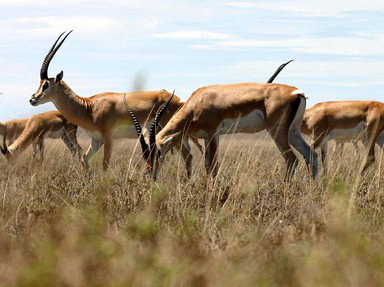
Antelopes are a group of even-toed ungulates (order Artiodactyla) that comprises members of various subfamilies of the family Bovidae. These herbivorous mammals, renowned for their running and jumping skills, live in Africa, the Middle East and India, with a few species found in Central Asia and Russia. There are, however, no species native to Australasia, and no extant species are found in the Americas. Most antelope species live in the forests and savannahs of sub-Saharan Africa.
Unlike deer (family Cervidae), which they often resemble in body conformation, antelopes have permanent horns with a bone core sheathed in keratin. These horns come in a great variety of shapes and sizes and are used both for defensive purposes and in fights between males. In about half of extant antelope species females also grow horns. Though often referred to as an antelope, the pronghorn (Antilocapra americana) sheds its horns every year like deer.
Some members of the subfamily Antilopinae are known as "true" antelopes (tribe Antilopini): the dorcas gazelle (Gazella dorcas) and the springbok (Antidorcas marsupialis) are two of them, while the four species of dik-dik (Madoqua sp.) belong to the tribe Neotragini. These antelopes are small to medium-sized, with slender bodies; dik-diks in particular are among the smallest antelope species. The dorcas gazelle is native to the northern part of the African continent, while the dik-dik and the springbok (the national mammal of South Africa) are mainly found in eastern and southern Africa. On the other hand, the saiga (Saiga tatarica), the sole member of its tribe (Saigini) and genus, is the only antelope still found in Europe (southern Russia). It has a very distinctive appearance, characterized by its proboscis-like, bloated nostrils.
Not surprisingly, some of the largest antelope species belong to the subfamily Bovinae and are thus closely related to cattle, bison and buffaloes. The nilgai (Boselaphus tragocamelus), native to the Indian subcontinent, is Asia's largest antelope with a sturdy body, thin legs and a small head topped by short, straight horns. The bongo (Tragelaphus eurycerus) and the greater kudu (Tragelaphus strepsyceros) both have a striking appearance, the former because of its glossy reddish-brown coat marked with thin white stripes, the latter because of the large, twisted horns of adult males. They are both found south of the Sahara Desert - the bongo in West and Central Africa, the greater kudu in eastern and southern Africa. The giant eland (Taurotragus derbianus) is the largest of all antelopes, though the "giant" epithet refers to the size of its V-shaped, spiraling horns. A vulnerable species now found mainly in national parks and reserves in Senegal and Central Africa, this imposing antelope and its closest relative, the common eland (Taurotragus oryx), have been partly domesticated.
The addax (Addax nasomaculatus) and the Arabian oryx (Oryx leucoryx) both belong to the subfamily Hippotraginae, whose name (from the Greek for "horse-goat") hints at the horse-like characteristics of their bodies. The addax, whose coat turns nearly white in the summer, is a critically endangered species currently found only in very small areas of West Africa, particularly Niger. Unlike oryxes, which have almost straight, annulated horns, the addax has spiraling horns that can grow to over 1 m (3.2 ft) in length. The smallest member of its genus, the Arabian oryx is also the only oryx species native to Asia. This white-coated antelope with brown legs and black facial markings went extinct in the wild in the 1970s but was subsequently reintroduced to the Arabian Peninsula. The Arabian oryx is the national animal of Jordan, Oman, the United Arab Emirates, Bahrain and Qatar.
The hartebeest (Alcelaphus buselaphus) is part of the subfamily Alcelaphinae, to which the two species of wildebeest (Connochaetes sp.) also belong. Its common name means "deer beast" in Afrikaans: indeed, this large antelope, with seven extant subspecies found in much of sub-Saharan Africa, does bear a slight resemblance to some deer species because of its pointed ears and elongated face. Though once widespread in the African continent, this antelope has been negatively impacted by hunting and habitat loss.
The only member of its subfamily (Apicerotinae) and genus, the impala (Apicerotys melampus) is a medium-sized, slender-bodied antelope found in eastern and southern Africa. Unlike other antelope species, it favours woodland areas with plenty of shade and water sources nearby. The males have ridged, lyre-shaped horns. Impalas are known as excellent leapers and make ample use of this ability when escaping predators.
The six wrong options are all members of the order Primates. The aye-aye is a lemur, while the bonobo is an ape; the gelada, the Nepal grey langur and the mandrill are Old World monkeys, while the emperor tamarin is a New World monkey.
This quiz was reviewed by FunTrivia editor rossian before going online.
Any errors found in FunTrivia content are routinely corrected through our feedback system.