FREE! Click here to Join FunTrivia. Thousands of games, quizzes, and lots more!
Quiz about Theres a Snake in My Boot

There's a Snake in My Boot! Trivia Quiz


I will give you ten questions about snakes, and you pick the correct answer.

A multiple-choice quiz by blake_aus_nsw. Estimated time: 2 mins.
  1. Home
  2. »
  3. Quizzes
  4. »
  5. Animal Trivia
  6. »
  7. Reptiles and Amphibians
  8. »
  9. Snakes

Time
2 mins
Type
Multiple Choice
Quiz #
423,893
Updated
Apr 26 26
# Qns
10
Difficulty
Easy
Avg Score
8 / 10
Plays
52
Last 3 plays: Guest 100 (9/10), dmaxst (8/10), Guest 209 (6/10).
- -
Question 1 of 10
1. Where do anacondas primarily live? Hint


Question 2 of 10
2. What is the primary reason snakes shed their skin? Hint


Question 3 of 10
3. How did the king cobra get its name? Hint


Question 4 of 10
4. Are most snakes dangerous to humans?


Question 5 of 10
5. Which one of these snakes is NOT indigenous to Australia? Hint


Question 6 of 10
6. How many eggs does a female parrot snake typically lay at one time? Hint


Question 7 of 10
7. Do snakes have eyelids?


Question 8 of 10
8. What is the world's longest snake? Hint


Question 9 of 10
9. Do all snakes lay eggs?


Question 10 of 10
10. How do snakes hear? Hint


(Optional) Create a Free FunTrivia ID to save the points you are about to earn:

arrow Select a User ID:
arrow Choose a Password:
arrow Your Email:


Most Recent Scores
Today : Guest 100: 9/10
Today : dmaxst: 8/10
Today : Guest 209: 6/10
Today : Dotty39: 7/10
Today : Guest 98: 8/10
Today : zartog: 8/10
Today : Guest 71: 7/10
Today : Guest 81: 9/10
Today : Guest 188: 9/10

Quiz Answer Key and Fun Facts
1. Where do anacondas primarily live?

Answer: In tropical rainforests and wetlands

Anacondas are native to South America. They typically reach 4.5 to 6 meters (15 to 20 feet) in length. They prefer shallow, slow-moving, or stagnant water. Their main diet consists of mammals, birds, reptiles, and fish.
2. What is the primary reason snakes shed their skin?

Answer: Growth and remove external parasites

Snakes shed their skin to help them grow, since their skin doesn't stretch like a human's. This shedding also helps remove any bugs or parasites, such as mites and ticks, that might be stuck to their old skin. The process of shedding is called ecdysis or molting.

Younger snakes shed their skin more often, sometimes every few weeks, because they are growing quickly. Adult snakes, on the other hand, usually shed their skin only about three to four times a year.
3. How did the king cobra get its name?

Answer: It eats other snakes

The king cobra is an impressive snake known for its unique diet. It is the only snake that primarily eats other snakes. Despite its name, the king cobra isn't a true cobra; it gets called that because it has some similar features.

Its scientific name, Ophiophagus hannah, actually means "snake eater."
4. Are most snakes dangerous to humans?

Answer: No

Most snakes are not a threat to people. In fact, only about 15% of the roughly 3,700 different types of snake are considered dangerous. Most snakes are quite timid and would rather flee than attack.

However, it's important to note that bites from venomous snakes do lead to around 81,000 to 138,000 deaths every year around the world, mainly in Africa and Asia.
5. Which one of these snakes is NOT indigenous to Australia?

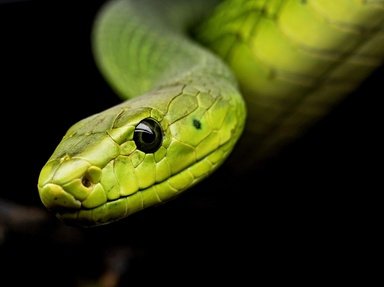
Answer: Black mamba

Black mambas are native to Africa. They typically reach 2 to 3 meters (6.6 to 9.8 feet) in length. They prefer rocky outcrops, sparse woodlands, and dry, open bushveld. Their main diet consists of rats, mice, and birds.
6. How many eggs does a female parrot snake typically lay at one time?

Answer: 2 to 10 eggs

The female parrot snake lays about 2 to 10 eggs once per year. Female parrot snakes generally lay their eggs in hidden locations such as leaf litter or under rotting logs. Their eggs take approximately 89 days to hatch.
7. Do snakes have eyelids?

Answer: No

Snakes lack eyelids, possessing instead a protective, transparent scale known as the brille that covers each eye. This fixed structure serves to shield the eye from potential damage and environmental debris.

As a result, snakes are unable to blink, and they maintain a state of unblinking vigilance even during sleep.
8. What is the world's longest snake?

Answer: Reticulated python

Reticulated pythons are native to Asia. They typically reach 6 to 7 meters (19.7 to 23 feet) in length, but reports of sizes up to 10 meters (33 feet) have been recorded. They prefer tropical rainforests, woodlands, and humid grassland habitats. Their diet depends on their size.
9. Do all snakes lay eggs?

Answer: No

Approximately 70% of snake species are oviparous (egg-laying), while the remaining 30% exhibit either ovoviviparity or viviparity, resulting in live births. Live birth strategies are particularly prevalent in colder climates, providing thermoregulatory advantages that enhance neonatal survival.
10. How do snakes hear?

Answer: Via vibrations

Snakes can't hear the same way that humans do because they don't have ears or eardrums. Instead, they pick up sounds by sensing vibrations through their jawbones, which send sounds to their inner ears.

This helps them detect sounds in their surroundings, especially low sounds like footsteps or movements, alerting them to potential dangers.
Source: Author blake_aus_nsw

This quiz was reviewed by FunTrivia editor rossian before going online.
Any errors found in FunTrivia content are routinely corrected through our feedback system.
4/26/2026, Copyright 2026 FunTrivia, Inc. - Report an Error / Contact Us