FREE! Click here to Join FunTrivia. Thousands of games, quizzes, and lots more!
Quiz about Garter Snakes

Garter Snakes Trivia Quiz

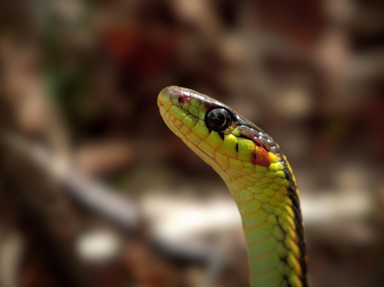
Genus Thamnophis

Here are ten questions about garter snakes: from habitat and venom to reproduction and survival strategies. Enjoy!

A photo quiz by JJHorner. Estimated time: 3 mins.
  1. Home
  2. »
  3. Quizzes
  4. »
  5. Animal Trivia
  6. »
  7. Reptiles and Amphibians
  8. »
  9. Snakes

Author
JJHorner
Time
3 mins
Type
Photo Quiz
Quiz #
424,135
Updated
May 10 26
# Qns
10
Difficulty
Easy
Avg Score
8 / 10
Plays
24
Last 3 plays: Guest 208 (8/10), japh (9/10), james1947 (10/10).
-
Question 1 of 10
1. The venom of the garter snake often causes severe necrosis in humans around the bite.


Question 2 of 10
2. Most garter snakes in the wild prefer to snack on what tasty comestibles? Hint


Question 3 of 10
3. Which species is the most widespread garter snake in North America? Hint


Question 4 of 10
4. Unlike many reptiles, some species of garter snakes are remarkable because they can do what? Hint


Question 5 of 10
5. In colder regions, garter snakes often survive winter by doing what? Hint


Question 6 of 10
6. Garter snakes can be found on all continents except Antarctica.


Question 7 of 10
7. What defensive behavior are garter snakes known for when threatened? Hint


Question 8 of 10
8. What species is one of the largest garter snakes and is found in the wetlands of California's Central Valley? Hint


Question 9 of 10
9. Which species is well known for forming enormous dens in Manitoba, Canada? Hint


Question 10 of 10
10. Garter snakes are precocial, meaning that they are highly self-sufficient from the moment of birth.


(Optional) Create a Free FunTrivia ID to save the points you are about to earn:

arrow Select a User ID:
arrow Choose a Password:
arrow Your Email:


View Image Attributions for This Quiz

Most Recent Scores
Today : Guest 208: 8/10
Today : japh: 9/10
Today : james1947: 10/10
Today : Kabdanis: 5/10
Today : Rumpo: 10/10
Today : Guest 216: 8/10
Today : TimMike3: 6/10
Today : zurddog01: 6/10
Today : Guest 174: 9/10

Quiz Answer Key and Fun Facts
1. The venom of the garter snake often causes severe necrosis in humans around the bite.

Answer: False

Garter snakes do produce a mild venom, which surprises a lot of people because they have such a squeaky-clean reputation... at least as far as snakes go.

The venom comes from a gland in the mouth called the Duvernoy gland, and it's delivered through enlarged rear teeth rather than scary hollow fangs like a rattlesnake. Still, for humans, the effects are usually pretty minor.

Most bites are a nuisance at worst. Some mild swelling. Maybe a little itching if you're unlucky. They may get grumpy from time to time, but they're not out to kill you.
2. Most garter snakes in the wild prefer to snack on what tasty comestibles?

Answer: Earthworms and amphibians

Garter snakes aren't picky eaters, but earthworms and amphibians are on the menu for any self-respecting restaurant owner catering to them. Frogs, toads, salamanders, tadpoles, and big juicy worms make up much of their diet across North America. Some species also go after small fish, slugs, leeches, and occasionally an embarrassingly unlucky rodent.

Fun Fact: a few species have developed a superpower involving toxic newts. The rough-skinned newt produces something called tetrodotoxin. It's one of the nastier neurotoxins in nature, and this little guy contains enough to kill several adult humans. Certain garter snakes evolved resistance to it through an evolutionary arms race that has been going on for ages. The snake eats the newt. The newt gets more toxic. The snake gets more resistant. Rinse and repeat. (This evolutionary arms race is part of the Red Queen Hypothesis of Evolution.)
3. Which species is the most widespread garter snake in North America?

Answer: Common garter snake

The common garter snake is everywhere. Well, almost everywhere. It has one of the widest distributions of any reptile in North America, ranging from southern Canada all the way down into parts of the United States and Central America. If you have ever nearly stepped on a harmless striped snake while doing whatever it is you do, there is a decent chance it was a common garter snake.
4. Unlike many reptiles, some species of garter snakes are remarkable because they can do what?

Answer: Give birth to live young

Many people assume all snakes lay eggs, but garter snakes scoff at your expectations. Most species give birth to live young instead. This is called viviparity (or technically, ovoviviparity, if you really want to impress a biologist). The babies develop inside the mother and emerge fully formed, albeit tiny, squirmy, and a bit hyper. A single female can produce anywhere from a handful of offspring to more than 80 in extreme cases.

This system works out well in colder climes where eggs would have problems surviving. Garter snakes are found very far north indeed compared to many reptiles. They even live up in Canada, where the winters are just personally insulting. Developing young inside the body gives them a better chance against these chilly temperatures.

Note: There is no established evidence demonstrating that they CAN'T speak passable Klingon.
5. In colder regions, garter snakes often survive winter by doing what?

Answer: Gathering in underground dens

Garter snakes survive the northern chill by gathering in underground dens called hibernacula. These sheltered spaces can be natural rock crevices, abandoned mammal burrows, caves, or your shed. Hundreds or sometimes thousands of snakes may pile into the same den to ride out the cold together. Underground temperatures are more stable thus preventing these cold-blooded critters from turning into snake-flavored popsicles.
6. Garter snakes can be found on all continents except Antarctica.

Answer: False

I lied again. Garter snakes are native only to North America and parts of Central America. You'll mostly find them across the United States and southern Canada, where they have become one of the most familiar snakes on the continent.

They are not naturally found in Europe, Africa, Asia, South America, or Australia. Antarctica is obviously out too, unless some scientist heading to Amundsen-Scott brings a very wary pet garter snake.
7. What defensive behavior are garter snakes known for when threatened?

Answer: Releasing a foul-smelling musk

When threatened, many garter snakes release a foul-smelling "musk" from glands near the base of the tail. The smell is strong, oily, and persistent. Yum. So, the garter snake's strategy when it cannot win the fight is to make everyone involved absolutely miserable. Good plan. They may also thrash around, flatten their bodies slightly, and strike defensively, though their bites are generally harmless to people.

Hognose snakes are the drama theater kids and play dead, complete with writhing and fake death spasms. Cobras can spread hoods by expanding the neck ribs. A few species such as spitting cobras prefer to spray venom toward the eyes of predators.

Garter snakes prefer to make you smell funny.
8. What species is one of the largest garter snakes and is found in the wetlands of California's Central Valley?

Answer: Giant garter snake

The giant garter snake is the heavyweight champion of the garter snake world, reaching lengths of up to five feet (1.5 m) or more. So not "giant" exactly, but not something you want to run over with the lawn mower either.

It lives mainly in the wetlands, marshes, and rice-growing areas of California's Central Valley, where it spends much of its time lurking around water. There it hunts fish, frogs, and other unlucky aquatic animals it can fit in its mouth.
9. Which species is well known for forming enormous dens in Manitoba, Canada?

Answer: Red-sided garter snake

The red-sided garter snake is world-famous for forming gigantic overwintering dens in Manitoba, Canada. They especially enjoy the Narcisse Snake Dens area, which I suppose is fitting. Every spring, tens of thousands of snakes emerge from underground limestone crevices after months of sleeping off the winter.

The result is one of the largest snake gatherings on Earth! Yay!

And what's the first thing on their minds? Sex! Mating season begins almost immediately, and massive writhing mating balls form around females. And no, they don't care how uncomfortable that sentence makes you feel.

The dens exist because the limestone bedrock up there creates deep cracks below the frost line. This allows the snakes to survive winters that would otherwise freeze them solid. The snakes return to the same dens year after year. Tourists travel from all over to witness the event, because tourists are weird that way.
10. Garter snakes are precocial, meaning that they are highly self-sufficient from the moment of birth.

Answer: True

Baby garter snakes are on their own almost immediately after birth. This saves precious money on parenting classes and daycare. The young are born fully formed, capable of moving, hunting, hiding, and trying to avoid becoming lunch for something larger. That is what "precocial" means in this context: relatively mature and independent right from the start. A newborn garter snake is only a few inches long (nothing wrong with that), however, it already comes equipped with the instincts needed to survive in a world full of predators.

And that's all I have to say about garter snakes.
Source: Author JJHorner

This quiz was reviewed by FunTrivia editor rossian before going online.
Any errors found in FunTrivia content are routinely corrected through our feedback system.
5/10/2026, Copyright 2026 FunTrivia, Inc. - Report an Error / Contact Us