FREE! Click here to Join FunTrivia. Thousands of games, quizzes, and lots more!
Quiz about Slide Into the Depths of Loch Ness

Slide Into the Depths of Loch Ness Quiz

Scotland's Famous Beastie

As I'm Scottish and have recently been writing quizzes about mysteries, I decided to make this one about our very own Nessie. She's avoided scientists, tourists and photographers for centuries. See how much you know about her. Good luck and have fun!

A multiple-choice quiz by Kalibre. Estimated time: 3 mins.
  1. Home
  2. »
  3. Quizzes
  4. »
  5. General Knowledge Trivia
  6. »
  7. The Unexplained
  8. »
  9. Cryptozoology and Monsters

Author
Kalibre
Time
3 mins
Type
Multiple Choice
Quiz #
423,209
Updated
Feb 24 26
# Qns
10
Difficulty
New Game
Avg Score
8 / 10
Plays
17
Last 3 plays: Dizart (8/10), xchasbox (3/10), cardsfan_027 (10/10).
- -
Question 1 of 10
1. According to popular jokes and light-hearted folklore, what is often said to be the Loch Ness Monster's favourite food? Hint


Question 2 of 10
2. In which Scottish region is Loch Ness located? Hint


Question 3 of 10
3. Which saint reportedly encountered a water beast in the River Ness in the 6th century? Hint


Question 4 of 10
4. What event in 1933 caused a surge in Loch Ness Monster sightings? Hint


Question 5 of 10
5. What was the famous 1934 'Surgeon's Photograph' of the Loch Ness Monster later revealed to be? Hint


Question 6 of 10
6. What creature is Nessie most commonly compared to? Hint


Question 7 of 10
7. Which alternative theory suggests the Loch Ness Monster exists in a non-physical form? Hint


Question 8 of 10
8. Which real species of fish has been suggested by some researchers as a possible explanation for Loch Ness Monster sightings? Hint


Question 9 of 10
9. What characteristic makes Loch Ness a plausible habitat for a large unknown creature? Hint


Question 10 of 10
10. Which 1996 film stars Ted Danson as a scientist investigating the Loch Ness Monster? Hint


(Optional) Create a Free FunTrivia ID to save the points you are about to earn:

arrow Select a User ID:
arrow Choose a Password:
arrow Your Email:


Most Recent Scores
Today : Dizart: 8/10
Today : xchasbox: 3/10
Today : cardsfan_027: 10/10
Today : bigjohnsludge: 10/10
Today : Reamar42: 7/10
Today : Guest 108: 7/10
Today : Guest 174: 10/10
Today : Gary10: 6/10
Today : Guest 108: 6/10

Quiz Answer Key and Fun Facts
1. According to popular jokes and light-hearted folklore, what is often said to be the Loch Ness Monster's favourite food?

Answer: Haggis

Haggis appears in countless jokes and cartoons about Nessie. Understandable really, because it's Scotland's most famous traditional dish. The idea of a prehistoric monster munching on haggis has become a running gag in Scottish tourism. Yes, visit a souvenir shop and you're sure to find Nessie chomping on a haggis on items such as postcards and mugs. I once saw a tea towel which showed her chasing a wild, hairy haggis! The same applies to tourist guides all around Loch Ness. It's become part of the legend's charm.

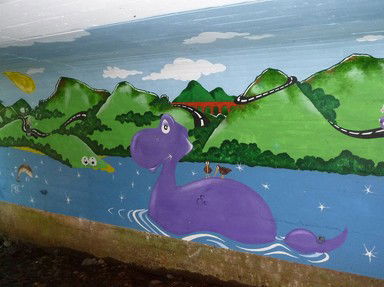
I think pairing Scotland's most famous monster with Scotland's most famous food is a great idea. It makes perfect sense in a daft way because, let's be honest, nobody actually thinks Nessie eats haggis (or perhaps some do!) It's just one of those humorous bits of folklore that adds to her personality. It also keeps the legend light-hearted rather than scary. She looks like a cute, friendly type of monster, the type you would love to have as a pet.
2. In which Scottish region is Loch Ness located?

Answer: Highlands

Loch Ness is situated in the Scottish Highlands. It's roughly 23 miles southwest of Inverness. The Highlands cover the northern part of Scotland and include some of the most dramatic landscapes in Britain. I'm sure you'd agree if you ever decide to visit. The area's known for mountains, deep lochs, and its sparse population. This remote setting adds to the mystery surrounding Nessie sightings.

The loch runs along the Great Glen, which is a massive geological fault line that cuts across Scotland from coast to coast. The Highlands have always been associated with Scottish folklore and legends. So, as you can imagine, having a monster legend living in this wild, isolated area fits perfectly with the area's mysterious atmosphere. The location has helped keep the Nessie story alive for centuries.

Loch Ness is roughly a three-hour drive from where I live. I've visited it a couple of times. Oh, and just in case you're wondering, no, I didn't even catch a glimpse of Nessie! : )
3. Which saint reportedly encountered a water beast in the River Ness in the 6th century?

Answer: Saint Columba

Saint Columba's encounter with a water beast is the earliest written account connected to the Loch Ness area. According to his biographer Adomnán, Columba was travelling through Scotland around 565 AD when he came across locals burying a man who had been attacked by a water creature in the River Ness. When one of Columba's followers went into the water, the beast appeared again. Columba commanded it to leave, and it obeyed.

This story predates modern Nessie sightings by over 1,300 years. Many people believe it's proof that the legend has ancient roots. However, sceptics note that medieval hagiographies often included monster stories to demonstrate saints' power over nature. The River Ness connects to Loch Ness, but they're not the same body of water. Whether this story relates to the modern Loch Ness Monster legend remains debated. It's definitely food for thought though.
4. What event in 1933 caused a surge in Loch Ness Monster sightings?

Answer: A new road was built along the loch

In 1933, a new road was completed along the northern shore of Loch Ness. The A82 road provided much better access to the loch and opened up clear views of the water that hadn't existed before. Trees had been cut down during construction, which meant more people could see the loch from their cars. This brought far more traffic to the area than it had ever experienced. Suddenly, hundreds more people were passing by every day with direct views of the water.

The road construction coincided with a massive increase in reported sightings. Some researchers believe the reports were genuine but increased simply because more people were watching the loch. Others suggest the road construction might have disturbed something in the water, but this seems unlikely. The modern Nessie legend really began in 1933 with these sightings. Newspapers picked up the stories and turned a local legend into an international phenomenon. Without that road, Nessie might have remained an obscure Scottish folk tale.
5. What was the famous 1934 'Surgeon's Photograph' of the Loch Ness Monster later revealed to be?

Answer: A toy submarine with a fake head

In 1994, a man named Christian Spurling confessed on his deathbed that the famous 1934 photo was a hoax. He revealed it was actually a toy submarine bought from Woolworths with a plastic head and neck attached. His stepfather Marmaduke Wetherell had organised the hoax as revenge after the Daily Mail humiliated him over fake monster footprints. Wetherell recruited Robert Kenneth Wilson, a London gynaecologist, to take the photograph because a doctor would seem trustworthy. Wilson's professional credentials gave the image credibility it wouldn't have had otherwise.

The revelation came 60 years after the photo was taken. By then, the image had become famous and appeared in books and documentaries. The hoax worked so well because the photo was grainy enough to hide the model's small size. When people finally saw how tiny and crude the fake monster head was, many were shocked that such a simple trick had fooled the world for decades. I've looked at it and it does look genuine, even though I know it's not.

The photograph became known as the 'Surgeon's Photograph' because Wilson was a medical professional, though he always refused to have his name formally attached to it. What an amazing hoax! : D
6. What creature is Nessie most commonly compared to?

Answer: Plesiosaur

The plesiosaur comparison became popular in the 1930s when Nessie sightings increased. Plesiosaurs were marine reptiles that lived during the age of dinosaurs and had long necks, small heads, and large flippers. They went extinct about 66 million years ago. The description matched what many witnesses claimed to see in Loch Ness. It made it the favourite theory for believers.

However, scientists point out major problems with this theory. Plesiosaurs were air-breathing creatures that would need to surface regularly, making them much easier to spot. They also lived in oceans, not freshwater lochs. Most importantly, Loch Ness was completely covered in ice during the last ice age, which ended only 10,000 years ago. No large creature could have survived there during that period. Despite these issues, the plesiosaur theory remains the most romantic explanation.
7. Which alternative theory suggests the Loch Ness Monster exists in a non-physical form?

Answer: The interdimensional/ethereal being theory

Some researchers and believers suggest Nessie might not be a physical creature at all, but rather an ethereal or interdimensional being. This theory proposes that the monster exists in a non-physical state, occasionally manifesting in our reality before vanishing again. In my opinion, this would explain why no bodies are ever found, why DNA studies find nothing. The monster appears real to witnesses but leaves no physical evidence behind. You might have noticed that photos of these creatures are never clear enough to reach a conclusion about them. You're always left thinking 'Is it real or not'.

This theory connects Nessie to Scotland's ancient folklore about water spirits and supernatural beings. You see, Scottish legends are full of kelpies, selkies, and other shape-shifting water creatures that weren't considered physical animals but mystical entities.

The ethereal theory suggests Nessie belongs to this tradition rather than being a surviving prehistoric reptile. It explains why thousands of people report sightings across centuries whilst scientists find no concrete proof. The monster exists, but just not in the way conventional biology expects.
8. Which real species of fish has been suggested by some researchers as a possible explanation for Loch Ness Monster sightings?

Answer: Sturgeon

Sturgeon have been suggested as a likely explanation for some Nessie sightings. These fish can grow extremely large and can sometimes reach lengths of 3-4 metres (9.8-13.1 feet) or more. They have prehistoric-looking bony plates on their bodies and can live for decades. When a sturgeon surfaces, its humped back and protruding snout could easily be mistaken for a monster, especially from a distance. They're rare in Scottish waters but not impossible.

Sturgeon usually live in coastal waters and rivers rather than deep lochs, so this makes this explanation less convincing to some researchers. However, they have been recorded in Scottish waters historically. The fish can look genuinely strange and frightening to someone unfamiliar with them.

So, a large sturgeon breaking the surface unexpectedly could account for at least some of the more dramatic sightings over the years. I guess that's possible. It's a more plausible explanation than surviving dinosaurs.
9. What characteristic makes Loch Ness a plausible habitat for a large unknown creature?

Answer: It's extremely deep and murky

Loch Ness is extremely deep and murky. It reaches depths of about 230 metres at its deepest point. The water contains high levels of peat, which makes it very dark and difficult to see through. Visibility is often less than a metre below the surface. This murkiness means that even modern sonar and submarine searches struggle to get clear readings. What a perfect place for a large creature to hide in!

The loch is also enormous and holds more freshwater than all the lakes in England and Wales combined. It's roughly 36 kilometres (22.4 miles) long and nearly 2 kilometres (1.24 miles) wide at its broadest point. The sheer volume of water provides plenty of space for something to remain undetected.

However, scientists argue that the loch doesn't contain enough fish to support a population of large predators. That's a good point, because a single creature couldn't survive alone long-term, and a breeding population would be spotted more frequently.
10. Which 1996 film stars Ted Danson as a scientist investigating the Loch Ness Monster?

Answer: Loch Ness

The film 'Loch Ness' starred Ted Danson as Dr. Jonathan Dempsey, an American scientist sent to Scotland to debunk the monster legend. He's sceptical at first but becomes involved with the local community and a young girl who believes she's seen Nessie. The film was shot on location around Loch Ness and featured beautiful Scottish scenery. It took a lighter, family-friendly approach to the legend rather than making a horror film.

The film didn't become a major box office success but it gained a following among Nessie enthusiasts. It's one of several films to use the Loch Ness Monster legend, though most are lesser-known productions. The 2007 film 'The Water Horse' is probably better known today. The 1996 film captures the tourist industry and local culture surrounding Nessie quite well, showing how the legend has become part of Scottish identity.
Source: Author Kalibre

This quiz was reviewed by FunTrivia editor agony before going online.
Any errors found in FunTrivia content are routinely corrected through our feedback system.
2/24/2026, Copyright 2026 FunTrivia, Inc. - Report an Error / Contact Us