FREE! Click here to Join FunTrivia. Thousands of games, quizzes, and lots more!
Quiz about Unplated Vegetables

Unplated Vegetables Trivia Quiz


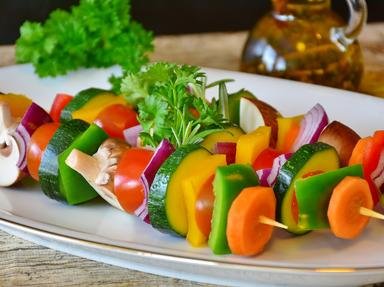
Vegetables are such an integral part of most diets globally that their very presence has permeated many aspects of our everyday lives outside of meals. Here are ten questions on vegetables that are unlikely to see a plate anytime soon.

A photo quiz by 1nn1. Estimated time: 3 mins.
  1. Home
  2. »
  3. Quizzes
  4. »
  5. General Knowledge Trivia
  6. »
  7. Thematic Food
  8. »
  9. Thematic Vegetables

Author
1nn1
Time
3 mins
Type
Photo Quiz
Quiz #
423,302
Updated
Apr 14 26
# Qns
10
Difficulty
Easy
Avg Score
8 / 10
Plays
45
Last 3 plays: Guest 98 (10/10), Guest 24 (7/10), Guest 174 (10/10).
Author's Note: Note. While there are many botanical arguments about what constitutes a vegetable, which can actually be a fruit, for this quiz, a vegetable is defined by its culinary aspect (e.g., a tomato is a vegetable).
-
Question 1 of 10
1. Which of the following was a real person connected to James Bond Movies? Hint


Question 2 of 10
2. Which vegetable can follow all of the following words idiomatically: hot, couch, and small? Hint


Question 3 of 10
3. "Attack", "Return" and "Fried" are the first words in the titles of well-known movies. What is the single vegetable mentioned in each of these titles?
Hint


Question 4 of 10
4. All the following are vegetables with their vowels removed. Identify which one of the following options is NOT a root vegetable: Trnp, crrt, kl, nn, and clrc?

Answer: (Known as "clwt" in the UK. Full name please)
Question 5 of 10
5. "Green Onions", an instrumental, was a massive 1962 hit for which artist? Hint


Question 6 of 10
6. Some animals are named after vegetables. What do you think that this animal is called? Hint


Question 7 of 10
7. Vegetables feature in many idiomatic phrases. Each of the following phrases contains a missing vegetable. Which one is the odd one out? Hint


Question 8 of 10
8. Australia has a large collection of roadside attractions such as the Big Mower, the Big Pineapple and the Big Crocodile. True or false: The image shows the Big Potato? (Look carefully!)


Question 9 of 10
9. Gregor Mendel (1822-1884) was called the Father of Genetics because of his work on cross-breeding pea plants. However, what was his first and primary occupation? Hint


Question 10 of 10
10. "The Potato Eaters" is a famous 1885 painting depicting rural life. Who painted this masterpiece? Hint


(Optional) Create a Free FunTrivia ID to save the points you are about to earn:

arrow Select a User ID:
arrow Choose a Password:
arrow Your Email:


View Image Attributions for This Quiz

Most Recent Scores
Today : Guest 98: 10/10
Today : Guest 24: 7/10
Today : Guest 174: 10/10
Today : lethisen250582: 10/10
Today : Guest 162: 5/10
Today : Guest 98: 7/10
Today : Guest 98: 9/10
Today : dmaxst: 8/10
Today : Guest 24: 7/10

Quiz Answer Key and Fun Facts
1. Which of the following was a real person connected to James Bond Movies?

Answer: Albert Broccoli

CELEBRITIES

Albert Romolo Broccoli (1909 - 1996), nicknamed "Cubby", was an American film producer who produced over 40 movies, including 17 James Bond movies, either as sole producer or with Harry Saltzman or his stepson Michael G. Wilson. He also produced 15 movies with Irving Allen.

Broccoli came from an Italian family that claimed to have introduced broccoli into the United States. His father and uncle were Italian immigrants who founded a successful broccoli farm on Long Island in the first two decades of the 20th century. He claimed that the vegetable was named after his family. Etymologists state the name likely derived from the Italian "broccolo" meaning "the flowering crest of a cabbage". The vegetable was first described in 1794.

Brussell Crowe is a pun on Russell Crowe, as it is Augbergine Hackman, better known as Gene Hackman. In this case, British actor Olivia Coleman has been given the coleslaw treatment.
2. Which vegetable can follow all of the following words idiomatically: hot, couch, and small?

Answer: Potato

HUMANITIES

A "couch potato" is someone who spends too much time seated watching television or playing video games.
A "hot potato" is a controversial or difficult issue. Further, if you "drop (someone or something) like a hot potato, you abandon that person or thing.
Something that is "small potatoes" is insignificant.

Pictured is a couch potato. No, it is not a self-portrait.
3. "Attack", "Return" and "Fried" are the first words in the titles of well-known movies. What is the single vegetable mentioned in each of these titles?

Answer: Tomato

MOVIES

"Attack of the Killer Tomatoes" was a 1978 American independent parody film spoofing B-movies. It was made on a budget of $100,000 and was so bad that it was box office gold.

The first sequel, "Return of the Killer Tomatoes!" was worse. Its only redeemable feature was that it featured George Clooney in one of his first film roles.

"Fried Green Tomatoes" was a 1991 American comedy-drama movie, based on Fannie Flagg's novel "Fried Green Tomatoes at the Whistle Stop Cafe" 1991. The screenplay was written by the novel's author and Carol Sobieski. It starred an ensemble cast including Kathy Bates, Jessica Tandy, Mary Stuart Masterson, Mary-Louise Parker, and Cicely Tyson. The plot revolved around a middle-aged housewife (Bates) who befriends an elderly nursing home resident who retells encounters from her past. The movie was a critical and commercial success, earning $119.4 million against a $11 million budget.
4. All the following are vegetables with their vowels removed. Identify which one of the following options is NOT a root vegetable: Trnp, crrt, kl, nn, and clrc?

Answer: kl

BRAIN TEASERS

Kale is a leaf cabbage belonging to Brassica oleracea, the same family as cauliflower, broccoli and Brussels sprouts. Known as colewort in the UK, kale is grown for its edible leaves, which can be bumpy, flat or curly and can be green or purple. Kale is considered a superfood because of its exceptionally high nutrient density, with large concentrations of vitamins K, A, and C, as well as antioxidants, fibre, and manganese.

Often confused with collard greens because of its lack of a head, kale is a different cultivar of the same species.

Turnip, carrot, and celeriac are all true root vegetables. Onion (nn in this question) is not a true root vegetable, which is a modified underground stem surrounded by leaves. However, in a culinary context, it is generally classified as a root vegetable because it grows underground.

The image depicts a crop of kale from above.
5. "Green Onions", an instrumental, was a massive 1962 hit for which artist?

Answer: Booker T. & the M.G.'s

MUSIC

Booker T. & the M.G.'s were an American R&B and jazz band formed in Memphis, Tennessee, in 1962. The group members were Booker T. Jones (Hammond organ, piano), Steve Cropper (guitar), Lewie Steinberg (bass), and Al Jackson Jr. (drums). They served as the house band of Stax Records, a Memphis soul music label, as well as its subsidiary Volt Records. They played on many soul recordings by artists including Wilson Pickett, Otis Redding, Bill Withers, Rufus Thomas, Johnnie Taylor, and Albert King, to name a few. They were an instrumental group as they lacked a vocalist.

In 1962, the instrumentalists were jamming when a singer, Billy Lee Riley, failed to show for a recording session. The owner of Stax Records, Jim Stewart, was impressed with the resulting tune, which was given the title of "Behave Yourself". Needing a B-side, the band improvised on a riff with a 12-bar blues bassline that Booker demonstrated. They recorded "Funky Onions", which became "Green Onions" before it was released. Taken to a local Memphis radio station, WLOK, initial airings favoured "Green Onions" as the A-side. The song went to number three on the Billboard Hot 100 and number one on the Hot R&B Singles Chart, and number 53 on the Billboard Year End Chart.
6. Some animals are named after vegetables. What do you think that this animal is called?

Answer: Tomato Frog

ANIMALS

Tomato frogs are any of the Dyscophus genus (family Microhylidae). There are three species: D. antongilii, D. insularis, and D. guineti. They are endemic in Madagascar.

Their common name arises from their bright red colouration. Colouration increases as the frog matures. Females are larger than males and can attain 10 cm / 4in in length. Males are at least 5 cm / 2 in and can reach 7.5 cm / 3 in. Females are more brightly coloured from reddish-orange to bright dark red. The bellies are yellowish, and sometimes there is black colouration on the throat and flanks. Males are more of a duller orange-red or brownish-orange. Their bright colouration serves as a warning to predators that they are unpalatable.

When threatened by predators, the tomato frog's skin can secrete a thick, sticky, white, milky mucus that numbs the predator's eyes and mouth, causing the predator to release the frog. This mucus can cause severe allergic reactions in humans, but it is not fatal.
7. Vegetables feature in many idiomatic phrases. Each of the following phrases contains a missing vegetable. Which one is the odd one out?

Answer: ____ as a cucumber

LITERATURE

"Cool as a cucumber" is an idiomatic phrase that has lost its original context. In a contemporaneous setting, it means to keep one's composure when under stress or not to be phased by external factors.

Originally, the simile was formed by alluding to the coldness of cucumbers, which, because they were mainly water, were cool to the touch.

'As cool as a cucumber' is first recorded in John Gay's "Poems, New Song on New Similes" (1732):

"My passion is as mustard strong;
I sit all sober sad;
Drunk as a piper all day long,
Or like a March-hare mad.
Round as a hoop the bumpers flow;
I drink, yet can't forget her;
For, though as drunk as David's sow,
I love her still the better.
Pert as a pear-monger I'd be,
If Molly were but kind;
Cool as a cucumber could see
The rest of womankind."

The other three idioms all involve peas:
"Two peas in a pod" refers to any two items that resemble one another. Its origin is unknown but it has been recorded as being in use since the late 16th century:
John Lyly used the phrase in "Euphues and his England" (1580):
"Wherin I am not unlike unto the unskilfull Painter, who having drawen the Twinnes of Hippocrates, (who wer as lyke as one pease is to an other)."
Use of 'pease' as the singular form was Standard practice in Tudor England.

The phrase "pea souper" comes from 19th-century Cockney London to describe very thick, yellowish-green, or greeny-brownish fogs caused by copious coal smoke mixed with water vapour or fog. Its consistency resembles thick pea soup, a common and economical cheap meal at that time, facilitating the phrase becoming popular in the late 1800s.

The origin of "pea-brained" is more recent, with the Oxford English Dictionary citing the earliest known use as 1942. It is an informal adjective used to describe someone as foolish or unintelligent, by way of suggesting their brain is tiny, as it compares the brain to a pea, thereby indicating a limited intellectual capacity.
8. Australia has a large collection of roadside attractions such as the Big Mower, the Big Pineapple and the Big Crocodile. True or false: The image shows the Big Potato? (Look carefully!)

Answer: False

WORLD

A uniquely Australian phenomenon is its propensity to display "Big Things", which are examples of novelty architecture and sometimes sculptures displayed as roadside attractions. Whilst most were built as promotional advertisements, particularly for locally grown produce, several, such as the Big Banana in Coffs Harbour, the Big Pineapple on Queensland's Sunshine Coast, and the Big Golden Guitar in Tamworth, NSW (promoting the country music capital of Australia), have become huge tourist attractions in their own right.

Possibly inspired by the aptly named Roadside Giants of the United States, the Australian versions of these attractions have become affectionately revered despite being kitsch. There is a national register of such structures. In 2022, there were 1075 registered Big Things in Australia.

Food items are particularly well represented with fruit being very popular, especially oranges, apples and avocados being replicated several times over. Vegetables, though, are not as often seen. There is the Big Potato in Robertson, NSW and the Big Spud in rural Tasmania, and the Big Pumpkin in Gumlu, North Queensland, but very few others, perhaps because of difficulty in depicting vegetables so they are instantly recognisable.

A case in point may be The Big Brussels Sprout, affectionately named Arthur, which is a 4-metre-high fibreglass sculpture found in Coldstream, in the Yarra Valley near Melbourne, Victoria. It was unveiled in 2015 outside Adams Farm, which is one of the largest producers of Brussels sprouts in Australia. However, without this pertinent information, the structure is not instantly recognisable as a Brussels sprout.
9. Gregor Mendel (1822-1884) was called the Father of Genetics because of his work on cross-breeding pea plants. However, what was his first and primary occupation?

Answer: St Augustine monk

SCIENCE / TECHNOLOGY

Gregor Mendel was born into a farming family in the Austrian Empire. He was a keen childhood gardener and studied beekeeping when he was young. He was keen to study science and became a substitute teacher while studying to become a certified high school teacher, but recurrent illness caused him to fail his exams, and he struggled to pay for his tuition. He became a monk in the St Augustine order, in part, to be able to continue his studies without having to worry about an income to pay for them. His studies on cross-breeding peas were groundbreaking in the field of genetics.

He found that when he crossbred a pure strain, as pictured, of yellow pea seeds with green-seeded peas, the first generation offspring were all yellow pea seeds. However, the second generation produced three yellow-seeded peas and one green-seeded variant. He deduced that each parent contributed one factor (later called a gene) to the offspring and that one trait was dominant and one was recessive. In the pictured case, the crossbred offspring were Yg and Yg, (where the capital letter indicates the dominant or expressed trait) and the smaller letter, the non-expressed gene, was the recessive gene. When two Yg strains were crossbred, the offspring were YY, Yg, gY, and gg. Green-seeded peas were possible when two recessive genes were combined.

Mendel went on to describe that the various forms (or alternatives) of a gene were called alleles. He correctly deduced that offspring will inherit two different genes from their parents. This is called genotype (e.g., YY, Yg, gY or gg). The observable appearance of the gene is called the phenotype (e.g., YY, Yg, gY or gg will produce yellow, yellow, yellow, and green pea seeds, respectively). Mendel had outlined the basic laws of DNA genetics. These principles defined the ways that genes operated. Mendel's work was largely unrecognised for 35 years.
10. "The Potato Eaters" is a famous 1885 painting depicting rural life. Who painted this masterpiece?

Answer: Vincent van Gogh

HUMANITIES

Dutch artist Vincent Van Gogh painted "The Potato Eaters" in 1885 while living with his parents in Nuenen, a small rural town known for its high proportion of farmers and labourers. The painting is considered one of Van Gogh's masterpieces and is on permanent display in the Van Gogh Museum in Amsterdam, despite being stolen twice (and recovered twice).

Van Gogh was initially heavily criticised for this painting, including from his brother Theo. Van Gogh had written to his brother stating, "that these folk, who are eating their potatoes by the light of their little lamp, have tilled the earth themselves with these hands they are putting in the dish, and so it speaks of manual labour and-that they have thus honestly earned their food" but Theo was not impressed, urging his brother to improve his technique. Van Gogh's friend, Anthon van Rappard, also a painter, was highly critical of the piece, insisting in a letter, "You can do better than this," criticising the proportions of the figures. Van Gogh refused to change his painting, defending it against every criticism.

Van Gogh Museum curator Bregje Gerritse told "The Guardian" in a 2021 interview. "[Van Gogh] says there is a certain life in it, writing that while, of course, there are technical mistakes, but that technical perfection isn't what he is after; it is the impression that it conveys about peasant life that is much more important, and that he is sure people will forgive him for that."
Source: Author 1nn1

This quiz was reviewed by FunTrivia editor agony before going online.
Any errors found in FunTrivia content are routinely corrected through our feedback system.
4/14/2026, Copyright 2026 FunTrivia, Inc. - Report an Error / Contact Us