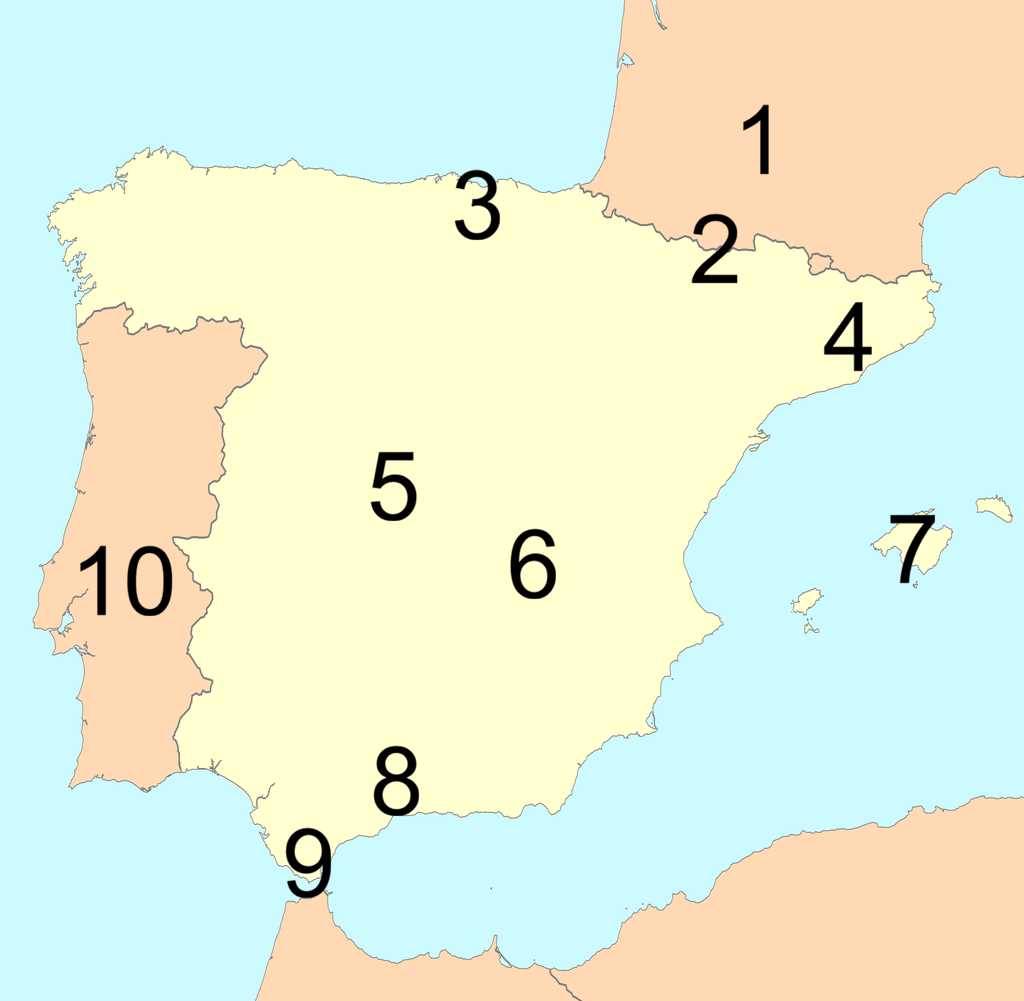
BilbaoPortugalFranceMalágaMadridCastilla-La ManchaPyreneesBarcelonaMallorcaGibraltar* Drag / drop or click on the choices above to move them to the answer list. View Image Attributions for This Quiz
Spain's northern neighbour is on the other side of a natural division, the Pyrenees Mountains, but that has not made them historically willing to live and let live. The Franco-Spanish War (which was actually a series of conflicts in which both sides had different allies along the way) began in 1635, and was ended by the Treaty of the Pyrenees in 1659. This treaty, signed by Louis XIV of France and Philip IV of Spain, established the independent territories. It was signed on Pheasant Island, in the middle of the Bidasoa River, part of the border. This island has remained a condominium - a region where two or more states agree to share control.
Because the treaty explicitly transferred villages in the Pyrenees from Spain to France, the town (you've got to love international law) of Llívia, separated from the rest of Spain by a strip about a mile wide, remains a Spanish exclave. The road bridging that strip is maintained jointly by France and Spain. In the 1970s the French tried to control traffic along it by erecting stop signs that gave priority to the French roads that crossed it. this led to the so-called War of the Stop signs, with Spanish protesters tearing down the signs, contending that they inhibited the guaranteed freedom of movement along the road. This was eventually settled in the early 1980s, when the Spanish government paid for the construction of a bridge over one of the crossroads, and the French agreed to give the highway priority at the other intersection (which now has a roundabout).
2. Pyrenees
These mountains form the border between Spain and France, with Andorra squashed in between. This tiny mountain state is jointly ruled by co-princes: the Bishop of Urgell in Catalonia, Spain, and the president of France.
The mountains gained their name in reference to the mythological princess Pyrene, who was involved with Heracles in the course of one of his Twelve Labours. (Sources are fragmentary and contradictory, some placing her as living in Gaul, some in Iberia; some show Pyrene seducing Heracles, etc. What follows here is in accord with the account of Silius Italicus, from the first century.) On his way to obtain the cattle of Geryon as part of his tenth task, Heracles arrived at the court of King Bebryx, where he was royally feasted. Well and truly drunk, Heracles raped Princess Pyrene and went on his merry way. She gave birth to a serpent, for some reason, and fled to the mountain woods to hide her shame. There she caught the attention of wild beasts, who tore her limb from limb, to use a well-established cliché. When Heracles returned on his way home, he was devastated to find her remains (surprising, since he had shown her so little regard earlier), and buried her deep under the ground.
3. Bilbao
Why would you visit the largest city in the part of northern Spain known as the Basque country? It might be to hear the locals speaking Basque, a language which is totally unrelated to any other European language, and which was repressed under the Francoist regime as indicating an unsuitable level of independence. Since the 1960s, it has not only been permitted, it has been encouraged, and a standardised form developed to unify the regional variants which still exist.
Another reason to pick Bilbao specifically, of course, is the Guggenheim Museum of Bilbao (one of several museums established by the Solomon R. Guggenheim Foundation). The building was designed by the renowned architect Frank Gehry, showcasing his approach to architecture as a form of sculpture. The gleaming metallic plates and swooping curves of the building, with its suggestion (from one angle) of a boat ready to launch on the nearby Nervion River, have made it a worldwide attraction. The museum is often credited with being one of his earliest demonstrations of the way a single dramatic building can serve to revitalise an entire precinct or city. The fact that the museum holds regularly-changing exhibits of contemporary art, emphasizing both local artists and large-scale installations, is a bonus for the visitor.
4. Barcelona
Barcelona is the capital of Catalonia, which was a central focus of the Spanish Revolution of 1936 until the Fascists captured it in 1939. For more vivid details of this, I recommend George Orwell's 'Homage to Catalonia', in which he recounts his experiences fighting with the Partido Obrero Unificación Marxista (POUM; Workers' Party of Marxist Unification), supporting the Confederación Nacional del Trabajo (CNT, National Confederation of Labor). Orwell commented on his perception that in Catalonia the local people had set up a fundamentally socialist society. While this was brought into subservience during the Fascist regime, the regional sense of independence and self-reliance continues into the 21st century.
If you're not into history, you may find yourself drawn to Barcelona because it was the site of the 1992 Summer Olympics, and you want to indulge in a bit of sporting nostalgia. Or perhaps you wonder why on earth Manuel left Barcelona to work in 'Fawlty Towers'. Then again, many take the time to visit Sagrada Familia, the still-unfinished masterpiece of Antoni Gaudí (1852-1926) many of whose works can be seen around the city.
5. Madrid
If you're visiting a country, you really ought to stop by the national capital. While the etymology of the name Madrid is disputed (and none of the suggestions all that convincing), they tend to focus on the fact that it is located on the Manzanares River, on the central plateau of the Iberian Peninsula. It has the second-highest elevation of a national capital in the European Union, with only Andorra La Vella being higher. There is evidence of habitation since Paleolithic times, over 300,000 years ago, and you can visit archaeological sites of Celtic, Roman and Visigoth settlements. The area really became important during the 9th century, when a fortress was built there as part of the defense of the southern Moor-held part of the peninsula against the northern Christian area. Being on the border, it was ravaged multiple times, but became established as a city during the 12th century. Of course, its strategically significant location saw it involved in many later battles, but the end of the Spanish Civil War in 1939 saw it confirmed as the national capital.
As a result of all the warfare, little remains of Madrid's architectural heritage before the 18th century. Art treasures, however, abound - the street known as the Paseo del Prado features not only the world-famous Prado Museum (whose collection focuses on Spanish art from the 12th century to the early 19th century), but also the Reina Sofia (where Picasso's Guernica holds pride of place among other examples of 20th century art) and the Thyssen-Bornemisza Museum (with no particular focus, allowing it to fill in the gaps between its neighbours).
If you are more inclined to watching some sport, time your visit for a home game of Real Madrid, one of the most widely-supported football teams in the world. Or, more controversially, consider a trip to Las Ventas, the largest bullring in Spain. If you're there in May, the ATP Madrid Open (tennis tournament) may call you; in September, you have a chance of lining up to see the finishing stages of the Vuelta a España, one of the three major cycling races in Europe.
6. Castilla-La Mancha
Castilla-La Mancha is the autonomous region of Spain which covers most of Submeseta Sur, the southern part of the large plateau that forms the center of the Iberian Peninsula. It contains several World Heritage sites, including its capital, Toledo (listed in 1986). Being close to Madrid, it has experienced much of the warfare and change of ownership described in the previous question.
The region known as La Mancha (a name probably derived from the dryness of the land or the fact that it is part of a plateau) is famously the home of the fictional character Don Quixote, created by Miguel Cervantes in his novel published in two parts, in 1605 and 1615. Don Quixote is the persona adopted by Alonso Quijano as he tries to carry out the tasks appropriate for a travelling knight as described in the chivalric romances to which he is devoted, and which have driven him into a world of delusion. While Cervantes carefully did not identify any specific place, there are a number of towns in La Mancha which claim to be the site of one or more of the events described, and tourists who attempt to trace his footsteps will find numerous statues and plaques as they go. There are still a lot of windmills!
7. Mallorca
Mallorca (also sometimes spelled Majorca) is the largest of the Mediterranean Spanish islands known collectively as the Balearics. Along with Menorca, Ibiza, and Formentera, Mallorca is a very popular tourist destination - especially for those who are happy to find themselves surrounded by other holiday makers. Starting in the 1950s, Mallorca became a popular spot for expatriate artists to settle and work; it was not until the 1970s that short-term holidays started to bring millions of tourists each year.
Famous visitors (who stayed there long enough to complete significant work) include Frédéric Chopin (1838-9) with his partner George Sand, who described their time there in her travelogue 'A Winter in Majorca' and Agatha Christie (1932), who used the setting for her short story 'Problem at Pollensa Bay'. The 1982 film adaptation of Christie's 'Evil Under the Sun' was primarily filmed in Mallorca. But my reason for visiting Mallorca is more contemporary - the town of Manacor is the birthplace of Rafael Nadal, a tennis player whose rivalries with Roger Federer and Novak Djokovic defined the world of men's tennis for nearly two decades in the 21st century.
8. Malága
Located on the Costa del Sol (Sunshine Coast), Malága is one of the oldest continuously inhabited cities of western Europe. Following its original establishment by Phoenician traders around 770 BC, it became part of the Carthaginian empire during the 6th century BC, then the Romans took over in 218 BC. Following the fall of the Roman empire, Visigoths had a turn, followed by the Byzantines, with the Islamic conquest occurring around 710. In 1486 Castile (at the time still its own independent kingdom) regained control of the region.
Of course, tourists spend a lot of time on the beaches and enjoying the restaurants and nightlife of the city, but you may want to take time to visit the birthplace of Pablo Picasso - although the family moved to A Coruña (on the Atlantic coast) when he was only 10, then on to Barcelona before sending him to study art in Madrid when he was 16. The Museo Picasso Málaga was opened by his family in 2003 with nearly 300 pieces of his work donated for the purpose.
9. Gibraltar
Gibraltar is a British Overseas Territory located on the southern tip of the Iberian peninsula. Its main feature is the limestone monolith known as the Rock of Gibraltar, with a town sitting at its base. The name comes from Arabic Jabal Tariq (Mountain of Tariq), in honour of Tariq ibn Ziyad, the North African soldier who began the Islamic conquest of the Iberian Peninsula in 711 by crossing the Strait of Gibraltar. The castle he built there lasted until the 15th century, and its remains can still be visited.
The Rock is famous for the Barbary macaques which inhabit the nature reserve near its peak, and for the extensive tunnels which have been built within it. These tunnels were originally built by the British (starting in 1704) for military communications, but have been expanded to create what is virtually an underground city. Even before the tunnels were constructed, the limestone rock had produced a number of caves, including several with evidence that they were inhabited by Neanderthals, considered to be the most recent Neanderthal presence in Europe.
The strategic value of the site, projecting into the narrow Strait of Gibraltar between the Atlantic Ocean and the Mediterranean Sea, has seen its possession change hands multiple times. Great Britain has been in control since the Treaty of Utrecht, signed in 1713, but Spain continues to stake a claim, and the region has close cultural ties with Spain, even as the UK maintains its naval base.
10. Portugal
Portugal was established as a kingdom in 1179, one of the many pieces of territorial rejigging on the Iberian Peninsula as the Umayyad Caliphate, which had controlled most of the Peninsula since the 8th century, was driven out by the combined efforts of a number of Christian rulers (who in turn vied with each other, but that's another story). The border with Spain was established in 1297 by the Treaty of Alcañices. However, a dispute over who should inherit the throne of Castile unsettled this; in 1386 Portugal signed the Treaty of Windsor, establishing an alliance with England that is still in effect - the longest-standing alliance in Europe. What did they have in common? Mostly just enmity with Spain.
The Portuguese became one of the major players in the European Age of Discovery, setting up a colonial empire that extended down the Atlantic coast and that of the Indian Ocean. The 1494 Treaty of Tordesillas, aimed at reducing conflict between Spain and Portugal over colonial expansion, saw Brazil become the only part of the Americas which Portugal could claim. in 1529 they signed the Treaty of Zaragoza, dividing up the Pacific Ocean. (One might comment on the arrogance of these treaties that both assumed the lands were theirs for the taking, and ignored the expansionist interests of other European countries alongside those of the current residents, but that's another quiz.)
This quiz was reviewed by FunTrivia editor agony before going online.
Any errors found in FunTrivia content are routinely corrected through our feedback system.