Last 3 plays: cardsfan_027 (10/10), dellastreet (10/10), pehinhota (10/10).
Click on image to zoom
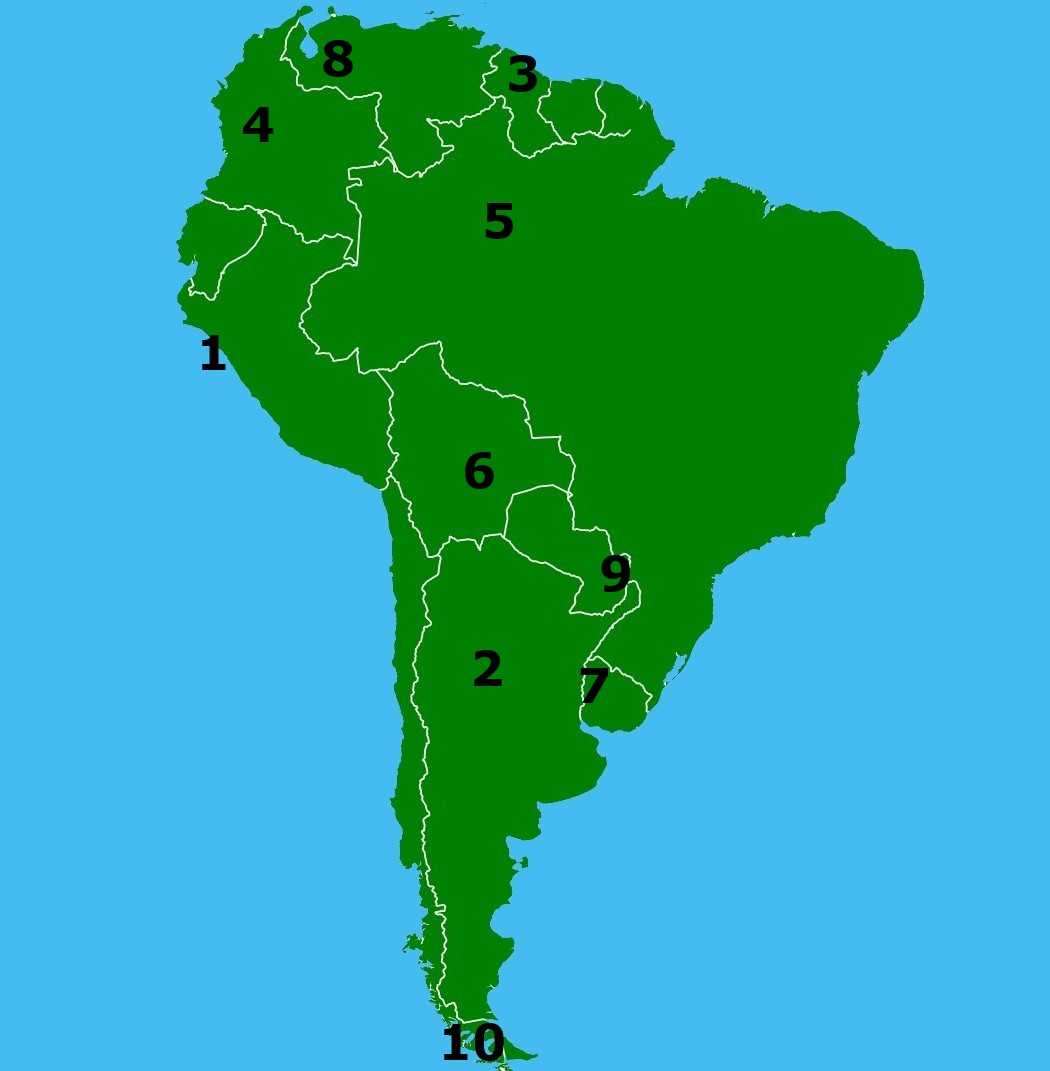
CórdobaGeorgetownPunta ArenasManausCiudad del EsteMedellínTrujilloSanta Cruz de la SierraBarquisimetoSalto* Drag / drop or click on the choices above to move them to the answer list. View Image Attributions for This Quiz
While most of Peru is mountainous, it might come as a surprise that the coastal city of Trujillo is not only one of the nation's largest, but most unique. While the Incas would proceed into the Andes to establish their empire, Trujillo was long-used as a key settlement for indigenous peoples, partly due to its convenient spot at the mouth of the Moche River. Referred to as the 'Cultural Capital of Peru', it's not only the origin of numerous seafood dishes (ceviche being one) and the Marinera dance, but it's the gateway to UNESCO-Protected sites like Huaca del Sol and Chan Chan, both of which predate Christopher Columbus' trip to the New World.
2. Córdoba
Named after the Spanish city of Córdoba, the Argentinean version is one of the largest cities in the nation, found smack-dab in the middle of the country. Córdoba, here, was settled midway through the sixteenth century and was, quite early on, a site at which Jesuit missionaries took root, creating a number of structures and cultural flourishes that still remain there to this day (including one of the oldest universities in the Americas).
The Jesuit Block, now a UNESCO World Heritage Site, was once the home of the late Pope Francis.
3. Georgetown
Georgetown is Guyana's capital, found at the mouth of the Demerara River as it winds its way from the inland rainforests and out to the Atlantic Ocean. Settled by the Dutch and further occupied by the English in the late eighteenth century when the British began to rule Guyana, Georgetown would become a key hub for the reason. Because much of Guyana is uninhabited Amazon rainforest, a large percentage of its population lives in this capital, and 90% of the nation lives near the coast.
Its official language, uniquely, for South America, is English.
4. Medellín
Built in the Aburrá Valley, Medellín is in a basin and along a number of hillsides in the Andes Mountains in Colombia, and it grew in the late 20th century to become one of the biggest cities in the nation. Characterized by growth first as a Spanish colony and then, in contemporary times, as a major urban design hub, Medellín has been considered somewhat of an international renaissance city, known for its forward-thinking city planning and well-conceived public spaces.
The epicentre of Antioqueños culture, there's nowhere in the world quite like it.
5. Manaus
The capital of the State of Amazonas in Brazil, Manaus is one of the more centrally-located cities in South America's largest nation, and it's pretty far from virtually everywhere else on account of that. Found where the Rio Negro and the Amazon meet, Manaus was settled by the Spanish in 1499 and built up a century and a half later by the Portuguese. Eventually, Manaus would be a leading supplier in the international rubber industry, booming to become a major metropolitan area despite its remoteness.
In the modern era it's also a major environmental and scientific hub on account of its spot in the heart of the Amazon.
6. Santa Cruz de la Sierra
The Bolivian city of Santa Cruz de la Sierra, despite not being one of the nation's two capital cities, became the largest city by population in the 1990s, surpassing La Paz. Naturally, Santa Cruz is heavily influenced by Spanish colonization, but this is coupled with the rich cultures of indigenous people of the Andean region. Built akin to traditional Spanish cities, Santa Cruz has historically grown outwards with its central districts, and many of its oldest, in a central region with ring roads radiating outwards, and because of its massive growth, it's been one of South America's quickest cities in terms of building vertically, modernizing with skyscrapers throughout.
7. Salto
Located in Northwestern Uruguay, Salto is the largest city in the country aside from its coastal capital, Montevideo. Originally built as an army base in the mid-19th century, Salto is, today, a border city that shares the Uruguay River with Argentina (and the town of Concordia on the opposite side).
The two nations connect upriver where the region's most famous structure, the Salto Grande Dam, provides much of the region's power supply. The area is also known for its thermal baths, found in the outlying hills.
8. Barquisimeto
Established in 1552, the Venezuelan city of Barquisimeto was originally founded by Spanish colonizers as they attempted to stake claim on what they believed to be a rich gold mining region. What resulted was the founding of a town that not only suffered all manner of disasters in its history (due to its construction next to apt-to-flood rivers), but remains to this day an earthquake-prone region. Barquisimeto is otherwise known for its numerous academic institutions, being home to more than a dozen universities.
9. Ciudad del Este
While Paraguay's capital, Asunción, is found on the border with Argentina much further west, Ciudad del Este is on the opposite side of the country, making part of the border with Brazil along the Paraná River. One of Paraguay's larger cities, Ciudad del Este is perhaps best-known for being a jumping off point for trips to the nearby Foz do Iguaçu waterfalls. Unlike a lot of the larger inland cities of South America, it's quite the new destination, having been established in the 1950s and intentionally built to bring Paraguay closer to the Atlantic.
They built it deep in the rainforest, naturally.
10. Punta Arenas
The southernmost city in Chile and South America, Punta Arenas has the distinction of being the closest major population centre to Antarctica. Ushuaia, in Argentina, is technically at a more southernly point, but is a smaller destination deeper into Tierra del Fuego and has, historically, held a smaller population. Punta Arenas hasn't had it easy though. Due to its awkward spot at a dangerous shipping cape, it struggled as a port (more so after the Panama Canal was built), eventually becoming a penal colony and before transforming into a significant player in the livestock industry.
This quiz was reviewed by FunTrivia editor agony before going online.
Any errors found in FunTrivia content are routinely corrected through our feedback system.