FREE! Click here to Join FunTrivia. Thousands of games, quizzes, and lots more!
Place the City - South America [3] Quiz
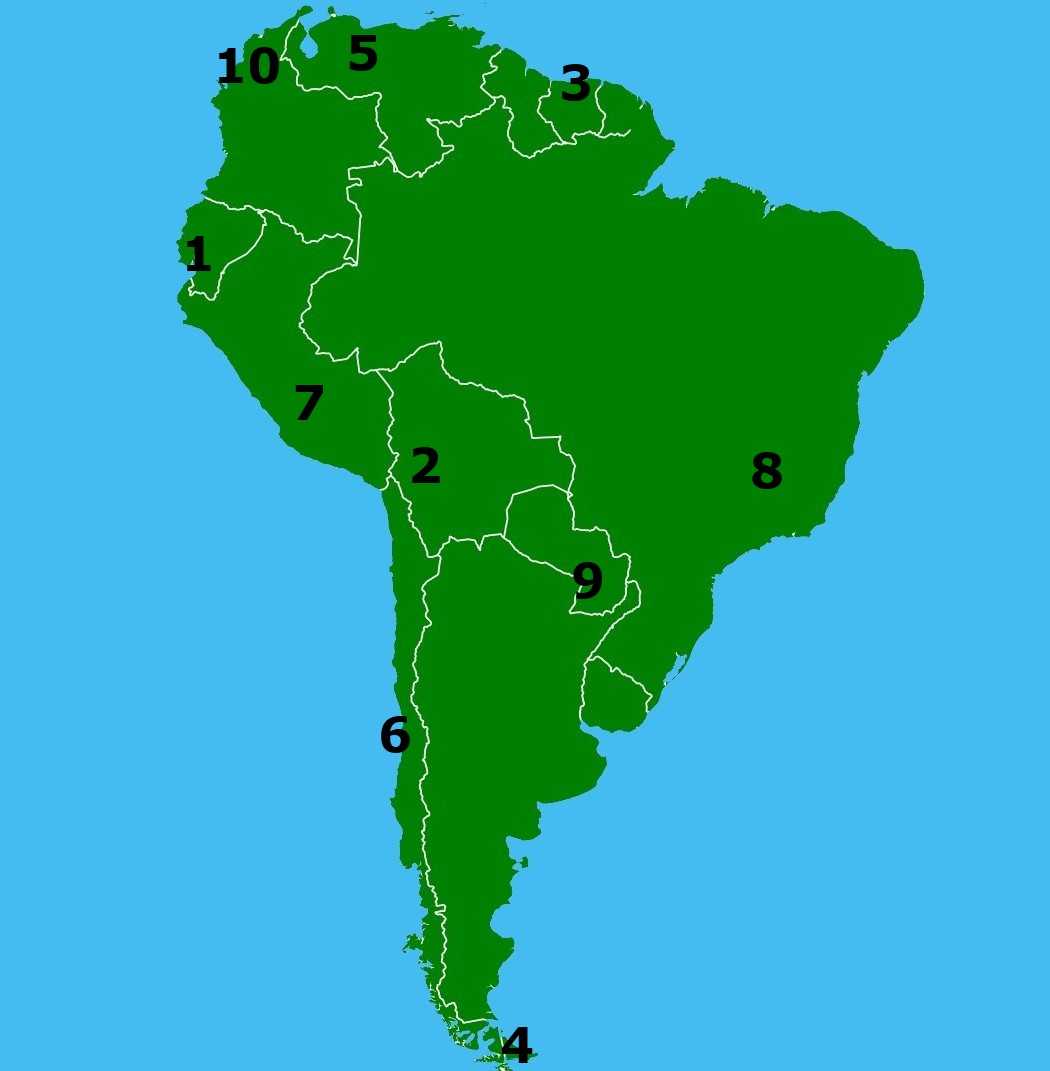
South America is a large and diverse continent, and the ten locations in the quiz, all of which you'll need to pick out on the map, are great examples of this variety. Good luck!
A label quiz
by kyleisalive.
Estimated time: 3 mins.
Last 3 plays: parrotman2006 (10/10), bigjohnsludge (10/10), Parachutus (4/10).
Click on image to zoom
ParamariboValenciaCochabambaCuscoGuayaquilUshuaiaValparaísoCartagenaSan LorenzoBelo Horizonte* Drag / drop or click on the choices above to move them to the answer list. View Image Attributions for This Quiz
While the Ecuadorian capital of Quito sits in the mountains as one of the highest altitude capital cities in the world, Guayaquil is at sea level, being found along the Guayas River just upstream from where it flows out into the Pacific Ocean, making it a key port city and major industry leader for the nation. Founded as a port by the Spanish, Guayaquil claimed its independence near the start of the nineteenth century, becoming a pivotal location in a number of South American battles as they pertained to Ecuador and Peru's borders.
2. Cochabamba
Located between La Paz in the mountains and Santa Cruz de la Sierra in the lowlands to the east, Cochabamba may be the Bolivian city that stays under peoples' radar despite its generally beautiful green spaces and pleasant climate. Found at the typical high Andean altitude in this region, Cochabamba was a notable location for the Incans who, seeking fertile land for key crops, used the land there for farming that could not be achieved in the mountains nearby.
The plains here were, at one time, dotted with lakes. Because of urban sprawl in Cochabamba's valley, those no longer exist.
3. Paramaribo
The capital city of Suriname, Paramaribo is the largest population centre in this small, northern nation sitting on the Atlantic Ocean. Paramaribo was founded where the Suriname River flows out into the sea, not unlike other nearby capitals like Cayenne and Georgetown, and it was a key port destination for the Dutch during the days of colonization. Paramaribo is a unique city in terms of architecture, drawing in influences from Dutch and British colonialism that persist to this day due to its relative remoteness.
4. Ushuaia
Generally considered the southernmost destination in Tierra del Fuego, the Argentine city of Ushuaia is smaller than Chile's Punta Arenas, but serves a different purpose, leading boats in and out of the Beagle Channel's east opening and acting as a port of call for Antarctic expeditions. Generally cold year-round, Ushuaia is far enough south to experience year-round frost and wet conditions (owing to its spot at the tip of the continent amongst the Andes).
It's also the site of numerous shipwrecks, a consequence of the rough waters that, at one time, were the only way to ship things around the Americas until the Panama Canal was built.
5. Valencia
The first Spanish settlement in this part of Venezuela, Valencia was actually the ideal spot for indigenous tribes millennia before, owing to its valuable freshwater resources, plentiful natural bounties, and pleasant weather. Found, now, between the cities of Caracas and Barquisimeto, it's only a short trip north to get to the Caribbean Sea.
It also happens to be surrounded by the Coastal Andes where the mountain range meets the edge of the continent.
6. Valparaíso
While Santiago is known to be one of the largest South American cities, Valparaíso is Chile's second-largest found only a hundred kilometres to the northwest on the Pacific Coast, acting as one of the most important port destinations on the continent's west side. Though Valparaíso grew out of being a massive trading port before the opening of the Panama Canal, it has since developed into other ventures out of necessity, becoming a vibrant destination for the arts and a beautiful, hilly city of labyrinthine streets, old-style funiculars, and colourful building facades.
7. Cusco
Found deep in the Andes in the southeast of Peru, Cusco is considered by most to be the point of embarkation for trips to Machu Picchu. Found at 3.4 kilometres above sea level, it can be a rough destination even for the most seasoned traveller owing to the high risk of altitude sickness. Visitors there, however, will find a wealth of cultural landmarks and unique things to do since Cusco was, at one time, the capital of the Inca Empire, and due to the blending of those influences with Spanish conquest and colonialism, you'll find a place unlike anywhere else.
8. Belo Horizonte
A planned city in southeastern Brazil, found north of Rio de Janeiro in the State of Minas Gerais, Belo Horizonte was settled in 1701 but became a destination of note due to intense and intentional development in the 20th century, allowing it to flourish as one of Brazil's largest cities. Surrounded by lush forests and state parks, Belo Horizonte is generally temperate year-round, making it a very favourable destinations for workers in all fields, and a high-demand location for the finance and service industries in Latin America.
9. San Lorenzo
One of Paraguay's larger cities, San Lorenzo is only a short drive from the nation's capital of Asunción, being part of its larger metropolitan area. While Asunción sits directly on the border with Argentina to the west (and the Paraguay River), San Lorenzo was built out of Jesuit ranches that used to exist in the area centuries ago. Now part of the larger, amalgamated capital area, it's home to the Universidad Nacional de Asunción, the nation's oldest institution for higher learning.
10. Cartagena
This coastal Colombian city sitting on the Caribbean Sea is amongst South America's most treasured destinations not just because it's a modern tourist destination with a rich cultural history, but because it has long been a critical port of call with relation to the West Indies.
Indigenous people have lived in the Cartagena area for thousands of years, though, like other parts of South America, it was colonized by the Spanish from the sixteenth century onward, growing to become not only one of the larger cities in this part of the empire, but having stake in the Age of Piracy. Today, it's one of Colombia's largest cities with much of its central portions being UNESCO-protected.
This quiz was reviewed by FunTrivia editor agony before going online.
Any errors found in FunTrivia content are routinely corrected through our feedback system.